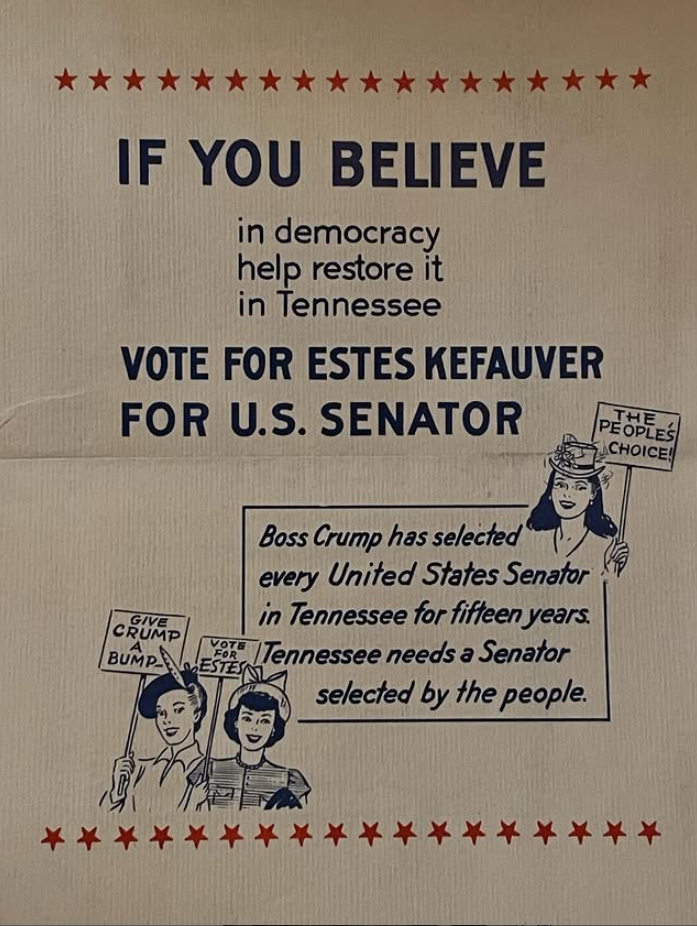
1948 was a heady year for Estes Kefauver. He defeated the powerful Crump machine and upset incumbent Senator Tom Stewart in the Democratic primary that summer, then rolled to a general-election rout in November.
Less than a week after the election, Kefauver was invited on the Chicago Round Table radio to discuss the meaning of the 1948 results, headlined by President Truman’s surprise re-election over Thomas Dewey. During the discussion, host Walter Johnson noted that Kefauver “licked the Crump machine in Tennessee.” Kefauver, however, was quick to correct him.
“As a matter of fact, I did not lick any machine,” the newly elected Senator said. “the people elected me in spite of the machine.”
This was a seemingly small distinction – so small that listeners probably wondered why he brought it up. But to Kefauver, the distinction was essential. Later in the discussion, he described the 1948 election as “a people’s victory” and said that the key to Truman’s shocking win was that he “correctly diagnosed the desire of the people.”
From another politician, talk about “a people’s victory” might have just been empty rhetoric. Not Kefauver. He did not consider himself the hero of his own victory, or Truman to be the hero of his.
He sincerely believed that it was the people who had defeated the Crump machine, and the people who had defied the pundits who’d proclaimed Dewey the next President before a single vote was cast. Politicians like Kefauver and Truman were merely the instruments through which the people expressed their will.
This belief – that in a democracy, power really does come from the people – animated Kefauver’s entire political career. Despite the fact that Kefauver proclaimed this belief often, to anyone who would listen, political reporters never seemed to understand that he genuinely meant it – which meant that they didn’t understand him. And they didn’t understand why the people kept supporting him in election after election.
A Bedrock Faith In the People
“The more the people have a chance to speak their minds, the closer we get to grassroots opinion and desires, the better our democracy works.”
That was Kefauver’s theory of democracy, as expressed while testifying before the Senate on his proposal to institute a national Presidential primary. As he saw it, the idea that the people should control the government was what America was all about.
“In my definition of freedom the individual is supreme,” he wrote in a message for the American Heritage Foundation to commemorate the country’s 175th anniversary. “From the individual flows the sovereign power to make constitutions and laws and governments.” He argued that this belief in the power of the individual “is the distinctive thing about our form of government, which exists for the people, and other forms, for which the people exist.”
Kefauver saw the tide of American history moving toward more and more direct role for popular government, a trend that he sought to continue. “To be entirely consistent with our democratic development,” he argued in a 1950 essay, “it is essential that more and more authority for the control of our government should pass to the people.”
He fought against the features of our political system that he saw as usurping or distorting the people’s influence. He battled against party organizations and political machines that controlled nominations and elections. He opposed poll taxes and restrictive laws that sought to prevent people from voting. He sought to abolish the electoral college, calling for presidents to be chosen by popular vote instead. He called for breaking up corporations that were massive enough to bend our political and economic systems to serve their own ends. Anything that got in the way of the people’s ability to steer America’s course was, to Kefauver, an impediment to democracy.
“There is nothing that the American people cannot overcome if they know the facts,” Kefauver wrote in his book Crime in America. Throughout his career, Kefauver sought to present Americans with the facts they needed to take action to improve their country.
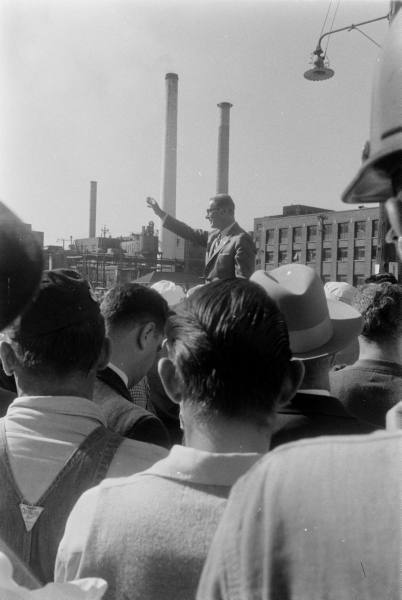
Kefauver applied the same philosophy to his campaigns, both for Senate and for the White House. He went to the people directly to talk to them, listen to their input, and ask for their votes.
During his Presidential campaigns, Kefauver accompanied each handshake with a simple, humble appeal to the voter: “I’m Estes Kefauver, and I’d appreciate your help.” His speeches were similarly straightforward: he spoke about the issues that mattered to them and made his case in plain, unadorned language.
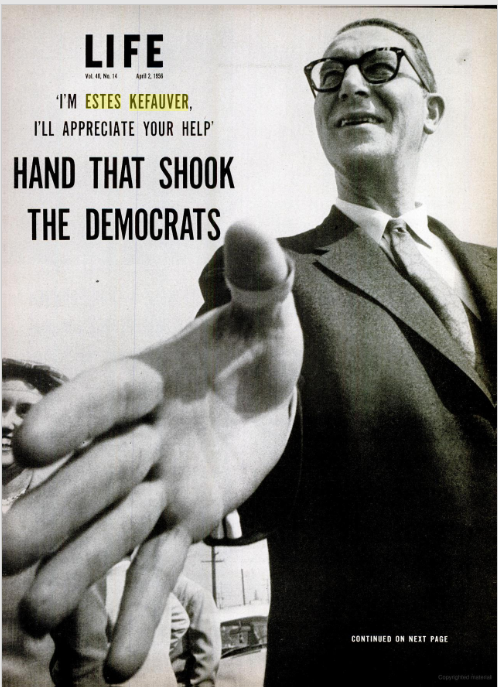
Reporters were mystified about why it worked: they found his “I’d appreciate your help” line trite and hackneyed, and they considered his speeches dull and boring, lacking in the wit and rhetorical flourish they associated with great candidates.
E.W. Kenworthy of the New York Times, struggling to explain the voters’ fondness for Kefauver, floated the theory that the connection was “no more than an elemental gratitude that rises in the voter on being sought out by a man running for President, and the resulting feeling of importance.”
Beneath the thick layer of contempt, Kenworthy was actually on to something. The average voter had never had the chance to meet a Presidential candidate. To not only meet one and shake his hand, but to have him ask for the voter’s help, to tell them that they matter and that they should have the power to choose the candidates for the Presidency – that was a powerful message.
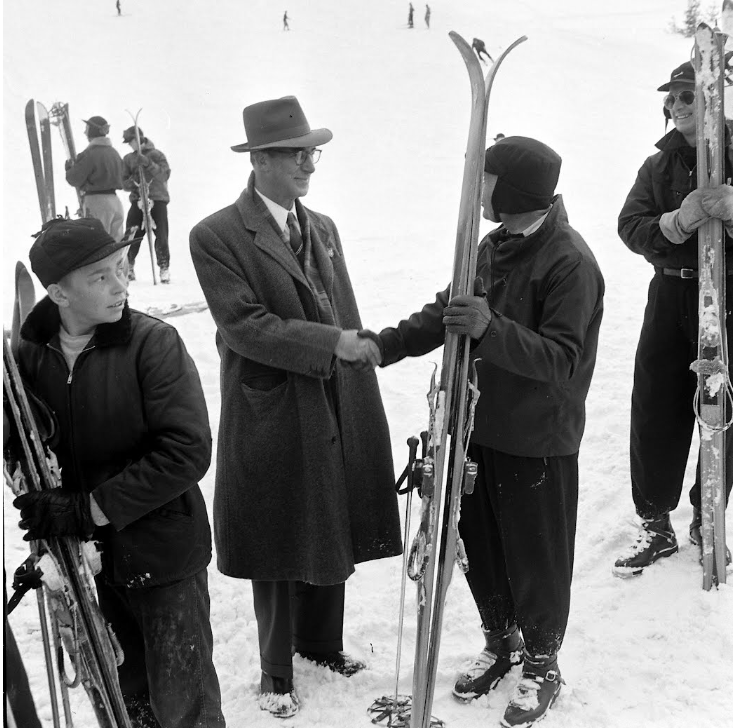
“What a wonderful thing that we live in a country where the people can decide,” Kefauver told the voters. “I think anyone from any section of the country should be able to have a shot at any office.”
A candidate for the highest office in the land telling the voters that they had the power to choose – even to run for the Presidency themselves – and backing it up with his behavior, coming to them personally to shake their hand and ask for their vote. No wonder they loved him.
Democracy Begins At Home
Kefauver brought the same approach to his Senate campaigns. At the end of every session of Congress, he traveled around Tennessee, giving voters his own personal report of what happened on Capitol Hill that year and listening to their input. He did this whether he was up for election that year or not. He kept regular contact with his constituents by mail, sending them congratulations for a high school graduation or condolences for a funeral.
This was not just early-career enthusiasm that faded as he became better established. To the end of his career, even as a nationally famous figure, his philosophy remained the same. Look at the illustrations in the “Big Few” brochure from his final campaign in 1960.
On the cover, an illustration of him marching in a parade with the people of Tennessee – not leading the parade, in the middle of it:

Inside was a cartoon showing the “corporate fatcats” who were trying to get Kefauver out of office by funneling money to his opponent.

Kefauver is drawn as being much smaller than the fatcat – he’s not big enough to stop them on his own. What’s saving him is the “home people,” much bigger than either Kefauver or the fatcat, standing behind him.
Even as a two-term Senator and one of the best-known politicians in America, Kefauver still understood that it was the voters who had the power – and he never forgot it. He campaigned just as hard in his last campaign as he had in his first one. He never took his office for granted; he understood that he needed to work to maintain the people’s trust and support.
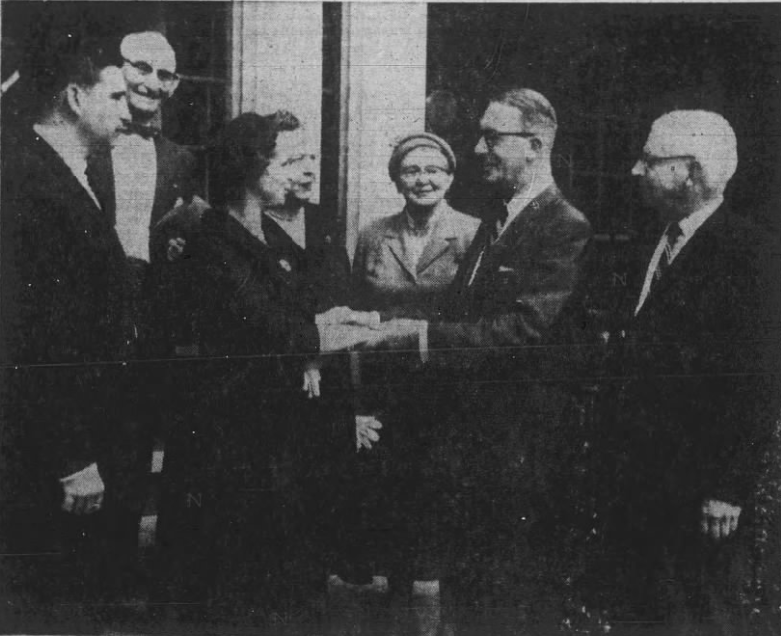
That’s why, when Kefauver’s opponents tried to use his liberal stances on civil rights and Communism to claim that he’d lost touch with Tennessee, the charges never stuck. Even voters who disagreed with him about segregation or about civil liberties knew that he hadn’t forgotten the folks at home. He proved it again and again – with his letters, his handshakes, his reports to Tennessee.
Kefauver never forgot that in America, it’s the people who have the power. And he never stopped showing that – like Truman back in 1948 – he “correctly diagnosed the desire of the people.”
The Mystery That Wasn’t
It was frequently said of Kefauver that nobody was for him except the voters. If Kefauver’s appeal to the voters was straightforward – and grounded in the philosophy that he espoused over and over – why was his success treated as an inexplicable mystery?
If I had a nickel for every time in my research I came across an article titled “The Mystery of Kefauver” or something similar, I’d be able to retire tomorrow. My favorite one is probably a column by William S. White from May 1958 entitled, “Kefauver Is a Mystery Deep Inside an Enigma.”

White, a veteran reporter considered the era’s foremost expert on the Senate, found the man from Tennessee baffling. In the column I mentioned above, he wrote, “Kefauver – and now the adjective ‘inexplicable’ is reached – defies any ready analysis or ready understanding as a political force.”
How could a smart and knowledgeable reporter like White – and all the other reporters who said similar things – fail to solve a mystery when the answer was staring them in the face? Because they were staring through politics’ lens of managed unreality, which prevented them from seeing Kefauver clearly.
White spent a lot of time in the Senate, which meant that he’d absorbed the institution’s viewpoint. (He understood that Senate’s customs so well that he wrote a book about it, Citadel, which explained the chamber to the uninitiated.) The Senate’s insider club loathed Kefauver, who refused to play by the usual rules and constantly pointed out the undemocratic nature of cherished Senate customs like the filibuster and the seniority system for selecting committee chairs.
The Senate’s undemocratic features were by design. The upper chamber long saw itself as a check on the majoritarianism of the House, and a place where careful consideration and reasoned debate ruled the day. Kefauver saw these features as an obstacle to enactment of the people’s will, and he sought to get rid of them.
When Kefauver’s Senate colleagues were cool to his Presidential bids, reporters took this as a sign that he was unworthy. In fact, their rejection reflected the Senate’s defense of its institutional self-conception. Not only was Kefauver not a true member of the club, he didn’t think it should be a club at all.
The reporters on the campaign trail, like Kenworthy, who considered Kefauver’s appeal a mystery had an advantage that White did not. The voters who found Kefauver appealing were standing right in front of them; they could have asked the voters why they liked him. But they never seemed to do this. Instead, they talked to each other and then wrote pieces proclaiming Kefauver mysterious.
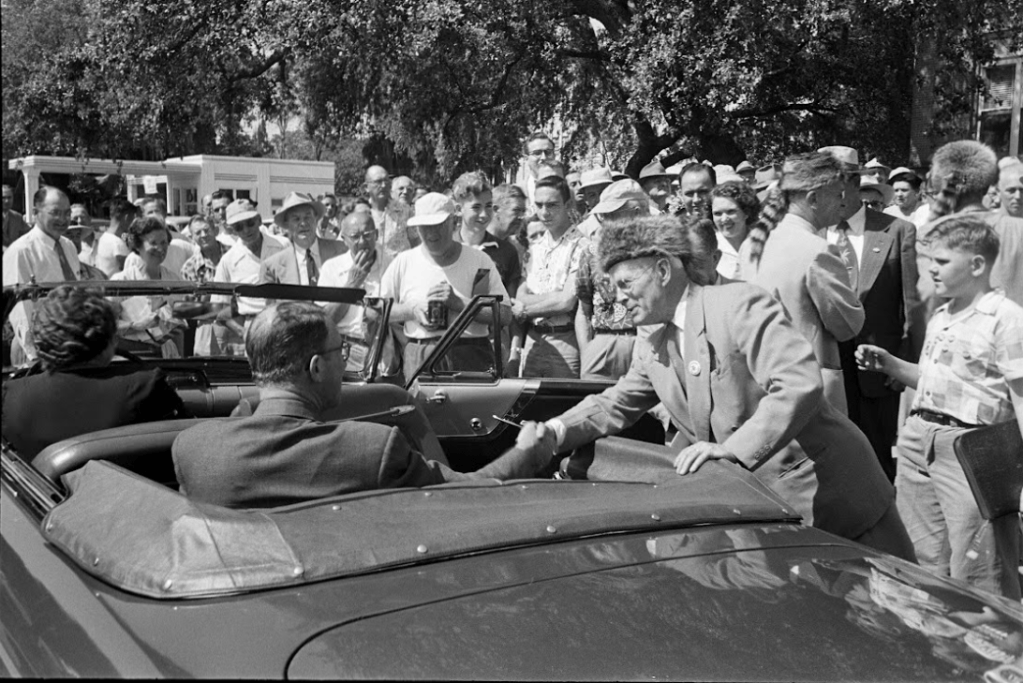
Like White and the Senate, they saw Kefauver through a distorted lens. They had absorbed the logic of the party organizations, which fiercely guarded their own control of the nominating process. When Kefauver railed against bosses ignoring the people’s will and hand-picking candidates, he was calling the legitimacy of the organization’s gatekeepers into question. This was especially uncomfortable for the Democratic Party, which liked to style itself as “the party of the people.” It was hard for them to uphold that title while simultaneously ignoring the candidate that the people actually preferred.
The reporters were also defending their own role in the process. The people who covered campaigns were used to passing authoritative judgment on candidates. They were confident that they knew what a good candidate looked like: someone who flashed charm and sparkling wit, who gave speeches full of soaring oratory, who seemed cheerful and vivacious while backslapping and greeting voters.
If a candidate who didn’t measure up by their usual standards was still popular and connected well with voters, it called the reporters’ ability to judge candidates into question. And if the people could connect directly with candidates and form their own judgments without the mediation of the press… what was the press for?
It all added up to one conclusion: If the voters’ chosen candidate wasn’t the one that the party and reporters all thought was the superior choice, the problem wasn’t that the gatekeepers’ judgment was off. The problem was with the voters.
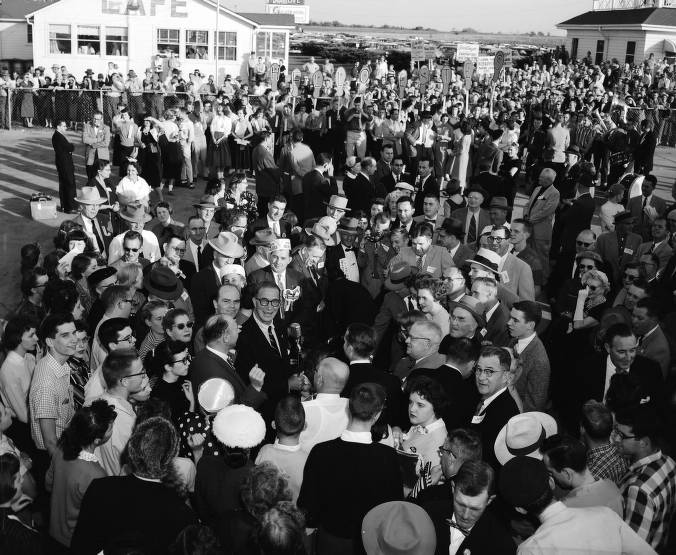
That’s why everyone kept looking for an explanation for Kefauver’s primary wins that avoided the obvious conclusion that the voters had decided he was the better candidate. Instead, they claimed that Kefauver’s success was a mirage, driven by his television fame. Or that he just told voters in every state what they wanted to hear. Or that he tricked the voters into believing he thought they mattered. Or that Republicans were secretly propping up his campaign in order to damage the real front-runner.
They tried everything, it seems, other than taking Kefauver and the voters at their word. There was a reason for that.
If they took Kefauver’s rhetoric – and the voters’ positive responses – seriously, they’d have to engage with his argument.
They’d have to defend the anti-democratic features of the Senate, and the party organization hand-picking nominees, and reporters’ and party leaders’ insistence that they knew what was good for the voters better than the voters did. They’d have to explain why, even though American government was supposed to be of the people, by the people, and for the people – it was better that the people didn’t have too much control over things.
Kefauver’s approach exposed the shared fictions that defined the managed unreality governing the Senate and the nominating process. So they kept looking at Kefauver through their distorted lens, insisting that their view of him was the correct one.
But Kefauver stepped around their lens. He let the voters see him as he really was, and he asked for their vote. He told them that they had the power to choose, and he showed them that he believed it. He showed them that they – not he – were the real heroes of American democracy.
The voters saw Kefauver. And they liked what they saw.


Leave a Reply