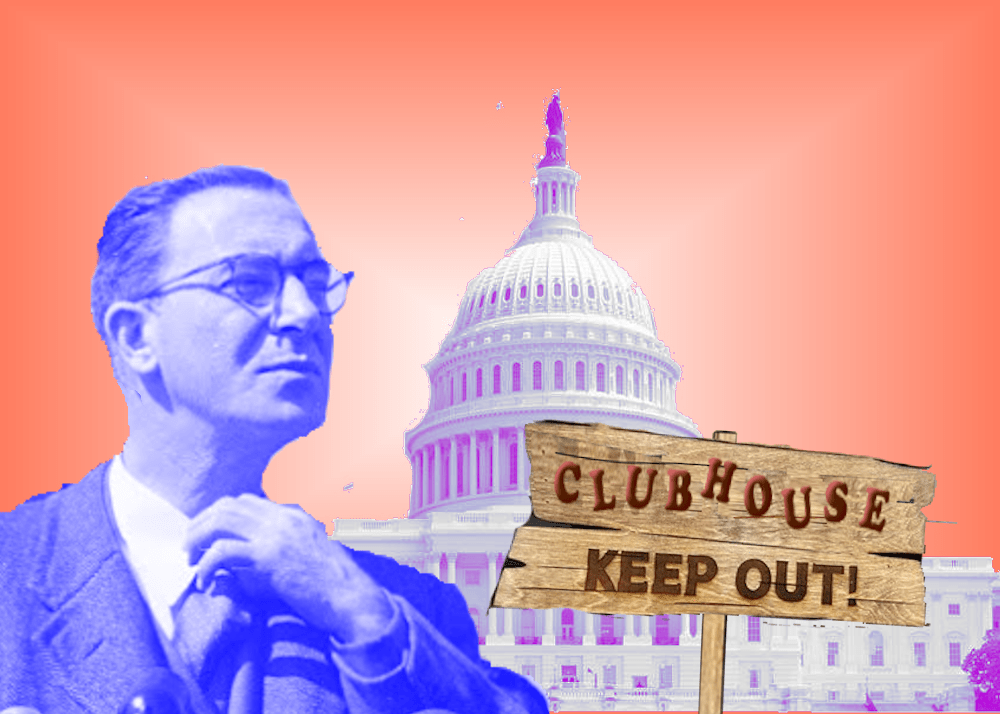
Estes Kefauver was widely popular with the American people. Except for the ones who served beside him in the Senate.
Kefauver’s unpopularity with his Senate colleagues was well documented throughout his career. As Theodore White put it in a profile on Kefauver during the 1956 primaries, “by and large, the Senate of the United States dislikes and distrusts him.” Adlai Stevenson made an issue of it during the primary campaign, noting that almost none of Kefauver’s fellow Senators supported his Presidential bid.
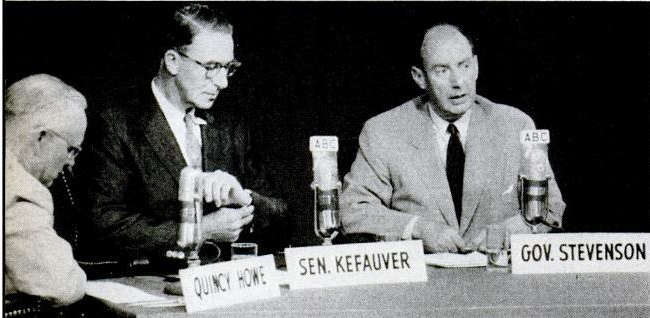
On the surface, the enmity toward Kefauver makes very little sense. The Senate has historically accommodated a wide variety of rogues, rabblerousers, crooks, cranks, zealots, and sociopaths. However difficult or annoying they might be to deal with, they were all generally welcomed and treated as honored colleagues. Kefauver didn’t get the same accommodation.
It’s easy to write that off, as Kefauver’s supporters often did, to petty jealousies and in-group sniping. But the truth is deeper than that. Kefauver’s entire approach to politics – and his conception of how an elected official should conduct his duties – were at odds with the norms and traditions of the Senate. And he was too popular and too prominent to just marginalize or ignore.
The world’s greatest deliberative body could handle almost anyone. But it couldn’t handle Kefauver.
The Case Against Kefauver
Kefauver’s fellow Senators voiced several reasons for their dislike of him. One of the most common complaints concerned Kefauver’s frequent absences from the Senate, and the related perception that he was not pulling his share of duty in committee work. He was always jetting off, the Senators complained, to go campaign somewhere, or give a speech, or hold an attention-grabbing televised hearing in another city.
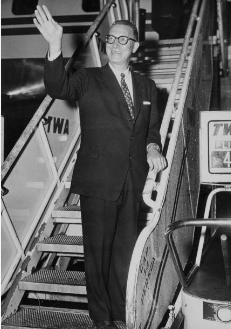
These complaints had some merit; Kefauver was away from the Senate a lot during the first half of his tenure. But he was hardly alone in absenteeism on Capitol Hill. As he himself mentioned in his 1948 article on “Congressional high jinks,” nearly 200 members of Congress were absent during the summer of 1947, many of them conducting redundant investigations in Europe or taking junkets to tropical spots like Hawaii and Panama. As Kefauver noted, there were so many missing Congressmen that staffers were frantically comparing notes trying to figure out who was actually in town.
Also, when Kefauver was away campaigning, he was often doing so on behalf of fellow Democrats. Given his fame and popularity with voters, he was a highly sought-after campaign speaker. But instead of lauding him for being a team player, they dinged him for being out on the trail rather than sitting in committee hearings.
This flows into the next complaint, which was that Kefauver was “eaten by ambition,” according to one Senator quoted by White. “He’s got Presidentialitis,” said another. One reason Kefauver’s colleagues didn’t praise his campaigning for them is that they believed he was primarily seeking to boost his own prospects for his next Presidential run.
Again, this charge has some merit: Kefauver did indeed have a burning ambition to be President. But so did many other Senators. The difference, they might argue, is that they weren’t spending all their time campaigning instead of doing their job.
But they didn’t spend all their time on the campaign trail because they didn’t have to. For most Senators who wanted to be President, the best path to the nomination was to persuade the party leaders to select them at the convention. They might enter a token primary or two, but they didn’t even need to do that. Kefauver knew the party leaders would never anoint him, so his only choice was to compete in as many primaries as possible, which was a time-intensive endeavor (especially the way he did it).
By contrast, Adlai Stevenson received the Democratic nomination in 1952 without doing any campaigning at all. In 1956, he did campaign actively in the primaries, but no one complained that he was neglecting his office – because he no longer had one. (His term as Illinois governor ended in 1953.)
If the chief complaints against Kefauver were – as it appears – either hypocritical or the product of a double standard, it may be tempting to conclude that their animus against him was just cover for personal grudges. But I believe the dislike was rooted in something real: the way that Kefauver exposed the Senate’s own contradictions and fictions.
Southern Discomfort
Although Kefauver was a proud Southerner, he was particularly loathed by his Southern colleagues. This is traditionally ascribed to Kefauver’s relatively liberal views on civil rights. Even before Kefauver was elected to the Senate, his support for a 1942 bill to abolish the poll tax drew a condemnation on the House floor by Mississippi’s John Rankin, who pointed at him and hollered, “Shame on you, Estes Kef-fow-ver!” Kefauver was famously one of only three Senators from Dixie who refused to sign the 1956 Southern Manifesto, which condemned racial integration.
But especially earlier in his career, Kefauver’s civil rights views weren’t that far apart from his colleagues. He was consistently opposed to the poll tax, but he was otherwise not particularly supportive of civil rights legislation until after the 1954 Brown v. Board of Education decision.
What really peeved his Dixie colleagues wasn’t his view on civil rights, but his opposition to the tools that Southerners used to maintain power and block civil rights legislation.
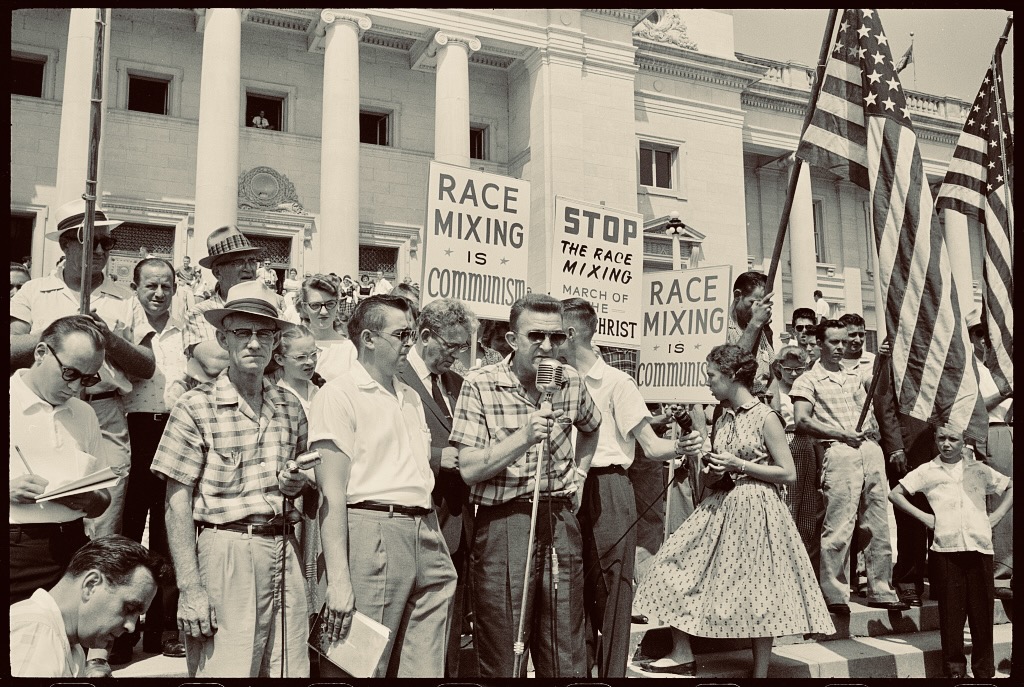
There were two reasons the South held disproportionate influence in the Senate in Kefauver’s era: the seniority system and the filibuster. At the time, committee chairmen and ranking members were chosen based on who had served on the committee the longest. This benefitted long-serving Senators from one-party states who never faced partisan competition. For the Democrats at the time, that meant the South. And the filibuster allowed a determined minority to block any bill by holding all Senate business hostage until and unless (at the time) two-thirds of their colleagues voted them down.
Kefauver considered both the seniority system and the filibuster undemocratic, and called for them both to be scrapped. He wasn’t shy about it, either.
In his 1947 book A Twentieth Century Congress – published the year before his election to the Senate – Kefauver devoted a whole chapter to the evils of the seniority system, saying that it “challenges the very character of truly representative government.” He stated plainly that the system unfairly advantaged Southern Democrats. (He also pointed out that the poll tax severely restricted the population of Southerners who could vote – another taboo.) He called instead for committee chairmen and ranking members to be selected by secret ballot of each party’s members on the committee.
Kefauver was even harsher on the filibuster, denouncing it as “utter negation of democratic procedure,” a “parliamentary farce,” and “legislative piracy.” He pointed out that the previous year, the filibuster had been used to kill anti-lynching and anti-poll tax bills, as well as a bill to create a Fair Employment Practices Commission. If the filibuster could not be abolished entirely, Kefauver called for allowing it to be stopped by a petition from a majority of Senators.
Kefauver’s fellow Southerners surely disliked his openness to civil rights. But what they really loathed was his willingness to attack the undemocratic methods by which they maintained control of the agenda and thwarted legislation they didn’t like, without having to command even close to a majority. They knew that if Kefauver’s changes were implemented, their power in the Senate would suffer a huge blow.
No Grease For Me, Thanks
There’s an old story that has long circulated among reporters and political insiders. The story features a powerful Senator (usually LBJ or Louisiana’s Russell Long, depending on who’s telling it) trying to convince a colleague to support him on the bill.
As the story goes, the colleague balked at the request. “It’s a bad bill,” he said. “You’re wrong, and I’ll be with you when you’re right.”
In response, LBJ (or Long) replied, “I don’t need you when I’m right! I need you when I’m wrong!”
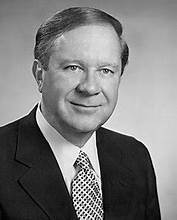
Even if the story is apocryphal, it gets at an important truth. The Senate in Kefauver’s era ran on handshakes and personal relationships. A colleague – or a leader – might ask for your vote on a bill, even if it was of dubious merit, as a personal favor. Maybe it was a bill to bring pork-barrel spending to somebody’s state, or a bill to provide someone with political cover back home.
Even though those bills were often poorly designed and wasteful, they greased the wheels of the Senate’s dealmaking machinery. If you could throw a few bucks somebody’s way, or pass a message bill to help him get reelected, you might get him to back a big important bill he was on the fence about. This was widely understood as the cost of doing business.
Kefauver, though, didn’t see it that way. To his mind, a bad bill was a bad bill, no matter what. On the campaign trail, Kefauver said, “The criterion of every vote I ever cast was whether it was good for the average citizen of the United States.” This wasn’t pandering; he really meant it.
This meant that he didn’t hesitate to be on the losing end of landslide votes, even it was 99-1. Most Senators willing to be the “1” in a 99-1 vote are either ideological zealots or performative contrarians who get political mileage out of defying their colleagues. Kefauver was neither; he largely voted like a mainstream liberal Democrat. But if he was convinced a bill was wrong, no amount of pleading or cajoling could change his mind – or his vote.
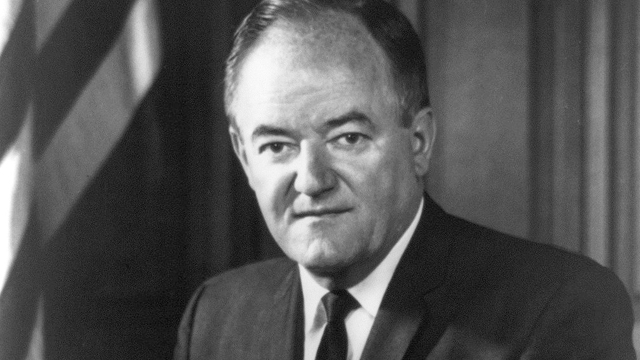
Sometimes, this willingness to buck overwhelming majorities wound up embarrassing his colleagues. His lone vote against the Communist Control Act of 1954 was a perfect example. Everyone in the Senate understood that it was poorly written and likely unconstitutional. But that wasn’t the point. The point was to give liberal Democrats like Hubert Humphrey who were running for reelection something they could use to refute charges that they were soft on Communism.
You might think that Kefauver, himself running for reelection against an opponent who kept accusing him of being a Communist sympathizer, could see the logic in this. But he couldn’t. In his mind, it was unconstitutional, and the people didn’t vote him into the Senate to vote for unconstitutional laws. So he voted no, even though he was alone, even though the vote infuriated his campaign staff – not to mention his fellow liberals.
This is a key reason why Northern liberals, despite generally sharing his political views, also found him frustrating. He refused to play the game by the normal Senate rules. He wouldn’t vote for a bad bill as a favor to a colleague, or just because everyone else did. And when he voted no, he exposed his colleagues’ political contrivances and hypocrisies.
One anonymous senator quoted by White complained of Kefauver, “He runs as the only good man in a band of outlaws.” But he wasn’t doing it to be sanctimonious or to deliberately undermine his colleagues. He did it because he believed that a Senator’s job was to vote only for legislation that served the people’s interests – no matter what.
The Johnson Treatment
No one in Kefauver’s era ever mastered the Senate’s unwritten rules and norms better than Lyndon Johnson. He was, in many ways, the anti-Kefauver. He worked the inside game to rise to the peak of the Democratic caucus in a few short years; once he reached the top, he conducted the caucus like a virtuoso to achieve his legislative goals.
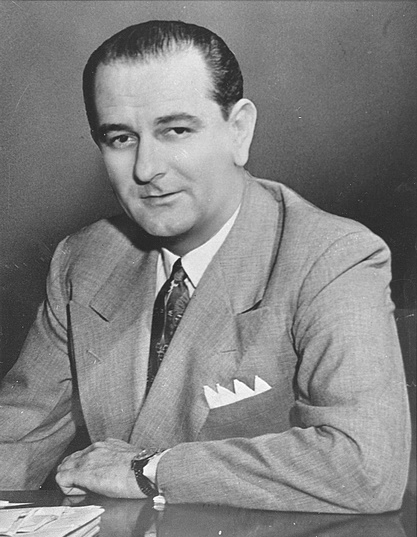
But even for a legislative operator as masterful as LBJ, Kefauver was a problem. He was mostly a reliable Democratic vote, but you never know when he would go his own way to make a quixotic stand against a bill that you needed to pass.
And though Kefauver was highly ambitious, he seemed impervious to LBJ’s attempts to coax or threaten him into compliance. Johnson had no problem freezing out legislators who wouldn’t get with the program, but he couldn’t really do that with Kefauver. The Tennessean’s popularity with the public and his skill at attracting headlines meant that Johnson couldn’t ignore him. Moreover, Kefauver believed that his power derived from popular support, not from the favor of the Senate in-crowd. Johnson’s usual tools of persuasion had no meaningful effect on him.
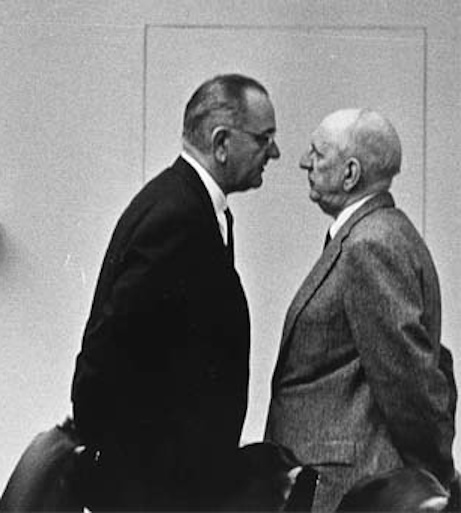
Given their very different conceptions of how politics worked, it’s no surprise that Johnson found Kefauver frustrating. But I also think he was fundamentally mystified by the man from Tennessee. How could a man who so clearly wanted to advance be so ignorant of or indifferent to the ways you actually got ahead?
For his part, I think Kefauver was equally mystified by Johnson. He saw that they were politically sympathetic, and he assumed that LBJ would recognize that and reward him accordingly. When LBJ didn’t, he couldn’t understand why. And he didn’t understand how Johnson was able to charm the southern colleagues who so resented him.
Kefauver’s attempt to negotiate with Johnson in 1955 for a spot on the Foreign Relations Committee, as reported by Robert Caro in Master of the Senate, is a case in point. When Kefauver asked Johnson to keep him in mind, Johnson replied, “I have never had the particular feeling that when I called up my first team and the chips were down that Kefauver felt he… ought to be on that team.” He said that if Kefauver agreed to be on his team, “I will meet you more than fifty percent of the way. I will push you into every position of influence and power that you can have.” Kefauver complained, “[H]onestly, you have never given me a break since you have been the Leader.” In reply, Johnson said, “You just look through your documents and see when you have said to Johnson that you were on my team… There’s no use our kidding each other.”
Caro portrayed this scene as Johnson trying to bring Kefauver to heel. But I think he missed that LBJ was expressing genuine exasperation.
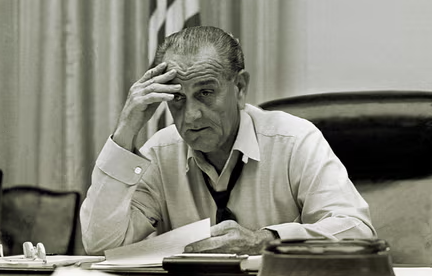
As far as he was concerned, he’d made the deal very clear: if Kefauver would be on Johnson’s “team,” vote the way LBJ wanted him to, swallow a few bad bills for the greater good, Johnson would give him all the power and influence he desired. What more could he want?
But Kefauver clearly didn’t get it. He thought being “on the team” meant being a loyal Democrat, which he was. He didn’t understand what loyalty really meant in Johnson’s terms. And even if he had, he wouldn’t have done it, because it would have required him to abandon his entire conception of a politician’s duty to the people and replace it with duty to LBJ and the Senate in-crowd. That was never going to happen. The two men were talking past each other, and neither one really understood why.
It’s as though Johnson were a developer trying to build a town in the Texas desert, only to find there was a Buddhist temple right in the middle of the plot he wanted to build on. He offered the monk a million dollars to buy out the temple, but the monk turned him down. The developer couldn’t understand it: a million dollars is a lot of money, and the monk could have used it to build a new temple somewhere else, with plenty of cash left over. The monk couldn’t understand why the developer ever thought the temple would be for sale.
Fundamentally, this was why Kefauver and his Senate colleagues couldn’t get along: he operated by a completely different political value system than they did. He couldn’t play by their rules without abandoning his values. Instead, he tried to play the game his own way: appealing to the people instead of the power brokers for support, holding hearings designed to inform and arouse the public instead of passing bills via logrolling and dealmaking, voting his conscience and speaking up for reforms even when it embarrassed and infuriated his colleagues.
That approach limited Kefauver’s effectiveness as a Senator, and it got in the way of his dream of being President. There’s a reason there are very few monks in politics. The Senate could accommodate crooks and cranks and zealots. It could not accommodate a man who simply meant what he said. His colleagues never understood him, but the people sure did. Perhaps the problem wasn’t Kefauver after all.


Leave a Reply