
It’s hard to be the underdog forever.
When Estes Kefauver first ran for the Senate in 1948, one of his campaign brochures depicted him as David facing off against Goliath. It was a fitting image – facing off against the powerful Crump machine, Kefauver was indeed the plucky underdog trying to take down the mighty giant. And it worked.

Kefauver’s final Senate campaign in 1960 was a different story. He was a two-term Senator at this point, a nationally famous figure who had run for President twice. And his opponent, Tip Taylor, tried to argue that Kefauver had gotten too big for his britches and lost touch with the people of Tennessee.
Using the civil-rights issue as a wedge, Taylor tried to claim that Kefauver had spent so many years courting the votes of Northern liberals that he’d betrayed the folks back home. He claimed that Kefauver “votes just like Hubert Humphrey,” and that by re-electing the incumbent, Tennessee was essentially furnishing New York with a third Senator.
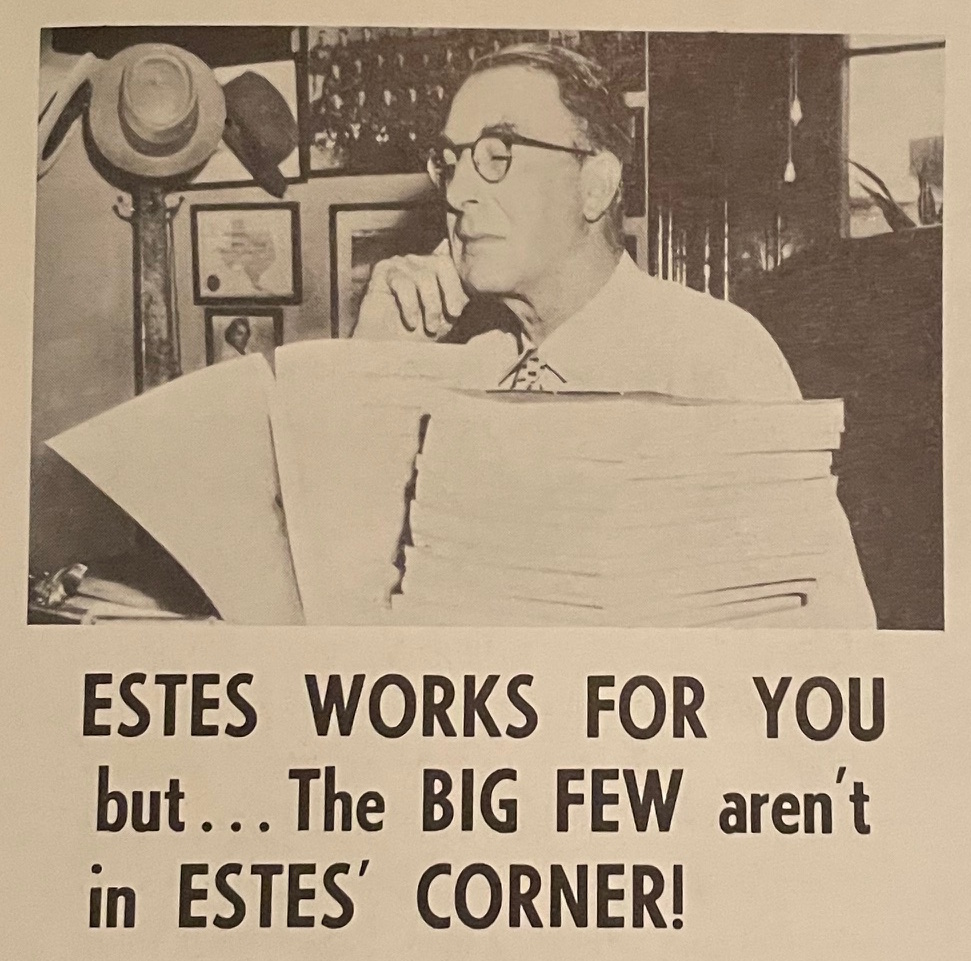
But Kefauver rolled to a third term, flattening Taylor by a margin of nearly 2-to-1. He did it in part thanks to the campaign strategy on display in this brochure:

This brochure is a masterpiece of campaign communication. No matter how long Kefauver served and how high he rose, he could still cast himself as David, the people’s champion, facing off against the powerful interests trying to take him down.
Join the Parade!
The brochure’s cover makes the framing plain: Kefauver is depicted as the candidate of the people, opposed by “The BIG FEW.”
Let’s take a closer look at that image on the cover, because it’s richly symbolic.

Kefauver is shown marching with the people of Tennessee – “just plain people,” as the illustration notes. Up front are representative of the groups that Kefauver is working for: farmers, housewives, teachers, working people, young people (depicting the student in a University of Tennessee sweater is a nice touch.)
But notice where Kefauver’s standing. He’s not at the head of the parade. He’s in the middle of it. He’s not leading the people – he’s walking with them. He’s tall enough to stand out in the picture, which is both accurate (he was 6-foot-3, after all) and symbolic. It calls to mind Paul Rand Dixon’s remark that Kefauver was known in his home state as “The Tall Man” because “this old boy walked upright and they knew it.”
So who were “The BIG FEW” opposed to Kefauver’s re-election? They’re defined inside the brochure, and defined in a very clever way.
The Big Few are described as “the powerful, selfish interests which foster monopolies against the best interest of the consumer, the honest businessman and our entire free enterprise economy,” and “the out-of-state forces Estes Kefauver has been fighting who are now pouring money and smear literature into to Tennessee to try to defeat him for re-election.”
This ties directly to the antitrust and monopoly work that Kefauver was focused heavily on at this stage of his career. But it’s more than that. The “smear literature” that the brochure mentions was real. Anonymous mailers were flooding Tennessee households, full of racist accusations that Kefauver was a traitor to the South and the white race because he was supportive of civil rights.
But the brochure provides a brilliant counter-framing. These descriptions don’t explicitly mention civil rights – nowhere in this brochure is the civil rights issue discussed – but it reveals the truth about the anonymous mailers: they’re coming from outside of the state, using inflammatory rhetoric in an attempt to turn the people against Kefauver, the candidate who is actually fighting for them.
The brochure then calls the Big Few “the same old crowd of reactionaries whom forward-looking Tennesseans, time and again, have repudiated at the ballot box… the same old crowd that has always wanted a stooge in the Senate.”
This is a masterful piece of political jiu-jitsu, completely inverting the Taylor campaign’s attack. Taylor was trying to depict himself as the true Southerner, the true Tennessean, while Kefauver was the sellout who had abandoned his home state to court national liberal voters.
Instead, Kefauver argues that he’s the true Tennessean – the one who walks with the plain people, the Senator who’s spent years working for his constituents. Taylor, meanwhile, is the stooge of the “same old crowd of reactionaries” who have been trying to crush the people and get rid of Kefauver throughout his career. (Note also the mention of “forward-looking Tennesseans,” which evokes his appeal to “twentieth-century Southerners” back in 1956. Just as he did them, Kefauver expressed his belief that his fellow Southerners weren’t stuck in the past, but focused on progress and improvement.)
Below the description of the Big Few is another brilliantly evocative cartoon.

Every aspect of this cartoon is clever. The state of Tennessee is depicted as a seesaw, which could go either way based on the outcome of the election. The anthropomorphized bag of money representing “Out-of-State Fatcats” is about to land on one end of the seesaw. Note where the fatcat is looking – not at Kefauver, not at the viewer, but backwards, out of frame, presumably at his fellow fatcats, telling them, “Watch me flip ol’ Estes!” He’s so confident that that he doesn’t even need to look where he’s leaping.
Meanwhile, Kefauver stands on the other end of the seesaw with his arms folded – firm, fearless, defiant. He’s a lot smaller than the fatcat, but he’s not running away or trying to brace himself; he’s ready for the assault.
And he has a secret weapon: the giant standing behind him with his foot on the scale, labeled “The Dimes and Dollars of Home People.” This was echoed on the back cover, where supporters were encouraged to send Kefauver “dimes, quarters, dollars… anything you can give.”
This reflects Kefauver’s belief in the small-dollar fundraising model: the idea that enough tiny contributions from enough people could effectively counter huge donations from wealthy out-of-state interests. This same model, supercharged by the Internet, that powers Democratic insurgent campaigns today. Kefauver tried it the 1950s and 1960s, asking his supporters to mail him their spare change.
As always in his campaign, Kefauver was placing his faith in democratic legitimacy – the idea that mobilizing a broad base of people was enough to prevail over money and power.
Actions Speak Louder Than Words
Of course, all of this positioning – and clever cartoons about out-of-state fatcats – would be meaningless if Taylor’s charge was correct. If Kefauver really had stopped working for his Tennessee constituents, no amount of populist rhetoric could disguise that.
But Kefauver had a record to match his rhetorical commitments, and he made sure people knew it. Most of his campaign materials from that 1960 campaign were aimed at rebutting Taylor’s charges that he’d abandoned his home state. One brochure provided a detailed summary of his views on issues and the work he’d done in service of those views. Another focused on specific acts he’d done in the Senate to help his Tennessee constituents.
The Big Few brochure didn’t just assert, “Estes is in your corner.” It invited voters to “Judge a man… by his deeds!”, and listed specifics from his record to demonstrate that his commitment to the people was real.

The list opened with Kefauver’s work to protect consumers from high drug prices and high prices in general. Cleverly, the brochure phrases the drug price issue this way: “Estes Kefauver has gone to bat for the consumer, the druggist and the doctor against high drug prices.” The Taylor campaign tried to make an issue of Kefauver’s prescription drug hearings by organizing “Druggists for Tip Taylor,” claiming that Kefauver’s crusade to lower drug prices was an attack on pharmacists. The brochure flips it, uniting druggists on Kefauver’s side with consumers and doctors against a common enemy: greedy pharma manufacturers.
After the first two bullets about prices, the brochure lauds Kefauver’s fight for family farmers against “the cost-price squeeze” and the policies of Agriculture Secretary Ezra Taft Benson, who opposed price supports for farm crops. It isn’t until bullet four that the brochure mentions Kefauver’s seniority in the Senate – always an important advantage for an incumbent – but even there, it’s mentioned in the context of Kefauver getting a seat on the Appropriations Committee, which allowed him to “work more effectively in obtaining Federal Aid for Tennessee communities.”
Down the list it goes, relentlessly tying Kefauver’s record and achievements to the groups who were walking with him on the front cover: price relief for housewives and working people, economic aid and rural electrification for farmers, education funding for teachers and youth, greater opportunities for small business, protection of TVA to provide affordable power.
Even Atlantic Union – a complex and controversial issue – made the list, explained as “trying to strengthen our economic and political ties among the Free Western Nations.” In one stroke, the phasing deflates the conservative bogeyman of world government. Instead, it made the idea sound simple and natural: Why wouldn’t we want to have closer ties with our democratic friends?
This list reflected Kefauver’s political faith that if you provided voters with honest information and treated them respectfully as thoughtful adults, they would make the right decision. Kefauver believed that stating – and demonstrating – that he was fighting for his Tennessee constituents would be enough to overcome charges that he cared more about winning the hearts of liberal elites than about the people back home.
Silence on Civil Rights?
Obviously, that belief proved justified, as Kefauver rolled to a blowout win. But it would be a bit uncomfortable to praise this as a political strategy if he had decided that the best way to deal with the civil rights issue was not to talk about it. Claiming that the pro-Taylor racist mailings were a conspiracy among out-of-state fatcats to distract and dupe Tennessee voters had some basis in fact, but it’s not the noblest campaign tactic.

Fortunately, Kefauver didn’t try to run away from his civil rights record, even though it wasn’t mentioned explicitly here. He discussed civil rights openly and forthrightly in other brochures, and on the campaign trail.
When Taylor attacked Kefauver’s vote for the Civil Rights Act of 1960, Kefauver told voters, “I voted for the civil rights bill this year… because I felt it was right, and I think you feel it was right too.” He referred to the bill as “reasonable, constructive, and morally right.” He even read aloud the provisions of the act and said after each one, “Well, I’m for that. I think it’s right. Is there anyone in the audience who’s against it?” He got applause each time.
Even Tennesseans who supported segregation could see that Kefauver had the courage of his convictions. And by bringing the receipts to show that he had never stopped working for the people’s best interests, Taylor’s accusations and the racist mailers fell flat. Voters could see for themselves that the image Kefauver’s critics painted was a false one.
It’s difficult to rise to the heights of power and influence and not lose the common touch. Kefauver was one of the rare politicians who managed it. And he proved to the people that he was still walking among them, even when he walked through the halls of the Capitol. Even as a powerful Senator with a national profile, he was still an underdog David, loading up his sling to face Goliath one more time.


Leave a Reply