
As a politician, Estes Kefauver understood the importance of having good staff. When staffing his office or the subcommittees he chaired, Kefauver sought out the best and most capable professionals he could find. He paid them well and treated them kindly, and as a result they often remained fiercely devoted to him, even after they moved on to other position.
One of Kefauver’s most notable staffers was Paul Rand Dixon, a Nashville native who served for decades as a staffer at the Federal Trade Commission. In 1957, when Kefauver finally achieved his long-sought chairmanship of the Senate Monopoly and Antitrust Subcommittee, he hired Dixon to serve as the subcommittee’s counsel and staff director. For four years, the two of them worked side by side, launching probes into the steel industry, the auto industry, bread bakeries, sports leagues, prescription drug manufacturers, and many more.
In 1961, President Kennedy offered Dixon the chairmanship of the FTC, and he took it. But he retained a deep respect and affection for his former boss.
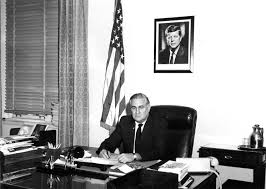
In August of 1963, Dixon spoke in front of the Senate about the latest developments with the FTC. It just so happened that this was a few days after Kefauver had died, and the same day that the Senate passed a resolution honoring their fallen colleague. So before beginning his prepared remarks, Dixon took a few minutes to offer a tribute to Kefauver.
Dixon’s remarks not only showed the depth of his admiration, but also did a good job capturing what made Kefauver such a special figure in public life.
After thanking the Senate for passing their resolution, noting how much it meant to Kefauver’s wife and family, Dixon said that Kefauver was known in his home state as “The Tall Man.” This was obviously in part a reference to the fact that he stood 6-foot-3, but Dixon believed the nickname had an added layer of meaning. “I think down in Tennessee they use that expression not so much from his physical stature,” he said, “but more from the fact that this old boy walked upright and they knew it.”
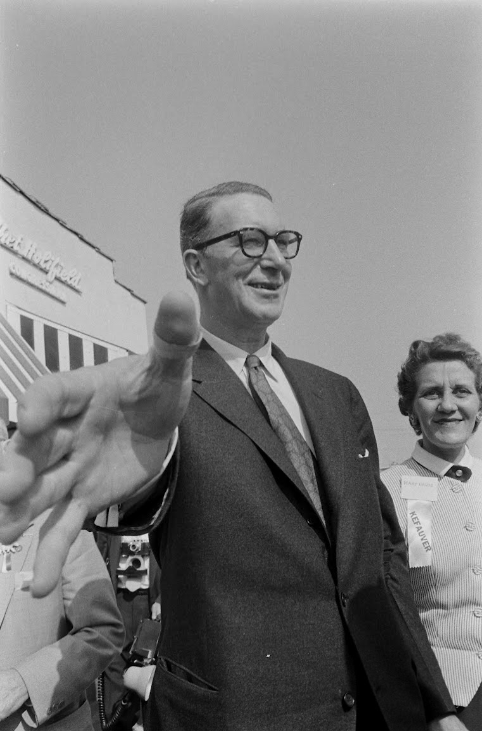
He then alluded to the fact that while Kefauver never really beloved by Washington insider or the so-called “smart set,” he was a hero to the people:
He was kind of a complex fellow, especially to the learned and the professional. But he wasn’t complex to the people. Each time he had to charge his battery, or recharge it, as some of you read in the newspapers, perhaps, he had a little difficulty finding that new charge in the ‘club.’ He always went out to the folks; and if you ever went with old Estes to the folks, you knew they loved him. Maybe they liked him because he came shuffling along. Maybe they liked him because he couldn’t quite put words together like others. But I’ll tell you one thing, they got the message.
I love Dixon’s reference to the fact that even though Kefauver wasn’t a great speaker, the people seemed to understand him nonetheless.
Dixon then remarked that “this country is going to be a better country because Estes served it,” and wondered who would follow in his footsteps. And the path that Kefauver walked, he noted, could be a solitary one.
It is awfully lonesome to walk alone, and be hesitant sometimes and say, “I wonder. Let’s turn over a rock and see what is under it. Let’s see if it is in the public interest. Let’s measure our progress by this standard: is it in the public interest?”
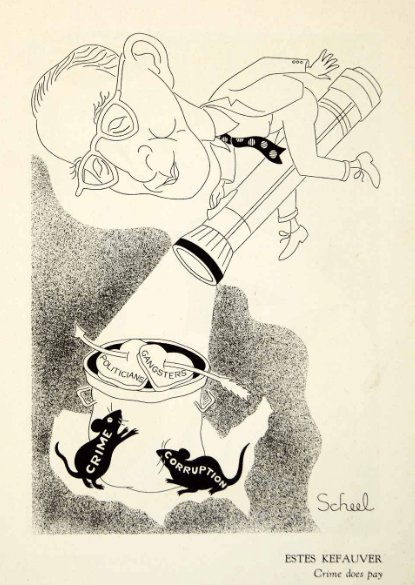
Dixon praised Kefauver for “habit of bringing out the best in people,” and told a story about how the Senator taught him the virtue of patience.
[A]s we sat in some of those long, lengthy hearings, I sometimes got terribly wound up, impatient. One day, when the ten-thousandth page had been reached in some piece of legislation, the third time it was being revised and hearings conducted on it, late in the afternoon I kept wanting to dart in and out and ask questions, and Estes kept cautioning me to be patient. “Oh, let’s get this over with,’ I said. ‘How can you stand this tommyrot? Why don’t you charge in there?“
He looked down – he had his shoes off and was wiggling his toes – and said, “Why don’t you, like me, be a great big bottle of calm?“
The image of Kefauver sitting outside a hearing room, wiggling his toes and talking about being “a great big bottle of calm” is just adorable.
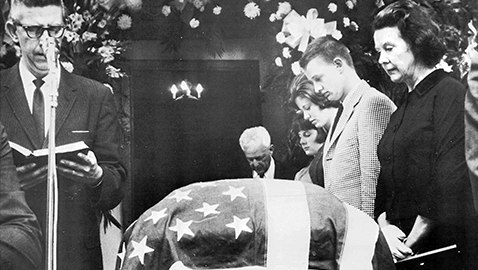
Dixon then touched again on what a loss the country had suffered with Kefauver’s death. “Yesterday in Washington, when I went out and stood before his casket… I thought the box was too small for this man,” he said. “I had a feeling that maybe they were burying, fixing to bury, a lot of the conscience of this nation.”
He then wound up by offering his vision of Kefauver up in heaven:
I rather visualize him as having been assigned a cloud, his own cloud, with two side boys assigned to him. And one of these side boys, I’m sure, had a bucket of ice, and the other had a bottle of Scotch and a soda bottle with him. As Estes runs into his old cronies, he says, “Come on over and have a drink with me, but go light on the ‘sody’, please.”
Kefauver was a hard man to summarize; he was a complex individual in a lot of ways. But in the span of a few minutes, Dixon sketched a memorable portrait of his former boss – and friend – and testified to the way in which he was a unique figure in American politics and American life.


Leave a Reply