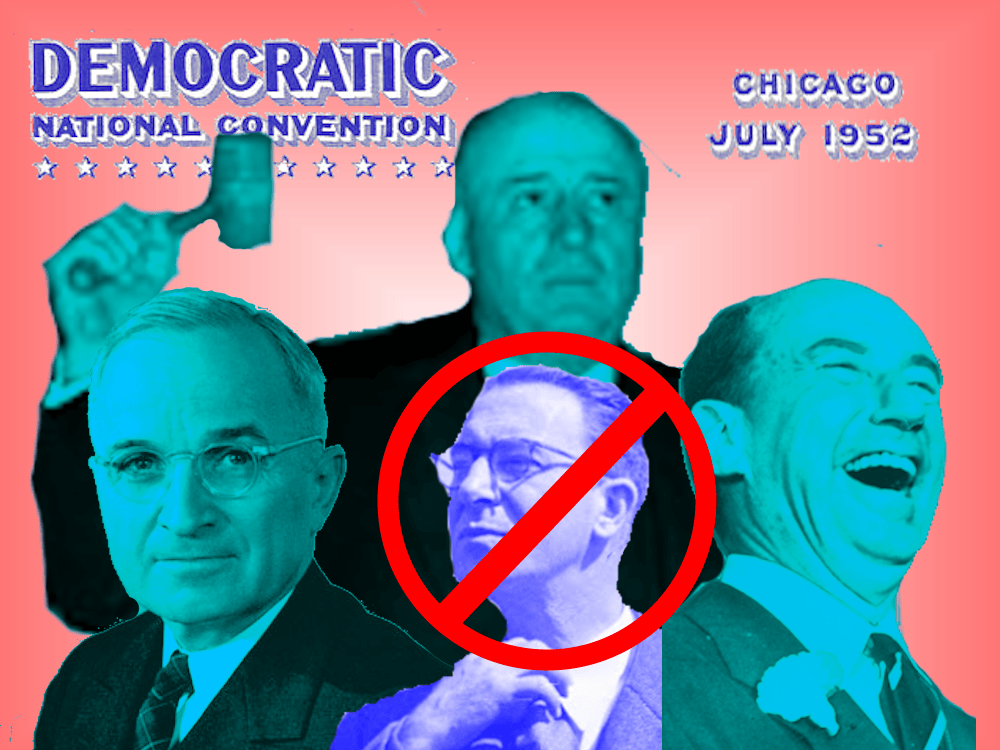
Drew Pearson called the 1952 Democratic convention “democracy in the rough.” He got that right.
Estes Kefauver entered the convention as the overwhelming winner of the primaries and with a significant lead in pledged delegates. But party leaders didn’t care. A number of powerful actors – Southern Congressional leaders, urban machine bosses, President Truman – bitterly resented Kefauver and were determined not to let him have the nomination.
Instead, they anointed Adlai Stevenson – who had not run in a single primary – as the nominee. They stifled every attempt by Kefauver supporters to influence the proceedings. Convention chairman Sam Rayburn wouldn’t even let Kefauver withdraw gracefully, making him sit on the platform and watch as the convention officially sealed his defeat.
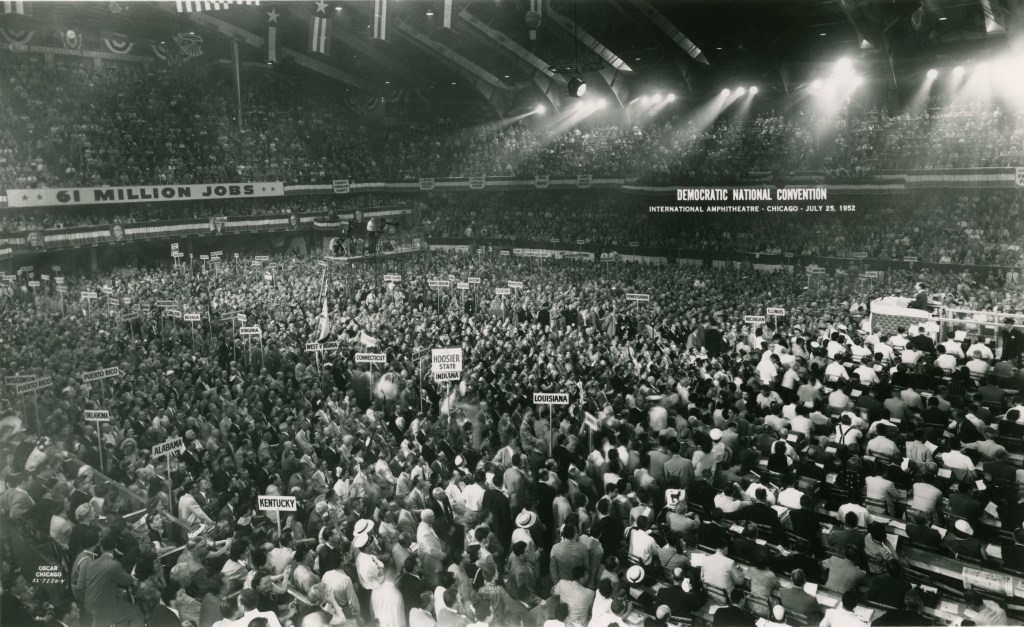
It was an ugly spectacle. And because it was broadcast on television, millions of people around the country got to watch the ugliness unfold in real time. Kefauver’s many supporters around the country were justifiably outraged about what they saw.
For a party that proudly proclaimed itself “the party of the people,” it wasn’t a good look. Party leaders needed a story to justify why they had ignored the primary results and tossed aside the candidate who’d received the support of millions more people than any other Democrat.
Columnist Ray Tucker told that story in his widely syndicated “National Whirligig” column in early August, a little over a week after the convention. In Tucker’s telling, Kefauver was an unsuitable candidate whose defeat was justified by his own actions. His supporters who were furious at the treatment he received were naïve, hysterical, and didn’t understand how politics worked. But even though Kefauver got what he deserved, it was still necessary for Stevenson to make nice with the loser, for the sake of his own and the party’s chances in November.
Tucker’s column deserves a close look, because it shows both the party’s naked contempt for Kefauver voters and the profound weakness of the party’s justification for its own actions at the convention. In his attempt to demonstrate that Kefauver and his supporters were wrong to be upset, Tucker accidentally confirmed just how valid their grievances were.
Oh, You Poor Baby
Tucker made it clear right away where he stood on Kefauver and the 1952 convention. Here’s the first sentence of his column: “Gov. Adlai E. Stevenson has been warned by promoters of campaign harmony that he must bestir himself to assuage the hurt feelings of the party’s problem child – Sen. Estes Kefauver of Tennessee.”
Right away, Tucker infantilized Kefauver. He wasn’t an ill-treated candidate with a legitimate grievance; he was a “problem child” with “hurt feelings.” This theme continued later in the piece, when Tucker claimed that Kefauver’s supporters falsely portrayed him as “the nice, quiet, well-behaved little boy who was beaten up badly by the Democratic bullies at Chicago.”
Meanwhile, Stevenson was asked to “bestir himself to assuage” Kefauver’s delicate feelings – again, not because Kefauver’s complaints were legitimate, but in the name of “campaign harmony.” It’s as if Stevenson was the weary father asked to get his kid to quit crying about big brother stealing his yo-yo, so the family could have dinner in peace. This served both to infantilize Kefauver and to trivialize his complaint about the convention.

After casting Stevenson as the father and Kefauver the whiny child, Tucker placed Kefauver’s outraged supporters in the mom role. He wrote that “[b]oth sincere and emotional advocates of reform, especially women, have a non-political, motherly, protective attitude toward” Kefauver.
That’s a remarkably loaded sentence. Let’s start with “sincere and emotional advocates of reform.” Tucker’s distinction between the two implied that there were right and wrong reasons to oppose political corruption, and that those who favored reform because they were repulsed by corruption were irrational and insincere. Take a guess which reform advocates fell in the “emotional” category.
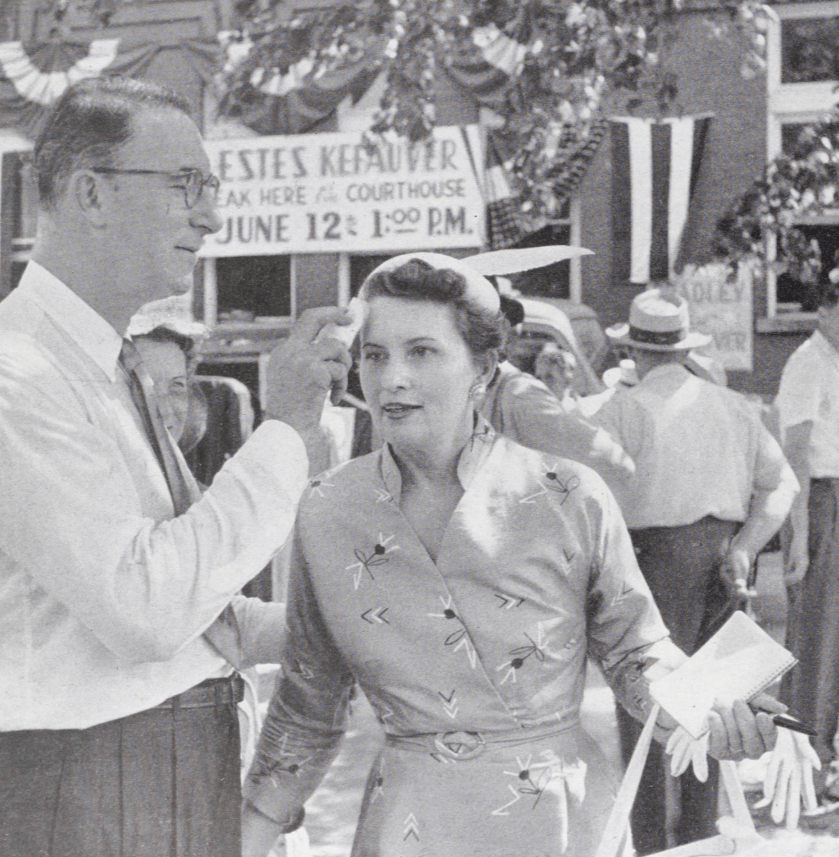
Actually, you don’t have to guess, because Tucker spelled it out – “especially women.” Kefauver’s political coalition was unusually – by 1950s standards – reliant on women. Many of them had watched his televised crime hearings and been moved to get involved in politics as a result. They worked hard campaigning on his behalf. They were understandably upset and outraged at seeing the results of the primaries – and their hard work – tossed in the garbage by party bosses.
But according to Tucker, these women weren’t driven by legitimate political convictions – rather, they felt a “non-political, motherly, protective attitude” toward Kefauver. This meant that their opinions and advocacy could be safely disregarded, because they were fundamentally unserious and illegitimate.
Having patronized Kefauver’s supporters and their interest in politics, Tucker went on to dismiss their outrage as rooted in political ignorance and naivete. “To the millions who do not understand the intricacies of professional politics,” he wrote, “denial of first or second prize to the hero of the primaries appears to reflect a cynical disregard of the supposedly democratic institution. It looks, as Kefauver has charged, as if the ‘bosses’ had acted upon a ‘public be damned policy.’”
You might think that party leaders’ actions “appeared to reflect a cynical disregard” for the will of the people because… it in fact reflected their cynical disregard. But no, Tucker explained, people who thought that just didn’t “understand the intricacies of professional politics.”
One of those intricacies, apparently, was that the primaries were just for show. Tucker’s dismissive reference to Kefauver as the “hero of the primaries” directly contradicted Kefauver’s argument that the millions of votes he’d received were a worthy gauge of popular sentiment. To Tucker, winning the primaries was roughly equivalent to finishing with the best record in spring training: a nice enough accomplishment, but not something that really counted.

Tucker’s dismissal of the primaries as a “supposedly democratic institution” drives home this attitude, implying that Kefauver supporters were foolish to argue that those results should count for something. If they really understood professional politics, they’d have known that it was the bosses – not the people – who got to pass judgment on who was truly worthy of the nomination.
And what were the bosses’ reasons for deeming Kefauver unworthy? Tucker explained those too. It probably won’t surprise you to learn they were riddled with the same dismissiveness and questionable logic that filled this column.
The (Flimsy) Case Against Kefauver
“The fact is that Kefauver was passed over for sound and legitimate reasons,” Tucker wrote. He listed four of them.
The first was that Kefauver “violated tradition by announcing his candidacy before Truman had publicized his 1952 plans.” This so-called “tradition” was dubious at best – Truman was the president, not a king – but more importantly, the charge ignored a few things.
Such as the fact that Kefauver met with Truman multiple times at the White House to discuss his interest in running before making his announcement. Or the fact that Truman – despite sporting a 22% approval rating and being dogged by numerous scandals – dragged his feet on deciding whether to run for reelection until after the primaries started. It was only after Kefauver thrashed him in the New Hampshire primary that Truman finally announced that he would not run again.
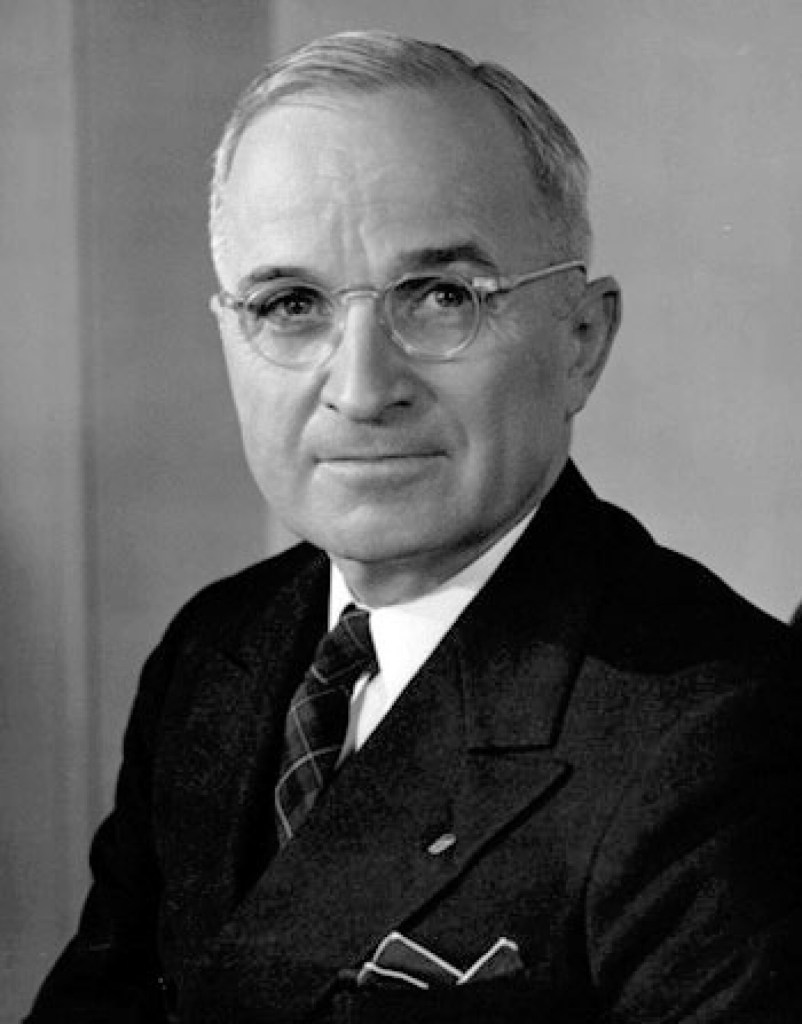
It’s understandable that Truman wanted to control the decision – either to run for reelection himself or to anoint his success. It’s less understandable why the party chose to go along with his desire – or why the people shouldn’t have been able to decide who they wanted.
The second charge against Kefauver is that his crime “exposes were largely responsible for Democratic setbacks throughout the nation in 1950 and 1951.” There is little evidence for this sweeping claim – and Tucker provided none. Even if it were true, however, it seems odd to blame Kefauver for uncovering the corruption, rather than the corrupt politicians themselves.
Tucker noted earlier in the column that the rejection of Kefauver “has created the impression that [Democratic leaders] prefer corruption to a cleanup.” Given that they attacked Kefauver for his exposure of the corruption and did not attack the corrupt politicians whose behavior was exposed, I’m not sure what other conclusion voters were supposed to draw.
The last two charges pertained to Kefauver’s behavior at the convention. Tucker wrote that Kefauver “allied himself with the northern radicals to achieve his ambition,” most notably by supporting a resolution that would have required all the delegations at the convention to commit to supporting the Democratic nominee in November. “As in the senate,” Tucker said, “he acted against the interests of his own section.”
Who were these “northern radicals?” People like Michigan Governor Soapy Williams, Senator Blair Moody, and former First Lady Eleanor Roosevelt – proud liberals all, but none of them “radical” in any meaningful sense. They certainly had ample reason to be concerned about Southern Democrats abandoning the ticket, since the Dixiecrat revolt had happened just four years earlier.
Whatever the merits of the proposed pledge, it seemed odd to refer to Democrats who were urging fellow Democrats to remain loyal to the party as “radical” – and not apply that label the Democrats threatening to bolt the party.
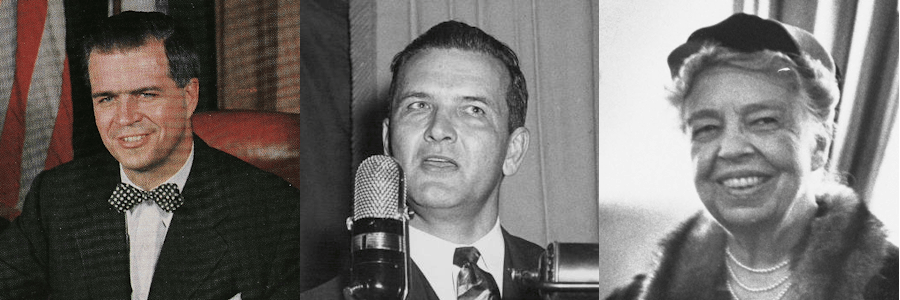
Kefauver, meanwhile, was judged guilty of acting “against the interests of his own section.” In the Senate, he had similarly acted against the South’s “interests” through actions such as opposing the poll tax and the Senate filibuster.
But who determined the South’s “interests”? Kefauver was apparently not allowed to make his own judgment about what was in the interests of his section. Rather, the South’s interests were determined by people like Richard Russell, James Eastland, and other segregationists.
These figures, whom Tucker dubbed “Dixie’s acknowledged and representative spokesmen,” also stated that Kefauver’s “New Deal-Fair Deal voting record” meant that he would be “no asset in holding a South wavering between the convention’s choice and Eisenhower.”
Which is interesting, since Stevenson’s 1952 running mate, Alabama Senator John Sparkman, supported the same New Deal and Fair Deal programs that Kefauver did. The primary difference between them is that Sparkman was a committed segregationist who would go on to sign the Southern Manifesto and condemn the Brown v. Board of Education as “judicial usurpation.” That, apparently, was acting in the interests of the South.
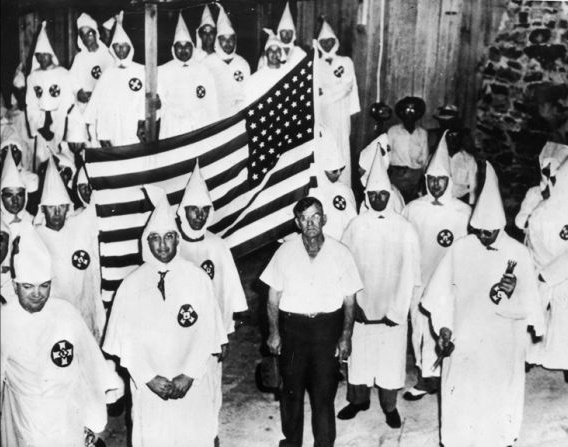
And, of course, it couldn’t be that Kefauver allied with Williams, Moody, and Roosevelt at the convention because he shared their beliefs. No, per Tucker, he simply sought “to achieve his ambition” of becoming President. As with Tucker’s dismissal of Kefauver’s female supporters as emotional and naïve, dismissing Kefauver’s actions as grounded in pure ambition conveniently prevented him from having to consider the case on its merits.
Kefauver’s final sin was that he “filled the air with charges that party and convention officials, including Permanent Chairman Sam Rayburn, were ‘knifing’ him.” In making these charges, Kefauver “furnished evidence for the G.O.P.’s current allegations that Stevenson is the product of a ‘smoke-filled back-room’ of connivers.”
The Eisenhower campaign did indeed allege that Stevenson was the bosses’ hand-picked candidate. But they didn’t need Kefauver to furnish the evidence of that. The evidence was right there in the open – and seen by anyone who watched the convention on television. As with the crime hearings, the party deemed that the bad behavior was not the problem – it was the guy who talked about it.
Beyond those specific charges, Tucker cited some broader and even less well-grounded charges against the man from Tennessee. He wrote that “Kefauver’s ten years in the house and four years in the senate had not shown him possessed of the qualification for an office whose occupant ‘stands only a heartbeat from the presidency.’”
He provided no evidence for this sweeping declaration. He made no attempt to reckon with the fact that Time magazine had named Kefauver one of the “Senate’s Most Valuable Ten” in April 1950, or the poll of political scientists cited by the New Republic in March 1952 that dubbed him the second most effective Senator. He simply dismissed Kefauver as unqualified with a wave of his hand.
He also cited the opinion of the same party chiefs who had denied him the nomination. “In the opinion of the leaders who had the party’s interests in mind, he did not measure up in any respect,” Tucker wrote. “He was simply a synthetic, televised figure – an apparition of popular emotion and imagination.”
There was the heart of Tucker’s – and the party leaders’ – argument. There was no need to engage with Kefauver’s merits as a nominee because there was no there there. He was a synthetic candidate, a figment of the imagination. The millions of people who’d loyally supported his campaign, who were outraged to see him denied at the convention – they were dupes, victims of a mass emotional delusion. They’d been seduced by an image on the television.
It’s no surprise that the party leaders wanted people not to believe was they saw on TV. Because there was one indelible image that they were particularly eager for the voters to forget.
The Cruelty Is the Point
For all the ugly scenes of raw politics on display at the Chicago convention, one of the ugliest occurred right toward the end. Kefauver, having realized that his dreams of winning the nomination had been dashed, wanted to do the gracious thing and unify the party by formally withdrawing and throwing his support to Stevenson. He went to the podium and asked for recognition.
But Rayburn ruled him out of order, claiming he couldn’t interrupt in the middle of a roll call. Instead, Kefauver had to sit on the platform, in full view of the camera, absorbing the humiliation while watching state after state cast their votes for Stevenson.
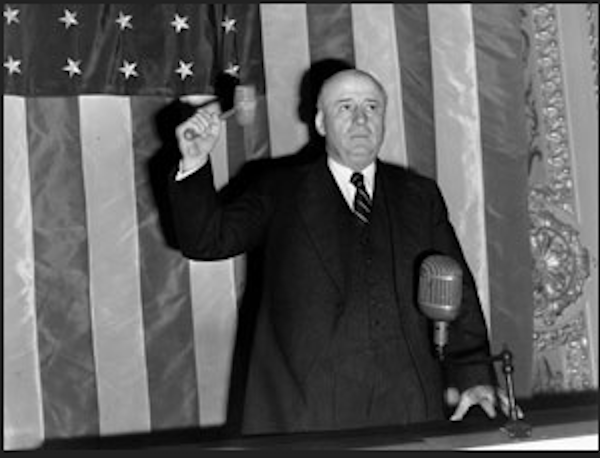
Kefauver’s frustration and distress were plainly visible as he sat there. The sight of his public suffering stirred the anger of his supporters, and justifiably so. Rayburn’s action was gratuitously cruel. There was no valid reason not to let Kefauver to withdraw gracefully – unless the point was to rub his nose in the defeat, to teach him a lesson.
Even party leaders recognized later that Rayburn had gone too far. Unsurprisingly, this was the hardest part for Tucker to justify. He tried his best, though.
He wrote that “Kefauver’s anguished and frustrated face, as he sat on the platform after his vain attempt to throw his support to the victorious Stevenson… only sharpened sentimentalists’ pity for Estes and his wife, Nancy. To the hard-boiled politicos, of course, it was the face of a ‘poor loser.’”
By engaging on this point at all, Tucker implicitly acknowledged the power of the image – its impact was too significant to ignore. But neither he nor Democratic leaders could acknowledge that the outrage of Kefauver’s supporters was valid, because that would have undermined their justification for the way his candidacy was treated at the convention.
So instead, Tucker once again trivialized the grievances of Kefauver’s supporters, once again in gendered fashion. He dismissed their reaction as sentimental, rooted in their motherly feeling of pity toward poor little Estes. Meanwhile, the “hard-boiled politicos” whose judgment wasn’t clouded by emotion and sentiment saw the truth: that Kefauver’s reaction proved that he was a “poor loser.” Because he had a visible human reaction to being humiliated on national television, this proved they were right to deny him the nomination in the first place. It was a remarkable cycle of self-justification.
It was too much even for Tucker. Toward the end of the column, Tucker admitted that although Rayburn claimed that he was just following the rules, he had in fact “hazed the young man in cowboy style.”
Refuting Rayburn’s claim that it was unheard of to interrupt a roll call, Tucker pointed out that the roll call at the 1932 convention was interrupted to allow California and Texas to shift their support to FDR to ensure his nomination – and that Rayburn knew all about that, since he’d been part of the Texas delegation. (Tucker might also have pointed out that Rayburn had no problem interrupting an earlier roll call in 1952 to give Virginia a chance to contest the loyalty pledge.)
In other words, Rayburn’s action was so gratuitous that even Tucker had to call it out. Of course, he also waved it off as a jocular bit of cowboy-style hazing – while Kefauver’s visible reaction to the hazing only confirmed his unfitness. Once again, the bad behavior wasn’t a problem – but calling attention to it was.
The Uncomfortable Truth
As astounding as Tucker’s whole column was, two sentences really stuck out. One was his insistence that “I am not condoning or criticizing anybody here. I am simply reporting the Kefauver drama – or tragedy.”
It’s hard to believe that in the middle of an account of the convention proceedings so one-sided that it practically could have been dictated by Truman himself, Tucker could claim that he was merely a neutral reporter. But as incredible as it is, I’m confident that he believed it.
This was precisely the problem with the political press. They had absorbed the perspective of party leaders so thoroughly that they didn’t even realize it.
They believed that party leaders’ rejection of Kefauver reflected sound political judgment, not personal resentment or institutional resistance. They believed that Kefauver’s record in office demonstrated that he was unqualified to be President – even if they’d said the opposite a couple years earlier. They believed that Kefauver’s supporters – especially the women – were sentimental, emotional, reacting to a televised phantom rather than true political principles. They believed that the primaries shouldn’t really matter – because party leaders, not the people, were the ones who could really judge the quality of a candidate.
The other remarkable sentence in Tucker’s column was the last one: “However, like him or not, Stevenson can not afford to neglect the angry and unhappy man in the coonskin cap.”
Tucker spent the entire column dismissing Kefauver as a synthetic lightweight and his supporters as overemotional dupes. Why should Stevenson devote any time to placating the man or his followers?
Because there were too many of them to ignore. That’s the subtext that Tucker was loath to acknowledge. If Kefauver’s many supporters stayed home in November – or crossed over to vote for Ike – Stevenson would lose in a landslide. Democratic leaders may not have liked or respected Kefauver and his followers, but they needed them in the tent.
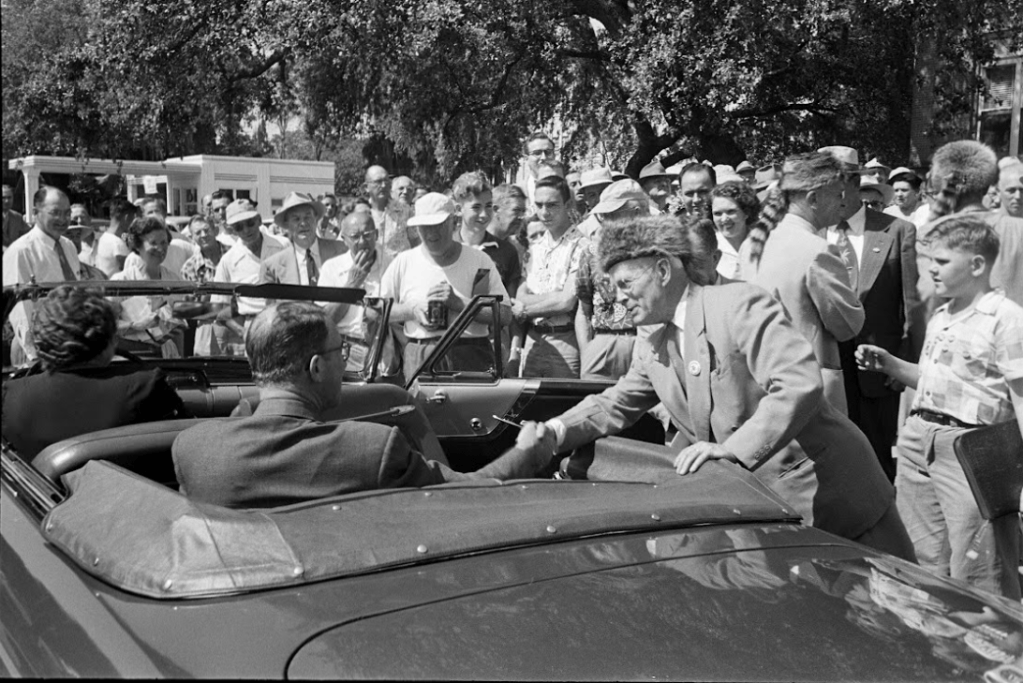
Perhaps they should have considered that before deciding to grind Kefauver’s campaign into dust at the convention. Perhaps Rayburn should have considered that before deciding to humiliate Kefauver on national television.
As it turned out, Kefauver was able to put his hurt feelings aside and campaign actively for Stevenson in the fall. He did more campaigning for Democrats that fall than anyone except perhaps Stevenson and Sparkman themselves.
And although this didn’t convince party leaders that Kefauver was a good and loyal soldier – they never warmed to him – the blowback from the 1952 convention was enough to convince them they couldn’t be so high-handed in 1956. They had to take the primaries seriously, and Stevenson had to compete in them in order to claim the nomination. (And try as they might, they couldn’t keep Kefauver from winning the VP nod.) The party leaders’ iron grip on the nominating process was starting to slip – and following the McGovern-Fraser reforms after 1968, it would be gone.
Tucker’s column showed that the party denied Kefauver at the 1952 convention because they could. But they’d soon discover that they couldn’t tune out the people forever.


Leave a Reply