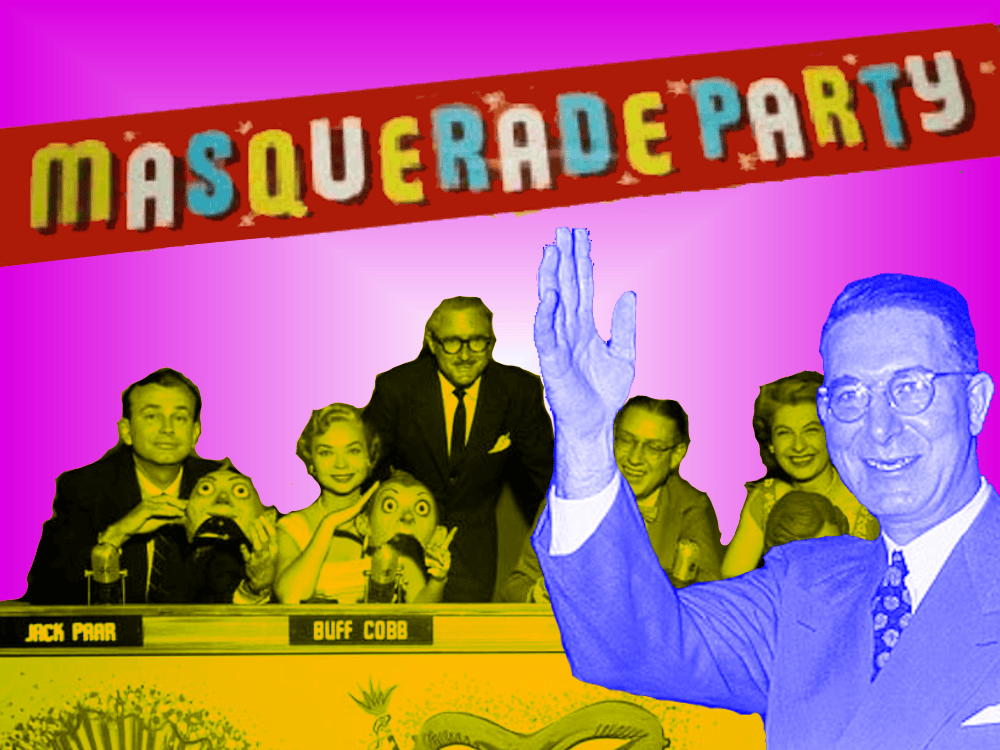
Estes Kefauver prided himself on never showing a false face to the people. But on one occasion, he did it proudly – and the people didn’t mind.
Previously, I’ve written about Kefauver’s 1951 appearance on the TV game show “What’s My Line?”, which occurred amid his famous Senate hearings on organized crime. That wasn’t his only game show outing, however. In August 1953, he appeared on a show called “Masquerade Party” – a program where false faces were not only accepted, but expected.
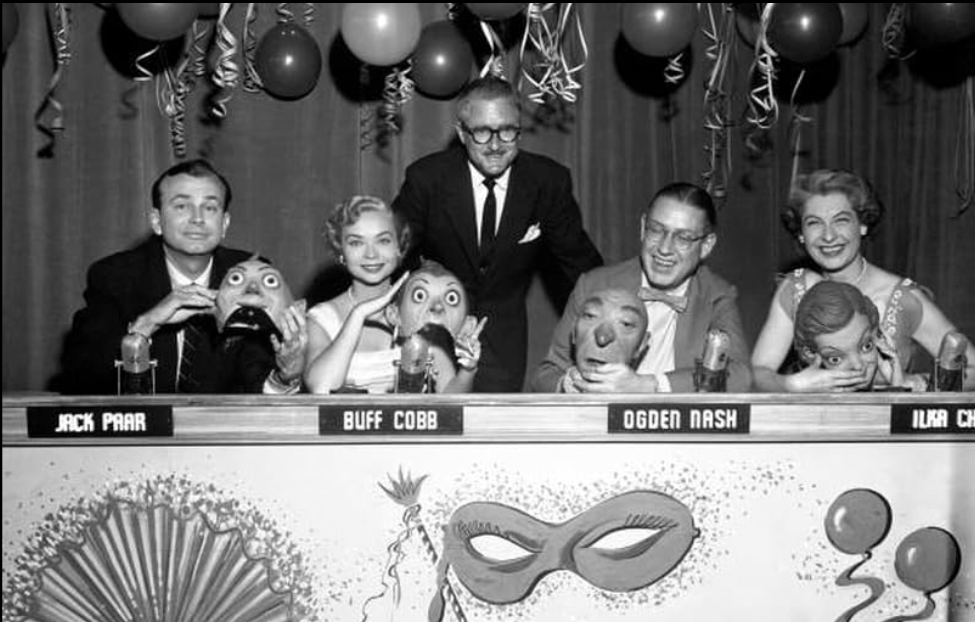
“Masquerade Party” was somewhat similar to “What’s My Line?” Both shows featured a four-person panel asking yes-or-no questions and attempting to guess the identity of their guests. On “What’s My Line?”, the panelists wore blindfolds so as not to reveal the mystery guest’s identity. On “Masquerade Party,” the guests were disguised – wearing a costume and concealed behind a mask or heavy makeup. However, the costume was intended to offer a hint as to the guest’s identity. (For instance, when polar explorer Richard E. Byrd appeared on the show, he was in a penguin costume.)
When Kefauver and his wife Nancy appeared on the show, they were disguised as Andrew and Rachel Jackson. It was a fitting choice: like Kefauver, Jackson was a Tennessean who believed in putting more political power in the hands of the people, and Kefauver frequently cited Jackson in his speeches.
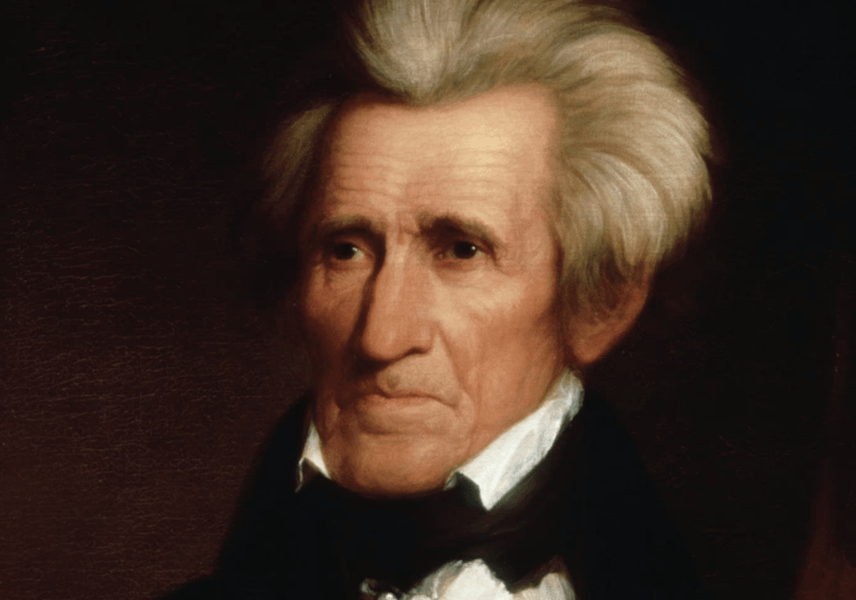
With a five-minute window to make an identification, the panel correctly guessed the Kefauvers’ identity within about three and a half minutes. The couple won a little over $200, which they donated to the Ladies’ Hermitage Association, the group responsible for maintaining Jackson’s historic home.
By appearing on the show, Kefauver – as he so often did – drew scornful comments from reporters. They considered it undignified and inappropriate for a United States Senator and aspiring President to play dress-up on a game show. Their comments reflected a deeper cultural anxiety about whether the line between politics and entertainment was growing too blurry – and whether the growing medium of TV held too much power in our political process. It’s an anxiety that’s still with us today.
Hollywood for Ugly People
Kefauver’s “Masquerade Party” appearance earned a harsh roasting from syndicated columnist John Crosby, widely considered the leading TV critic of the era. Famed for his caustic wit, Crosby was unsparing in describing the “nasty jar” he felt when seeing Kefauver’s face emerge from beneath the Jackson disguise.
“Here, I said to myself, is the guy who was the big television star of 1951,” Crosby wrote, “a man who… had us all neglecting our work for about a month, the man who may have been the biggest celebrity in the country for a while. And here he was playing his part on a quiz show! It just goes to show how the mighty can fall on television, doesn’t it?”
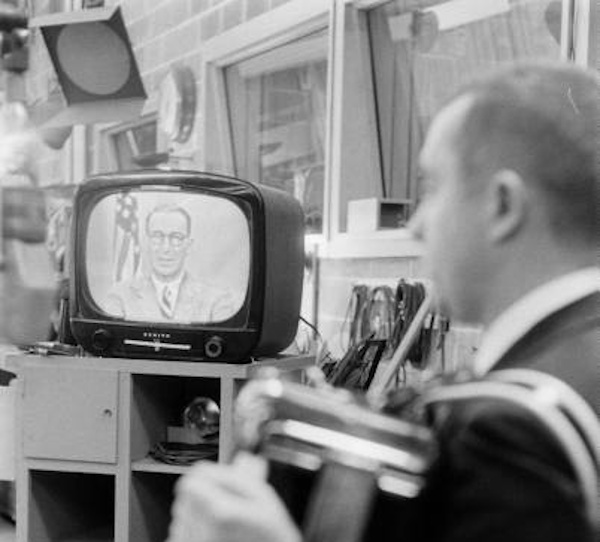
Crosby was right to flag the organized crime hearings as a watershed moment in politics. The dramatic showdowns between Kefauver’s subcommittee and the parade of gangsters and corrupt officials they grilled on live television not only captivated the nation, but they made Kefauver and his subcommittee colleagues into celebrities.
Kefauver went from a rising young Senator into a national hero and popular Presidential candidate in 1952, celebrated in songs and movies. His chief counsel, Rudolph Halley, went from obscurity into a successful run for New York City council president in 1951.
Other politicians saw the rapid rise of Kefauver and Halley, and they took notice. They began holding splashy televised hearings of their own, hoping for the same lightning that struck Kefauver. And they looked for any opportunity to get their faces on TV: sitting for interviews with news anchors, discussing their views on panel shows, and even appearing in costume on game shows.
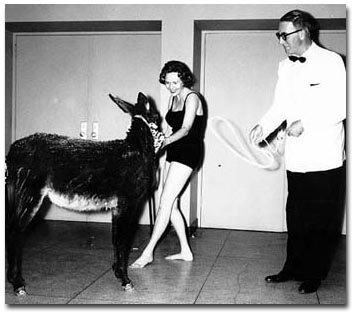
This eagerness led reporters to question whether politicians had become so thirsty for TV fame that they were sacrificing their dignity – and their public duties. Crosby cited Kefauver’s “Masquerade Party” appearance as evidence of “what politicians will do to get on television. They’ll do anything. Anything at all. They’ll be doing rope tricks or toe dancing with the chorus on the Ed Sullivan show.”
Columnist Irene Corbally Kuhn expressed a similar concern. “Certainly,” she wrote, “the eagerness with which the congressmen in both houses accept almost any invitation to appear on radio and television would lend weight to a suspicion I’ve been harboring ever since the Kefauver hearings, that some of our elected representatives would rather be on camera and mike anywhere than in their Washington offices concentrating conscientiously on the jobs that they were elected to do.”
This was a charge that would dog Kefauver throughout his Senate career: that he was more interested in publicity and advancing his personal ambitions than doing his Senate work. Kefauver would argue that high-profile public hearings were in fact an important part of his Senate work – they took issues of national concern and spotlighted them, attracting the public’s attention and stirring them both to demand action from their leaders and to take action themselves to clean up problems like crime and corruption.
But Kefauver wasn’t raising awareness on important issues by going on “Masquerade Party” in an Andrew Jackson costume. Reporters like Crosby and Kuhn felt that politicians like him were debasing the dignity of their office and neglecting their duties by engaging in such silly shenanigans.
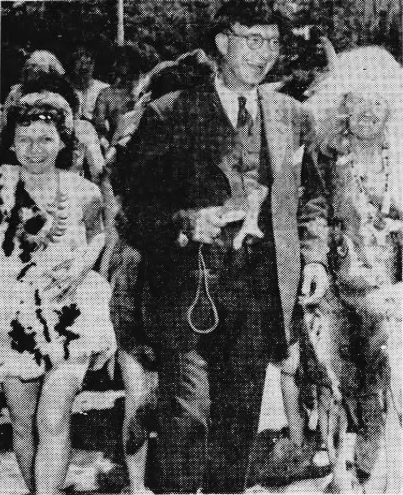
“Can it be that United States senators and representatives are not really lawmakers are all but just a bunch of frustrated actors?” wondered Kuhn. “Will the rivalry for the best working space in both the Senate and House Office Buildings now also will be extended to a demand for star dressing rooms in the capital with clerks doubling as make-up men, dressers, cue-callers?”
In response to such charges, Kefauver might argue that appearing on a game show was an opportunity to meet the people where they were. There were plenty of American voters who rarely paid active attention to politics, but they watched shows like “Masquerade Party.” If this was an opportunity for people to get to know Kefauver, he was willing to take it. It was the same spirit that propelled him to travel the country during his Presidential campaigns, visiting county fairs and ambling up and down small-town Main Streets – he wanted to establish a connection with the voters.
“Masquerade Party” in particular allowed Kefauver to lighten up his public image. During both the crime hearings and his 1952 Presidential campaign, Kefauver maintained an air of solemn seriousness, and was frequently knocked by political reporters for seeming to lack a sense of humor. Appearing in costume on a show devoted to silly fun allowed him to flash his lighthearted side. It also gave him an opportunity to appear on TV with Nancy, who was one of his greatest assets during the ’52 campaign.
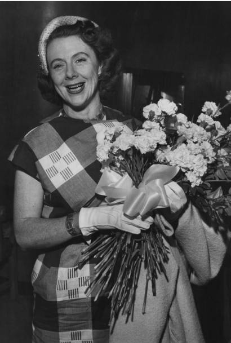
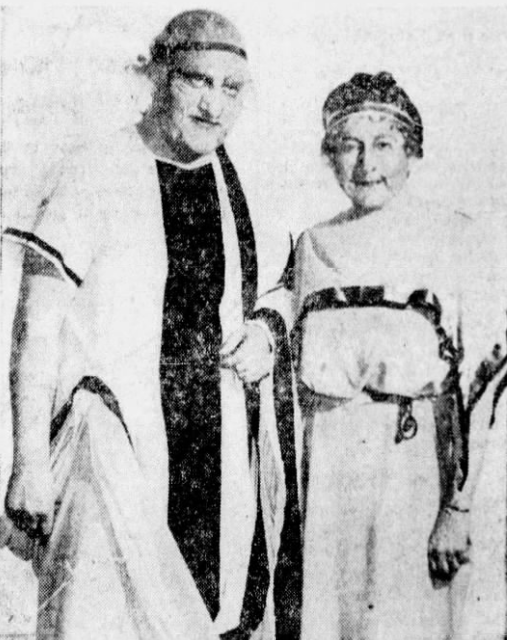
Kefauver was hardly alone in seeing the benefit of appearing on the show. In the years that followed, many of his Senate colleagues turned up on “Masquerade Party.” The list included Scoop Jackson (dressed as George Washington), Paul Douglas (as Abraham Lincoln), Richard and Maurine Neuberger (as Lewis and Clark), Homer Capehart (as a toga-clad Roman senator), Mike Monroney (as fellow Oklahoman Will Rogers), and Hubert Humphrey. Pennsylvania Sen. James Duff appeared twice: once as Benjamin Franklin, and again as William Penn. Like Kefauver, many of them appeared with their wives.
Did this indicate, as Kuhn claimed, that these Senators were “unclear about the difference between public responsibility and duty, and private privilege and indulgence”?
There was more than a whiff of condescension in Kuhn’s remark. Her remark implied that perhaps the voters who enjoyed seeing Kefauver and other Senators on “Masquerade Party,” rather than scoffing in disdain, weren’t serious enough about politics.
This was the same attitude that led Ray Tucker in 1952 to dismiss Kefauver as “a synthetic, televised figure – an apparition of popular emotion and imagination.” And it was the attitude of many political reporters in 1956, who argued that the primary voters who preferred Kefauver’s plain-spoken approach to the witty erudition of Adlai Stevenson were unsophisticated rubes who didn’t know any better.
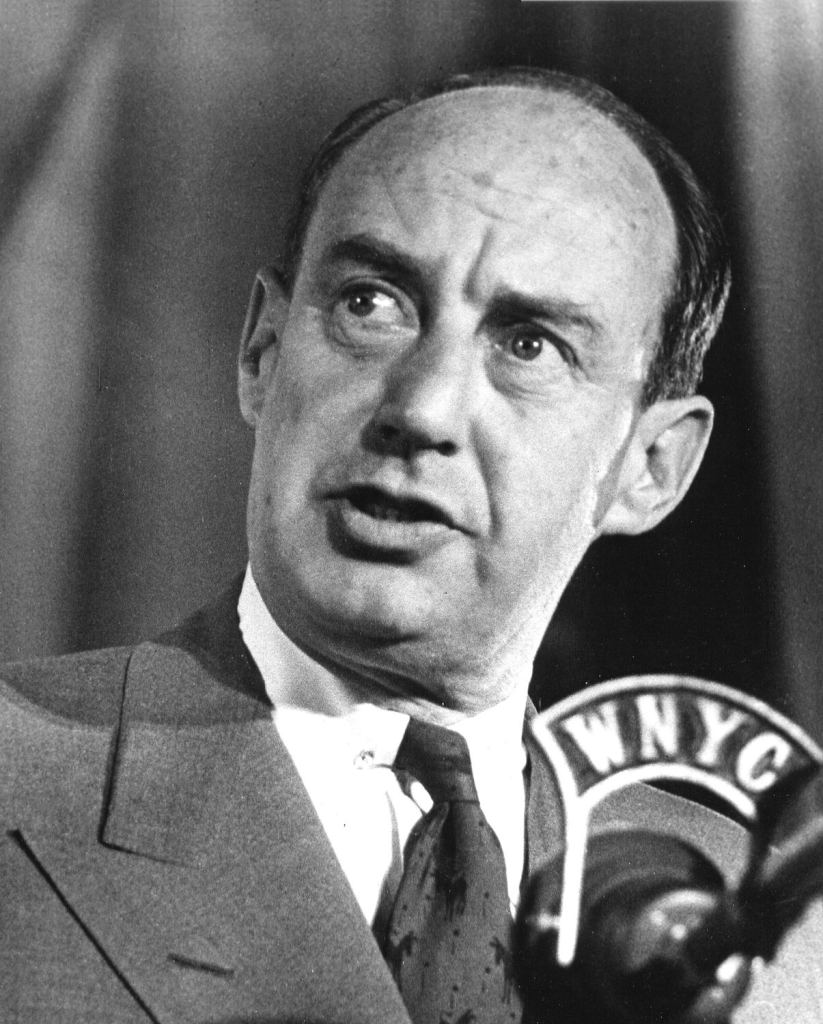
These commentators believed that that politics was a serious endeavor that should be kept away from common entertainment and televised spectacle. They weren’t wrong to worry that blurring that line would lead to more McCarthy-style show trials and a degradation of political discourse.
But they also tended to imply that it would be best for all concerned if political business was reserved for serious people – people like themselves – and the folks watching “Masquerade Party” should have as little say as possible. That was the gatekeeping attitude that Kefauver devoted his career to combatting.
It seems faintly ridiculous that journalists were wringing their hands over the idea that democracy was being undermined by “Masquerade Party,” a show so silly that it prompted panelist Buff Cobb to say, “We all love playing this dumb game.” (Having watched one of the few surviving episodes, I can confirm that Cobb’s assessment is accurate.) But the journalists’ concern tapped into a deeper anxiety about the growing role that television was playing in politics.
“The Best Man, Not the Best Actor”
In the early 1950s, television turned the world of American politics upside down. The 1952 election was, in the words of the Pittsburgh Post-Gazette, “the first widely televised presidential campaign.” Aspiring officeholders noticed how the organized crime hearings dramatically raised Kefauver’s national profile, and they wanted to leverage the airwaves for themselves. Not only did they seek all the TV appearances they could – even in costume on a game show – but they also sought to make their televised presence as appealing as possible.
TV executives shared that goal. The Kefauver hearings aside, most typical political proceedings didn’t make for exciting programming. And while most politicians knew how to conduct themselves in a committee room or at a campaign rally, those skills didn’t translate to the television studio. Looking and sounding good on TV was a new skill set – one that most politicians didn’t possess.
“I have interviewed a great number of politicians on TV,” said Los Angeles newswoman Judy Lawton, who began offering private media coaching to candidates in early 1952, “I have found that none of them knows TV technique. That’s why I decided to go into the business of teaching them… Too many of them attack TV as though they were speaking to their adherents in a huge American Legion hall. But on TV they are invading the privacy of the home. They must direct their remarks to individuals at home. Otherwise, they will be dialed out just like an irritating commercial.”
The executives at CBS agreed with Lawton, and in the spring of that year they created a TV Coaching School for Candidates at their studios in Washington. They invited all of the major potential Presidential candidates, as well as all Senators up for reelection and all House members running for Senate.
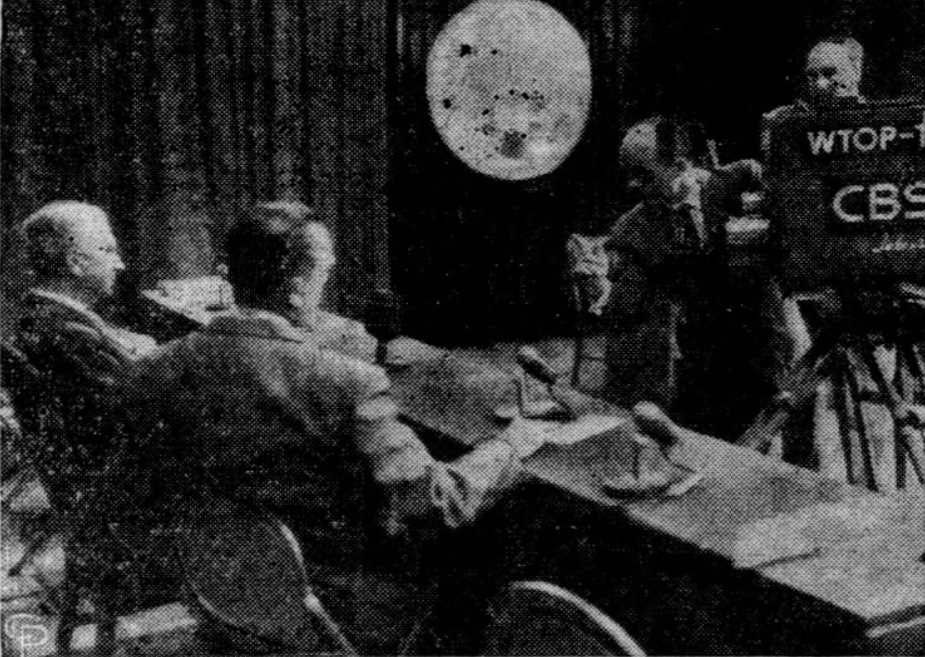
Led by news director Bill Wood and anchor Walter Cronkite, the network schooled the politicians on how to sit without slumping, how to address their remarks to the right camera, how to use cue cards effectively, how to dress and what makeup to use to avoid looking pale and haggard or causing a distorting glare under the studio lights. They ran film of previous televised speeches and appearances and rated the candidates’ appearance and deportment.
As CBS put it in a press release, they tried to teach candidates “the art of appearing to one’s best advantage before the television audience.”
On paper, it was a win-win: candidates learned the tips that helped them to master the new and powerful medium, while CBS improved the quality of their broadcasts by reducing the number of awkward, fumbling TV amateurs they had to air. (As Sen. Robert Kerr, a student of the CBS school, put it: “They’re either selling you the time or giving you the time, and they don’t want to lose any more audience than they have to.”)
But news of the CBS “TV school” generated a wave of critical columns and editorials, suggesting that the influence of television was corrupting American politics.
Several of these critics argued that teaching candidates to come off well on TV was fundamentally dishonest, and was essentially helping politicians to bamboozle voters.
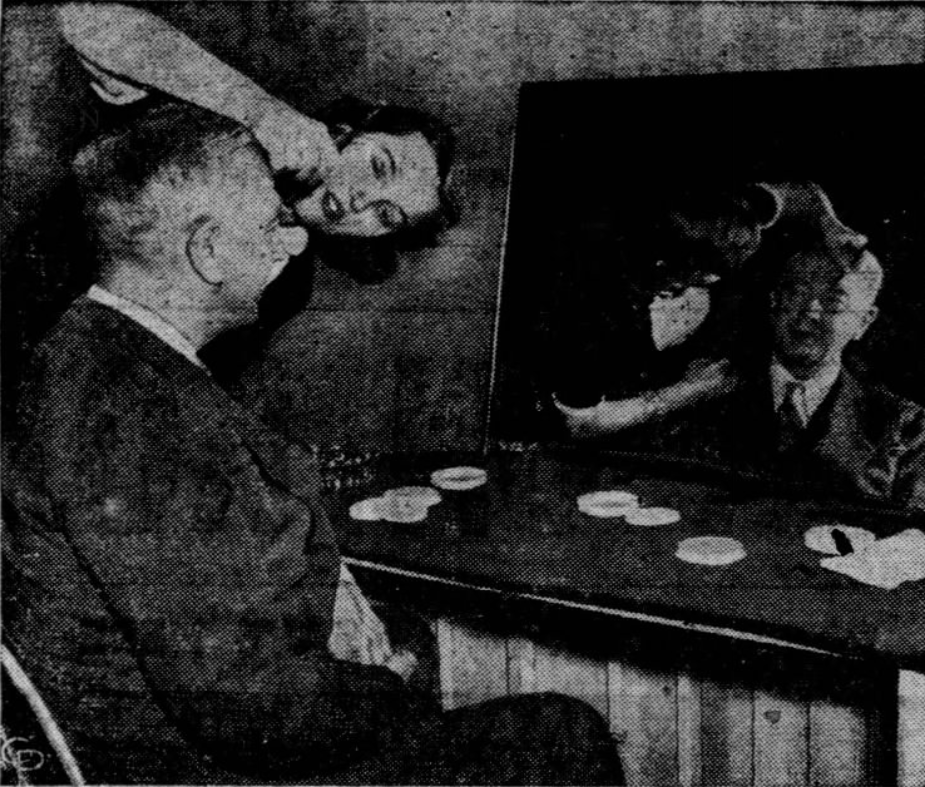
“[W]e are sure that no candidate who is interested in being elected should school himself in the syrupy phrases of the television commercial,” huffed the Portland Oregonian. “Genuine sincerity and honesty are… the qualities that will win votes for a candidate,” they added, “and lack of these will never be offset by a touch of rouge or an engaging manner before the camera. What do voters care about how a candidate stands, if they know where he stands?”
“It might be better,” wrote columnist Henry McLemore, “to elect a candidate who wears a shirt made of a flour sack and who blinks when the cameras are turned on him, but who is dead level honest, than one who is as at home before the cameras as Dagmar.”
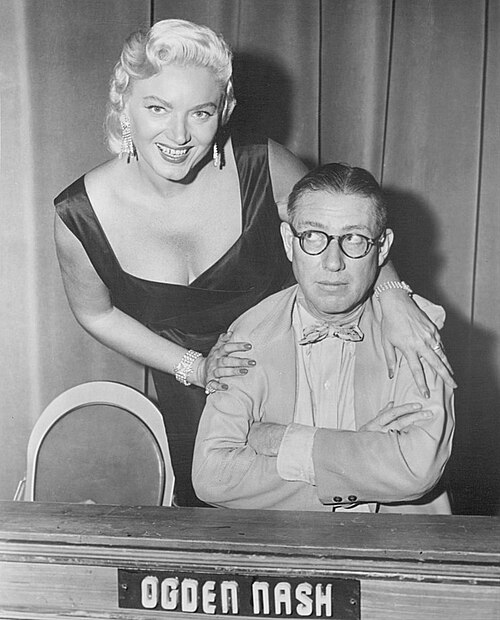
“I am a little apprehensive about teaching those boys the art of televised mental seduction,” wrote Houston Post TV critic Richard Harrison. “We need to know our representatives as they are – not as they are trained to perform for an audience. Get the votes, sure. But let the best man, not the best actor, win them.”
The Post-Gazette shared Harrison’s fear of televised seduction, with a dollop of sexism for good measure. “[I]t is evident,” they wrote, “that the telegenic candidate is going to make hay with the TV viewer, who, during the day, is most likely to be female and thus susceptible to his charm.” The same female voters whose support for Kefauver in 1952 was written off by Ray Tucker as protective motherly sentiment are dismissed here as being uniquely susceptible to televised charm – in both cases, women’s preferences were treated as irrational and foolish.
These reporters weren’t wrong to worry that a telegenic demagogue might be able to use TV as a weapon. But their criticisms also carried the same class-based condescension that led Crosby and Kuhn to object to politicians appearing on “Masquerade Party.” The foundational assumption is that the average voter – especially if she was female – would be easily fooled by an unworthy candidate with glib charm and a telegenic manner.
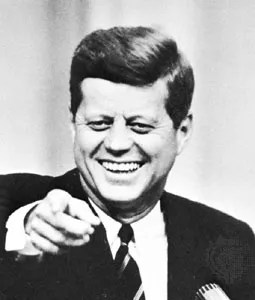
Reporters often claimed that Kefauver was such a candidate, even though he was not particularly smooth or comfortable on TV. Kefauver won voters through personal contact on the campaign trail, not slick televised speeches. And it’s notable that reporters tended not to say such things about the far more telegenic John F. Kennedy – because they were charmed by him too.
This also tapped into reporters’ related fear about television. Thanks to the new medium, it was much easier for politicians to speak directly to voters, without the mediating influence of the political press and their judgment of candidates’ merits. When political reporters worried about demagogues using TV to charm voters into giving them power, they were expressing a genuine fear for our democracy – but they were also envisioning a future in which their services were no longer needed. They were right to worry about that too.
Life Is A Masquerade
“Masquerade Party” went off the air in 1960. As it turned out, the show did not lead to the downfall of our democracy. But the debate that Kefauver started by showing up in his Andrew Jackson costume is still going on.
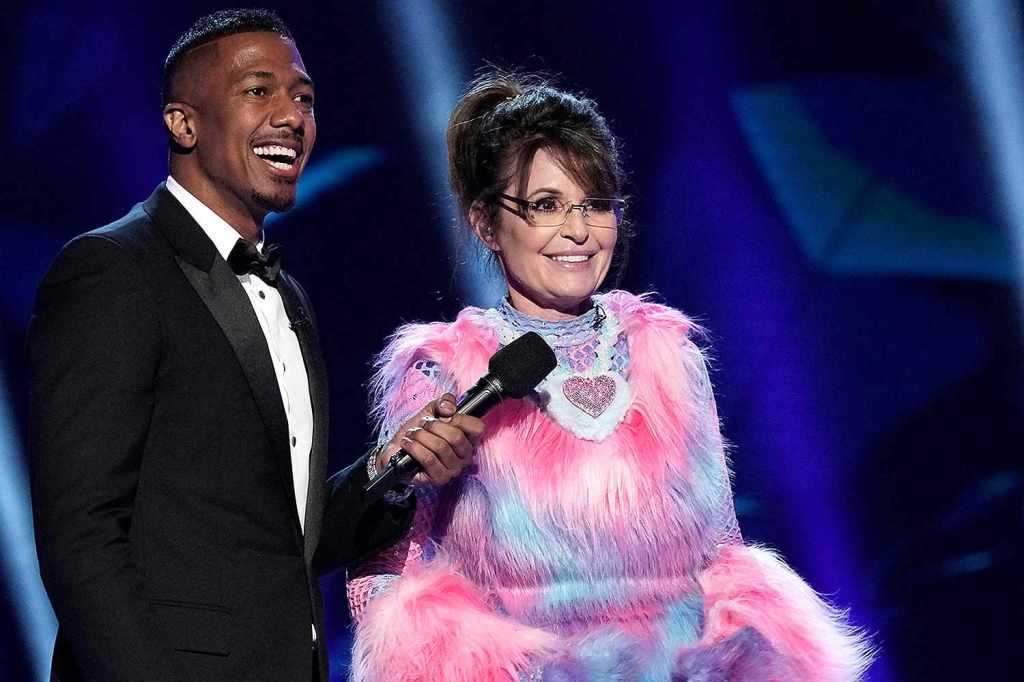
When Bill Clinton went on MTV and discussed whether he preferred boxers or briefs, we argued over whether this was an appropriate topic – or forum – for an aspiring President. When Bob Dole went from losing the 1996 election to shilling for Viagra, we wondered whether this was beneath the dignity of a longtime political figure. When Sarah Palin went on “The Masked Singer” – perhaps the closest modern equivalent to “Masquerade Party” – we questioned whether she was turning her political career into a joke.
And of course, we can’t talk about politicians using TV to bamboozle the public without talking about Donald Trump. Trump is proof positive that the reporters who worried about TV empowering demagogues were right to be concerned. But he’s been successful in part because voters feel that establishment politicians and traditional media look down on them and treat them as idiots – the same attitude that the political press so often displayed in the 1950s.
“Authenticity” is the watchword in politics today. What that looks like today is a lot different than what it looked like back when the press feared that CBS was teaching candidates how to fool the American people. But the people liked Kefauver because they believed he was being authentic with them – and he was.
And if a candidate wanted to go on TV today dressed as George Washington or Andrew Jackson, maybe that wouldn’t be so bad.


Leave a comment