
Estes Kefauver had the mindset of a reformer. As such, he was always willing to entertain unusual ideas and challenge conventional wisdom. In a 1950 article for the Virginia Quarterly Review, he floated a very unusual idea: Maybe it would be good if the “Solid South” wasn’t so solid.
At that time, the Solid South was considered a fact of political life. The 11 states of the former Confederacy, along with Oklahoma and Kentucky, had voted loyally Democratic in virtually every election since 1876. Imagining the South as a politically competitive region, at that time, was like trying to imagine gravity causing objects to fall up instead of down.
Kefauver acknowledged that this was an unusual proposition, particularly from a Democratic politician who benefitted from the status quo. “[B]ecause of my personal interest,” he wrote, “it could be surprising to many that I would make this statement: I would like to see a strong two-party system in the South.”
Southern Discomfort
Granted, it didn’t come out of nowhere. The 1948 election cycle saw the infamous Dixiecrat revolt, in which several Southern delegations walked out of the Democratic convention and wound up supporting the candidacy of Strom Thurmond. Thurmond won four Southern states and received 39 electoral votes.
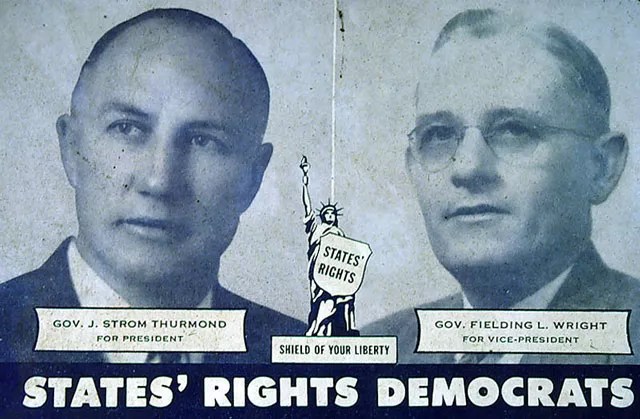
Kefauver understood that this was not just a one-time issue; it was a real fracture within the Democratic coalition. “The dissatisfaction with the Democratic party on the part of a great number of Southerners is growing, he wrote. “Internal differences are raising havoc within our ranks.”
He was also clear-eyed about the source of those internal differences. “At the very crux of this entire problem is the dispute over certain of the civil rights planks in the Democratic platform,” Kefauver stated. “To attract minority blocs, the Democrats adopted a far-reaching civil rights program, which was like waving a red flag in the face of a bull in so far as a majority of the Southern people are concerned.”
Previously, the Democratic party stood firm in support (or at least tolerance) of white supremacy in the South. As a result, even Southern voters with conservative views on many issues continued to vote Democratic. (A good example of this was the Byrd machine in Virginia, which was more conservative than a lot of Republicans at the time, but nonetheless remained nominally Democratic.)
Although Kefauver was more ambivalent about civil rights in 1950 than he would be later, he knew perfectly well what lay behind the “states’ rights” rhetoric employed by the Dixiecrats. For example, he noted that Southerners’ yen to bottle up civil rights bills prevented them from even considering Senate filibuster reform.
“The civil rights issue is so emblazoned on the minds of most of the Southern people,” he wrote, “that the more serious possibility that a resolution to declare war might be filibustered to death by a handful of isolationists is rendered secondary.”
Kefauver correctly pointed out that the situation was painful for everyone involved. The Truman administration struggled to work with Southern committee chairmen who, though theoretically in the same party, often had more conservative views. Southern politicians, meanwhile, had to balance maintaining the Democratic label with appealing to the Dixiecrat sentiments of a large chunk of their constituencies.
Nationally, both parties were fundamentally disjointed, trying to appeal to voters with wildly different positions on issues. “[L]ook at the voting records of the… Democrats from the South,” Kefauver noted. “You will be amazed. Some of them possess records that are more Republican in effect than the records of some Republicans. The reverse is true. The Republican side of the aisle produces many members with liberal ‘Democratic’ records. This, too, is the product of the one-party system.”
Kefauver also pointed out that one-party rule was a breeding ground for corruption. “[P]urity of politics requires competition,” he wrote. “The present one-party system in the South… fosters corrupt political machines and occasional demagogues who do not represent the people in fact.”
The solution to the South’s problems, as Kefauver saw it, was real political competition in the reion. “It is my considered opinion,” he wrote, “that a strong two-party system would bring a realignment of forces in the South.”
He pointed out that the Dixiecrat play was a dead-end strategy, since such a candidate could never gain a national majority. Their only hope was to prevent an Electoral College majority and throw the election to the House, where the bloc of Southern states could bargain for concessions from the major-party candidates (presumably an agreement to slow-walk or stop legislation on civil rights).
On the other hand, remaining loyal Democrats wasn’t paying dividends, either. The party took the Solid South for granted, rarely prioritizing the region’s needs in its platforms or selecting Southern candidates for national office.
But if both parties competed in the South, Kefauver believed, the region’s politics would be much improved. “Instead of factional Democratic primaries involving personalities,” he wrote, “we would see partisan elections involving issues and party philosophies.”
A Cure for Electile Dysfunction?
How might this two-party competition be achieved? Kefauver’s solution was to abolish the Electoral College. At the time, there was a proposed Constitutional amendment before Congress (called the Lodge-Gossett Amendment after its sponsors, Massachusetts Sen. Henry Cabot Lodge and Texas Rep. Ed Gossett) that would get rid of electors and replace the winner-take-all system for each state’s electoral votes with a system that would allocate the electoral votes proportionally to the percentage of each candidate’s votes in that state.
Since this system would make it likelier that no one achieved an Electoral College majority if there were three or more candidates, the threshold for victory would be lowered to 40 percent of the Electoral College votes. Congress (the House and Senate jointly) would only decide the election if no candidate reached that threshold, and they would decide between the top two candidates, reducing the odds for minor-party shenanigans.
Kefauver supported Electoral College reform throughout his career, and I covered his primary arguments when reviewing his 1962 article on the subject. But why would ditching the Electoral College status quo benefit the South specifically?
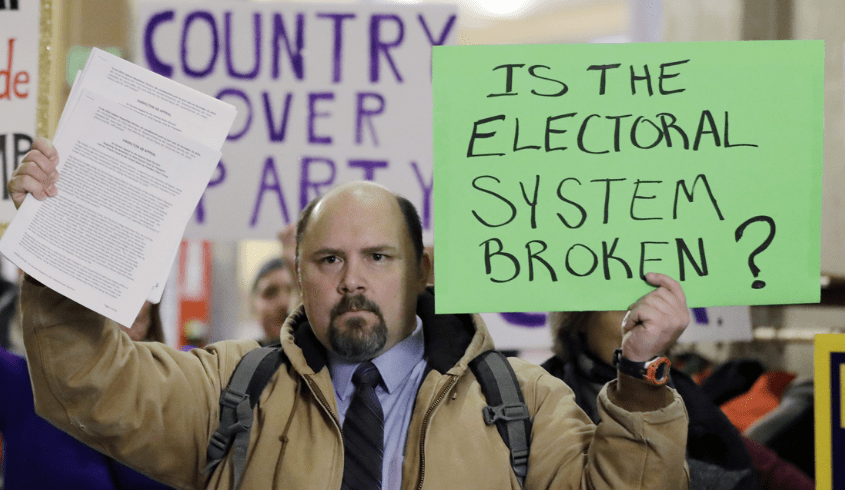
Because it would give both parties an incentive to campaign there. With the winner-take-all electoral vote system, there’s little reason to go to states that are firmly in one party’s camp or the other. After all, there’s nothing to be gained by getting 45% of the vote in a state instead of 40% or even 30% – it adds up to the same number of electoral votes (zero). Our current situation – in which national election regularly hinge on a small handful of “purple” states, while the rest of the country is largely ignored – underscores Kefauver’s point.
But in a proportional system, those votes might be enough to swing an election. “If Democrats had to campaign in rock-ribbed Republican states, and if the Republicans were compelled to seek votes in the Solid South,” Kefauver wrote, “a great educational process would ensue. Candidates and top-flight speakers would visit every state. The issues would be forcibly presented to interest local voters.”
The change wouldn’t just force the parties to up their game. It would also, Kefauver hoped, increase voter engagement. “The individual voter would begin to feel a greater personal responsibility for his government,” he wrote. “He would become a better citizen, and the nation would profit from it. The popular vote would increase immeasurably if the voter felt that his vote was an important unit, rather than a ballot that would not count in the end unless he voted the sentiment of the majority of his fellow citizens.”
Of course, the Lodge-Gossett Amendment would have required abolishing the role of individual electors. For Kefauver, this was a good thing. The idea of electors exercising independent choice in selecting a President was obsolete almost from the beginning, as soon as America developed a party system. But Kefauver also found the idea antithetical to his conception of how American democracy should work.
Kefauver’s essay quoted Thomas Jefferson: “[L]aws and institutions must go hand-in-hand with the progress of the human mind. As… new discoveries are made, new truths discovered and manners and opinions change with the circumstances, institutions must advance also to keep pace with the times.”
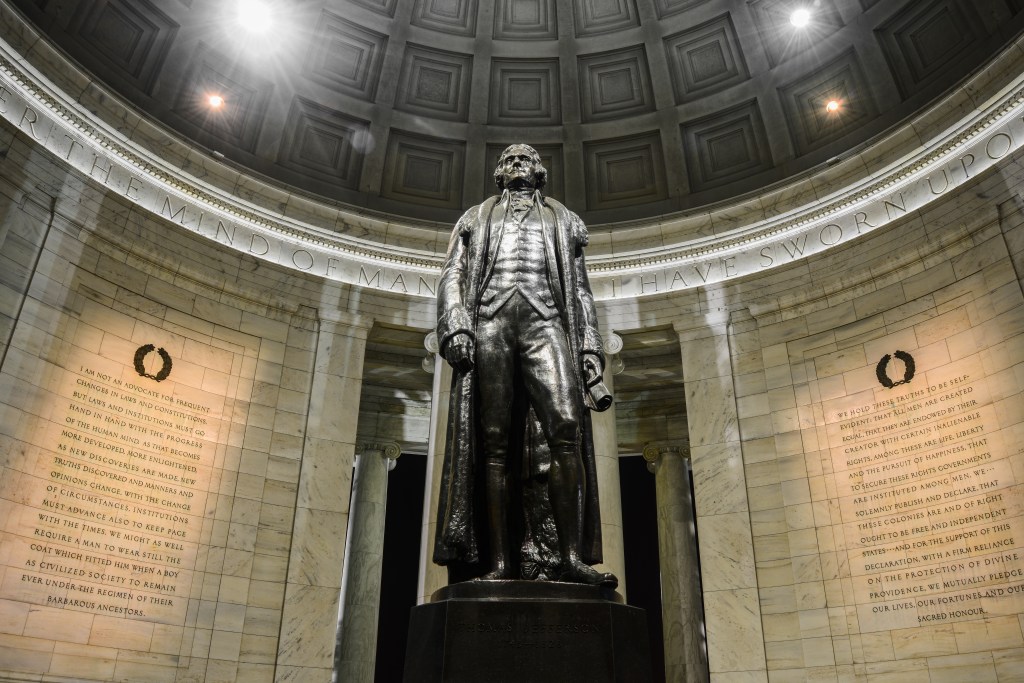
With that in mind, Kefauver felt that “[t]o be entirely consistent with our democratic development, it is essential that more and more authority for the control of our government should pass to the people.”
Kefauver believed that the people were now educated and informed enough to be active citizens. “The twentieth-century media of communication provide the back-hills citizen with as much opportunity to inform himself as the citizen living in the shadow of our nation’s Capitol,” he noted. “Each citizen… is in good position to determine the relative merits of the candidates, the party platforms, their history, and their pledges.”
Looking Back: Was He Right?
Almost 75 years after Kefauver penned this essay, how do his predictions look? I’d say it’s a mixed bag.
The Lodge-Gossett Amendment never became law. It passed the Senate but was never adopted by the House. Subsequent attempts to reform or abolish the Electoral College have met similar fates.
That said, some things that Kefauver forecast came to pass. The South did, for a time, become politically competitive. It started with Dwight Eisenhower’s election in 1952; he captured five Southern states. It accelerated when Lyndon Johnson championed the Civil Rights Act of 1964; that year, the only states Barry Goldwater won outside of his native Arizona were in the Deep South. In 1968, Richard Nixon’s made a point of appealing to disaffected Southern whites.

From the 1950s through the 1990s, the South was competitive. It’s probably no coincidence that multiple Presidents during this era hailed from the region (Lyndon Johnson, Jimmy Carter, Bill Clinton, technically George H.W. Bush). Kefauver was correct that political competition helped the South gain clout nationally.
The party realignment that Kefauver anticipated also came to pass, with liberal Republicans and conservative Democrats slowly going extinct. As for whether more partisan elections would lead to debates over issues and party philosophies rather than factions and personalities… judge for yourself, but I’d say the case is murky at best.
Of course, in the 21st century, much of the South has re-solidified, this time with Republicans as the dominant party. In many states, the Democratic label is as toxic now as the Republican label was in 1950. That said, we’re starting to see signs of another realignment. Virginia, for instance, new leans Democratic, while North Carolina, Georgia, and even Texas are drifting toward purple-state status.
I’d say that today’s Republicans cater more to the South’s regional preferences than the Democrats did in 1950. But that may be a matter of time. The Democrats eventually decided that they could no longer afford to openly support white supremacy, as it cost them too heavily in the rest of the country. The Republicans may someday make a similar calculation regarding issues such as abortion and civil rights for LGBTQ+ people.
Finally, as to Kefauver’s belief that a better-informed citizenry deserved more control of government: I agree philosophically, but I wonder what he would make of today’s information landscape. Today, citizens are flooded with information, much of it false or deceitfully framed. It’s easier than ever to pick and choose information sources that conform to your partisan biases.

Certainly, today’s politically engaged citizens aren’t necessarily having the kind of high-minded philosophical debates that Kefauver envisioned. Studies have shown that our most-informed citizens are often the most partisan. There are too many Americans today who believe that people on the other side of the partisan divide aren’t just misguided, but evil.
Of course, that was also true in 1950, just as it was true in the Founding Fathers’ day. American politics has never been perfect. Just as Kefauver did in his day, we muddle forward with our flawed democracy in our flawed country full of flawed citizens, searching for ways to keep making it a little bit better.


Leave a Reply