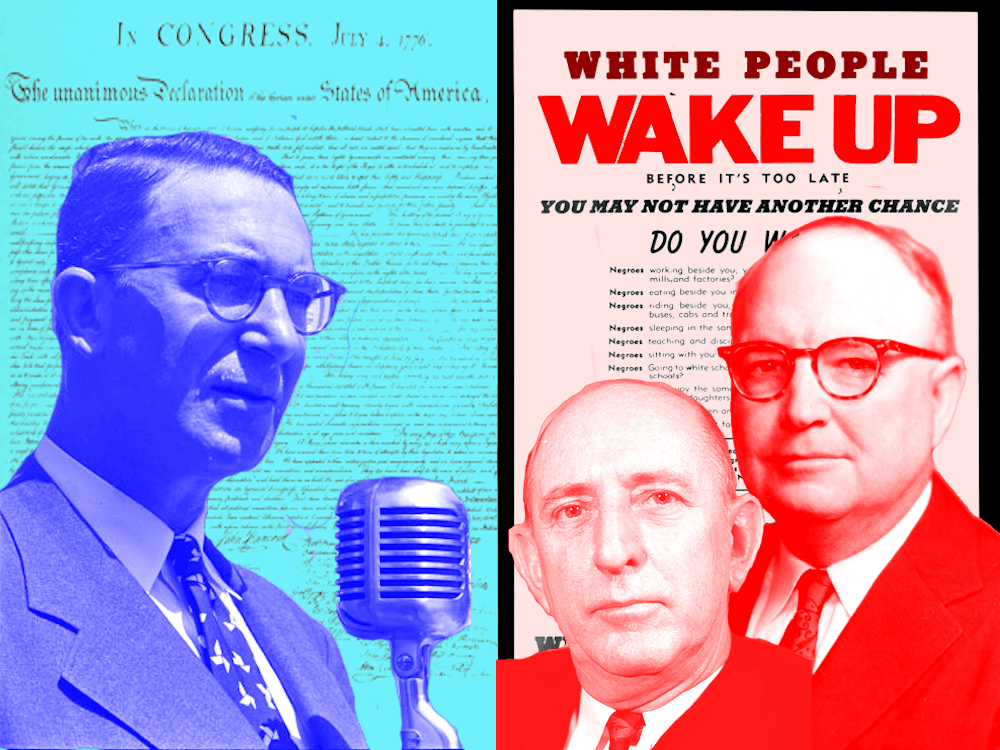
There’s no question that Estes Kefauver evolved on civil rights over the course of his career.
When he first ran for the Senate in 1948, he stated his opposition to President Truman’s civil rights program, with the sole exception of the ban of poll taxes. Eight years later, he was one of only three Southern senators who refused to sign the Southern Manifesto that condemned the Supreme Court’s ruling in Brown v. Board of Education. Four years after that, he was describing the Civil Rights Act of 1960 as “reasonable, constructive, and morally right” and saying “I could not clear it with my conscience” to vote against it.
What prompted this change? Was the Brown v. Board decision a road-to-Damascus moment that caused him to have a dramatic change of heart? Or, as some critics charged, did his Presidential ambitions cause him to abandon his fellow Southerners in hopes of winning votes from Northern liberals?
Actually, I’d argue that his evolution wasn’t quite as dramatic as it appeared. Rather, it was a matter of him following his own principles where they naturally led.

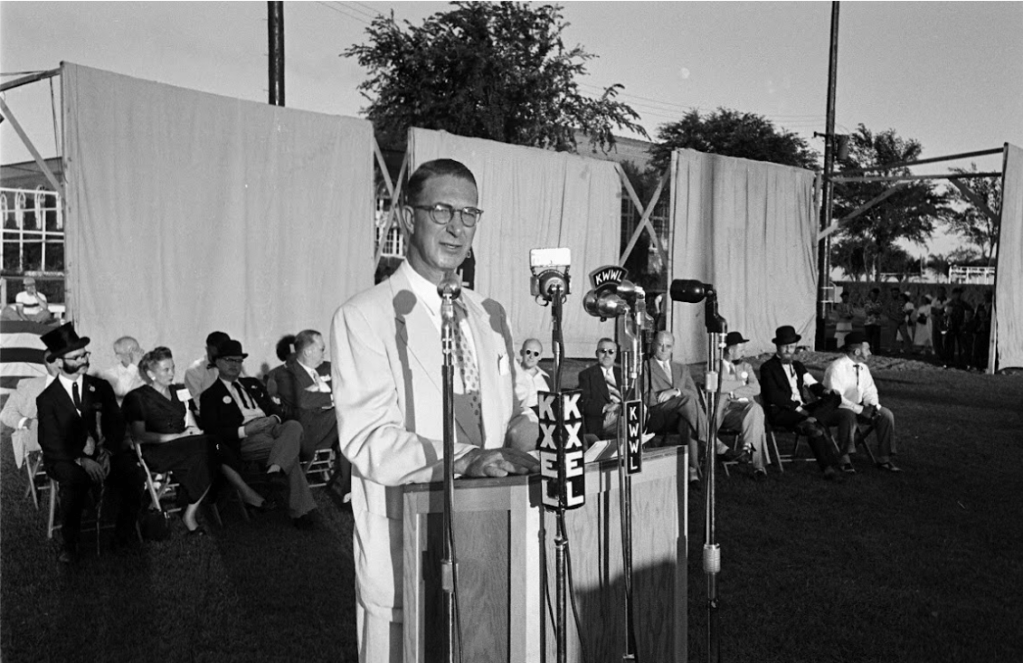
To illustrate this, let’s look at a speech Kefauver gave at a meeting of Young Democrats in Greensboro, North Carolina in February 1950. At this time, Kefauver was still accepting segregation as valid and opposing federal interference on the subject. But even here, he was subtly calling out appeals to racism and challenging the assumptions underlying white supremacy.
In his speech, Kefauver lays out a set of principles for race relations that would ultimately point in one unmistakable direction: the conditions faced by black people in the South were untenable and couldn’t be justified. He wasn’t ready to say that in 1950, but he was already laying out the signposts for the direction he would follow in the coming years.
Kefauver’s direction was the opposite of the one many white Southerners – and especially Southern politicians – took in that era. His direction would isolate him from most of his Southern colleagues in Congress and cause political challenges in his future Senate re-election races.
But that didn’t stop Kefauver from heading that way. He was too intellectually honest – and too committed to his principles – to go anywhere else.
It’s A Southern Thing
The heart of Kefauver’s Greensboro speech was an appeal to his Young Dem audience to embrace their role as future Southern leaders, and to devote themselves to addressing the region’s problems.
“Let us not deny that we have problems, merely because an outsider happens to mention them,” he told his audience. “Let us freely admit that we do have complex problems – let us talk about them frankly – and move courageously ahead to seek their solution. No one has ever condemned the South for refusing to stand still.”

“The South can no longer isolate itself from the rest of the Union,” Kefauver warned. “At a time when national unity in the common sense of peace and freedom is essential, it is imperative that we minimize the effects of the diversity.” He wasn’t referring to diversity in the modern sense, but the fact that Southerners “live, think and act different from our fellow Americans.”
This was the same approach he would use in his “twentieth-century Southerners” speech in the 1956 Florida primary. In both speeches, Kefauver rejected the idea that the South should isolate itself from the nation and cling to a bygone vision from the past, and instead encouraged his fellow Southerners to adopt a forward-looking attitude and take the lead in addressing regional issues.
To the Young Dems in Greensboro, Kefauver enumerated what he saw as the South’s “complex problems.” He cited the South’s domination by one political party (pitching electoral college reform as the solution), and the region’s struggling economy (noting that New Deal programs had given it a boost). Finally, he turned to the issue of race relations.
A very real problem of the South is our social structure, the pattern developed here whereby two races live side by side in relative harmony. It should be obvious to everyone that our customs are traditional, that they will continue to exist until southerners themselves decide to change them. No social custom can ever be altered or changed immediately by law or by force.
This truth should be obvious to those outside the South who demand that we change overnight a system under which we have lived in peace for generations.
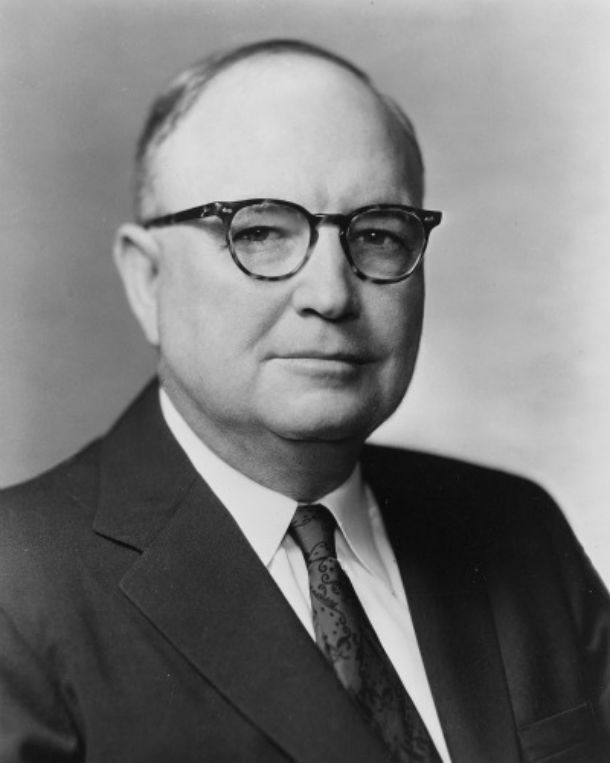
On the surface, this sounds like something Richard Russell or James Eastland might say: Segregation is a Southern tradition, and we’re not going to let a bunch of Yankees tell us what to do, no matter what the law says. One also suspects that Southern blacks would not agree that the races had “lived in peace for generations.”
Look closely, though, and you can see Kefauver painting a different picture.
For one thing, he referred to segregation as a “pattern” and a “social custom,” not an immutable law of nature. He also described that custom as “a very real problem.” This clearly distinguished him from Russell and Eastland, who believed that whites were biologically superior to blacks, and that it was essential and beneficial to both races that whites remain in charge. To Kefauver, segregation was a problematic social tradition that could change – and needed to.
Note also the nature of Kefauver’s complaint about outsiders. He wasn’t objecting to the demand that the South change its social patterns; he objected to the demand that the change happen “immediately.” He argued that segregation would “continue to exist until southerners themselves decide to change” – the implication being that they would decide to change. Eastland, meanwhile, loudly insisted that segregation would never change, and that Southern whites would fight tooth and nail to preserve it.
Kefauver’s framing of the issue showed his savvy understanding of his audience. He knew that if he’d said, “Segregation is wrong and you know it, and it needs to change,” he would have gotten nowhere. Instead, he established that he shared their values: he understood Southerners’ reverence for tradition, their resistance to outsiders telling them how to live, their belief that the existing social customs on race had served them well over time. He wasn’t an outsider lecturing them; he was a fellow Southerner holding a family conversation. By establishing common ground, he could get the audience to hear him out.
Democrats, Not Demagogues
Once he’d built that common ground, Kefauver then introduced a critique:
This truth should be equally obvious to those within the South who resist every effort to better the lot of the minority race – on the false notion that these efforts will disrupt our way of life.
The problem imposed by our pattern of living is that it provides a convenient weapon to oppose any program, however mild, which seeks to benefit the minority race. The fear that we may lose this pattern is a useful instrument for the demagog[ue] who plays upon the passions and prejudices of the people. By a strange coincidence, this fear is an instrument used largely by those southerners who oppose economic and social improvement for the average man of any race.
Kefauver was doing shrewd and careful work here. He wasn’t directly challenging anyone in his audience who supported segregation; indeed, he wasn’t making a moral argument against segregation at all.
Instead, he argued that segregation was a problem because conservatives could appeal to racism to thwart any social or economic programs that would improve people’s lives. It has long been (and continues to be) a popular move to argue against benefit programs by raising fears that a disfavored group will get something they don’t deserve.
Kefauver was hinting at an idea that is a staple of progressive and leftist thought: that the elites use prejudice to keep the people farther down the ladder (in this case, poor and working class whites and blacks) fighting with each other to prevent them from uniting against the elites. He didn’t state it that explicitly, but being willing to go there at all in North Carolina in 1950 – a time when Red Scare hysteria was really beginning to ramp up – took a fair bit of courage.
While Kefauver wasn’t by any means embracing Marxism, he was arguing that it was possible to improve the lives of black people without it automatically leading to the death of the Southern way of life. This was important for two reasons.
First, it demonstrated that New Deal-style liberalism was not incompatible with segregation. This meant that making the Democratic Party more forthrightly liberal – an idea that Kefauver strongly supported – would not kill it in the South.
Second, it reassured the members of his audience who supported improving living conditions for Southern blacks but weren’t ready (or believed the South wasn’t ready) to end segregation that it was possible to have one without the other.
Politicians like Eastland tried to scare Southern whites by claiming that any gain for blacks, no matter how small, was a slippery slope that would inevitably end with the loss of segregation and white social control.
Kefauver, meanwhile, argued that the slope wasn’t so slippery. He said that it was possible to take small steps without committing to the big leap that the South wasn’t ready for. (Whether he was right about that is a question I’ll revisit later.)
A Powerful Idea
Kefauver then explained his vision of a fair Southern society:
Most of us realize that to accord the minority race a full measure of legal justice, and its share of economic, educational, and political opportunity is the only sound basis for the progress of both races. Most of us realize that such goals can be achieved without disrupting, in any manner, the accepted pattern of social relations.
Here, Kefauver was more directly challenging the white supremacists (although as usual, he wasn’t calling them out directly, but arguing that “most of us realize” the rightness of his argument).
He evoked traditional New Deal Democratic principles – that the average man should have a fair “share of economic, educational, and political opportunity” – and pointed out that they should apply to blacks as well as whites. He presented this not as the radical ideology the white supremacists claimed it was, but as a natural extension of the beliefs his audience already held.
He was also pointing out that the legal justification for segregation rested on the idea of “separate but equal.” In order for segregation to remain defensible, “separate but equal” had to in fact be equal. Legally, economically, educationally, and politically equal.
It’s fascinating that Kefauver argued that equality was “the only sound basis for the progress of both races,” as this was the exact inverse of the logic invoked by white supremacists. They claimed that white social control was good for whites and blacks alike, as black people were incapable of governing themselves. Kefauver rejected that idea, and argued that accepting equality was necessary for both whites and blacks to advance.
In his speech’s most eloquent passage, Kefauver named the foundation upon which his concept of equality rested:
I do wish to suggest one underlying principle without which we cannot hope to solve any problem in human affairs on a world basis – on the national scale – or here in the South. That principle is one which, if it were enshrined in the hearts of men everywhere, would wipe out the hatred, the greed and the lust for power which today foster man’s inhumanity to man. That principle lies at the very foundation of our Christian civilization and of our democratic faith.
I refer to the principle that every man – regardless of his color – regardless of his name or origin – has been endowed by his Creator with a certain innate dignity. Every man has a certain value and worth by the mere fact that he is a human being. And when the dignity, the value, the worth of any man on this planet is impaired, the dignity of all men suffers thereby.
As Kefauver stated it, this was such a fundamental idea that it was virtually impossible to dispute. He also wisely grounded it in two belief systems – Christianity and democratic faith – that were foundational for his audience. This wasn’t the word of some supercilious Yankee or meddling federal judge – it was the Bible and the Declaration of Independence.
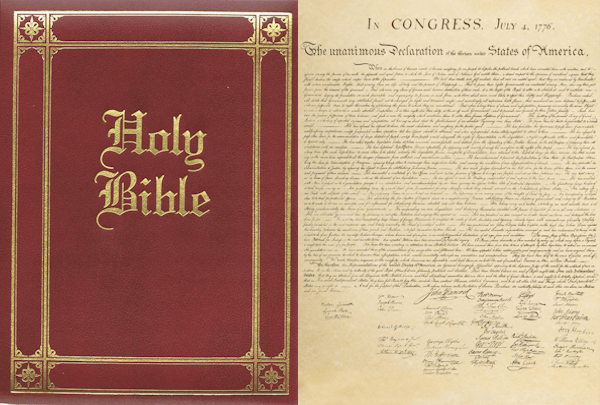
Kefauver pointed out where accepting this principle naturally led. It meant that “every man is entitled to have a voice in the conduct of his government – and that no individual may rightfully enjoy more influence in government than any other.” It meant that “every man is entitled, by his dignity as a man, to an education, to a decent place to live and rear his family, to the benefits of medical science, to perform useful work, and to receive just compensation for it.” It meant that “every man should be free to move as far up the economic ladder as his ability, initiative, and effort will carry him.” It meant that “we need to evaluate each individual for his individual worth – and to judge him by no other standard. There should be no other valid measurement.”
Accepting this principle meant that poll taxes and literacy tests as a qualification for voting had to go. It meant that condemning black children to substandard education in inferior schools was wrong. It meant that racial discrimination in hiring was wrong. And it meant that the belief that blacks were naturally inferior and unfit to govern – the principle that underpinned the white supremacist worldview – was invalid.
“The idea of the essential dignity of man is indeed a simple one,” Kefauver said. “But while we can send a message around the world in seconds, it takes years, generations sometimes, for a single idea to penetrate half an inch of human skull.”
Kefauver was certainly right about that. The next couple of decades would show just how hard-headed Southern whites could be when it came to accepting this simple idea.
A Steady Course Amid the Storm
Speaking in Greensboro that night, Kefauver told his audience, “These principles have general acceptance among the people of North Carolina, which is the major reason North Carolina has won true leadership among the States of the South.” That year’s election would call Kefauver’s assumption of “general acceptance” into question.
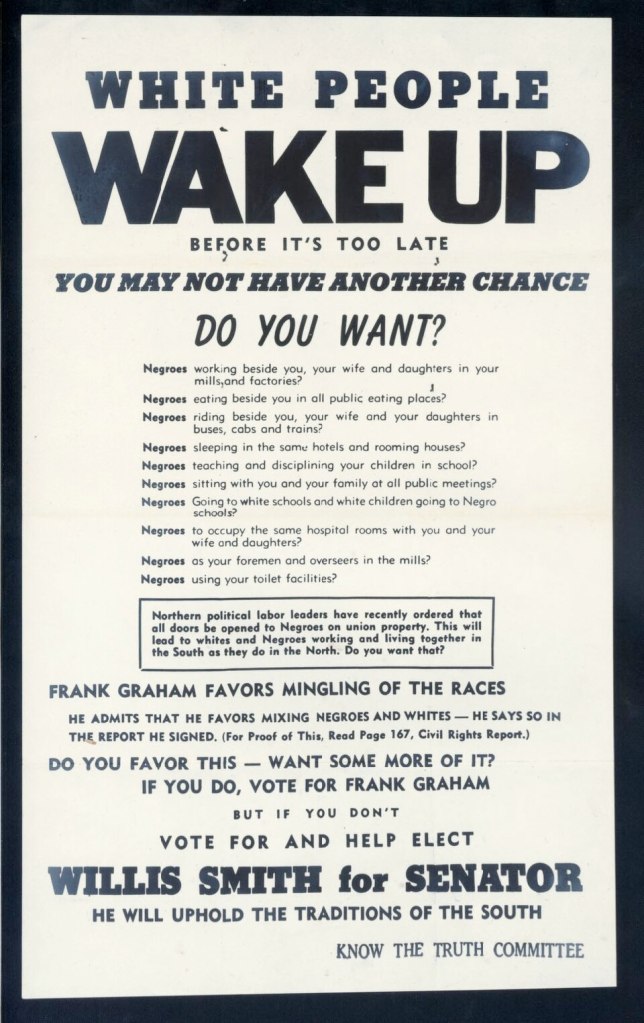
One of the people in the audience for the Greensboro speech was Senator Frank Porter Graham, who embraced the principles Kefauver had mentioned. (In fact, he liked Kefauver’s speech so much that he inserted it in the Congressional Record.) Graham, a former President of UNC, was a staunch liberal who had served on President Truman’s Commission on Civil Rights. He was challenged in the 1950 primary by Willis Smith, a conservative former speaker of the North Carolina House.
Smith ran a vicious campaign accusing Graham of being a socialist and arguing that his election would lead to forced racial integrations. Smith’s supporters – spurred on by his publicity director, the soon-to-be-notorious Jesse Helms – produced flyers reading “WHITE PEOPLE WAKE UP,” and claiming that “FRANK GRAHAM FAVORS MINGLING OF THE RACES.” Smith won the primary narrowly in a runoff.
That same year, another Southern liberal senator, Claude Pepper of Florida, lost in his primary to Rep. George Smathers. Their primary was one of the nastiest in Florida history; Smathers denounced Pepper as “the leader of the radicals and extremists,” and his supporters accused Pepper of favoring integration and interracial marriage.
The defeats of Graham and Pepper showed that the “demagogue who plays upon the passions and prejudices of the people” remained a powerful force in Southern politics. Results like these persuaded a number of politicians who had espoused moderation on racial issues to retreat from those positions, and some – most notably George Wallace and Orval Faubus – became full-throated defenders of segregation.
Kefauver never went either of those routes. The principles he described in the Greensboro speech explained why.
Once the Supreme Court struck down the legal fiction of “separate but equal” Brown v. Board of Education, the claim from Kefauver’s speech that segregation could coexist with equality between the races was no longer viable.
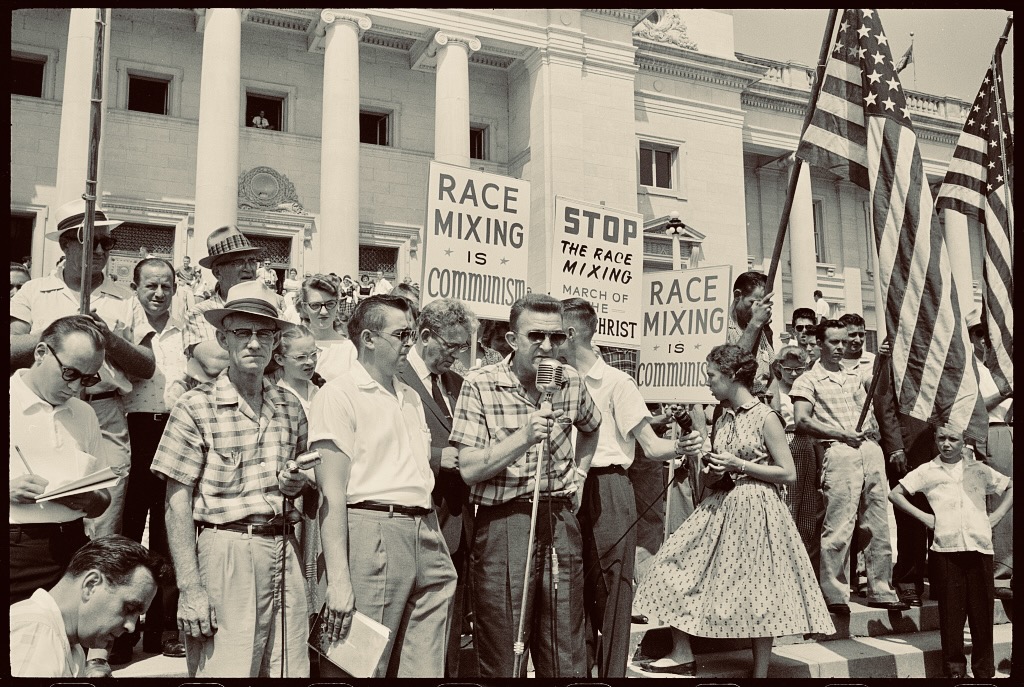
The white supremacists’ fears had contained a kernel of truth all along. The concept of the “revolution of rising expectations” holds that social upheaval spikes not when downtrodden groups are at their lowest point, but when things start to improve. Those incremental gains lead people’s expectations to rise faster than the system can change to meet them. Suddenly, the conditions they once accepted as inevitable now seem intolerable. Once people get a taste of progress and greater freedom, they demand more of it. As it turned out, Russell and Eastland were right that advances in rights for black people – even small ones – would eventually doom the whole system of segregation.
Once “separate but equal” was dead, the South faced a choice between the two. There was no question where Russell and Eastland would land – they’d made clear from the beginning that “separate” was the part that mattered to them, and that they’d never believed in equality between the races.
The Greensboro speech made it just as clear where Kefauver was going to land. To him, equality was the fundamental goal. That couldn’t be accomplished in a segregated society, so segregation had to go.
That was the logic of Kefauver’s argument in 1950. The Brown v. Board decision didn’t change the logic; it just removed the last available hedge that segregation might be compatible with equality. After Brown, Kefauver was increasingly willing to follow the logic to its conclusion – and to say so to his constituents.
Kefauver’s evolution on civil rights may have looked like a dramatic change in direction. But actually, he just kept going where he was already headed.


Leave a Reply