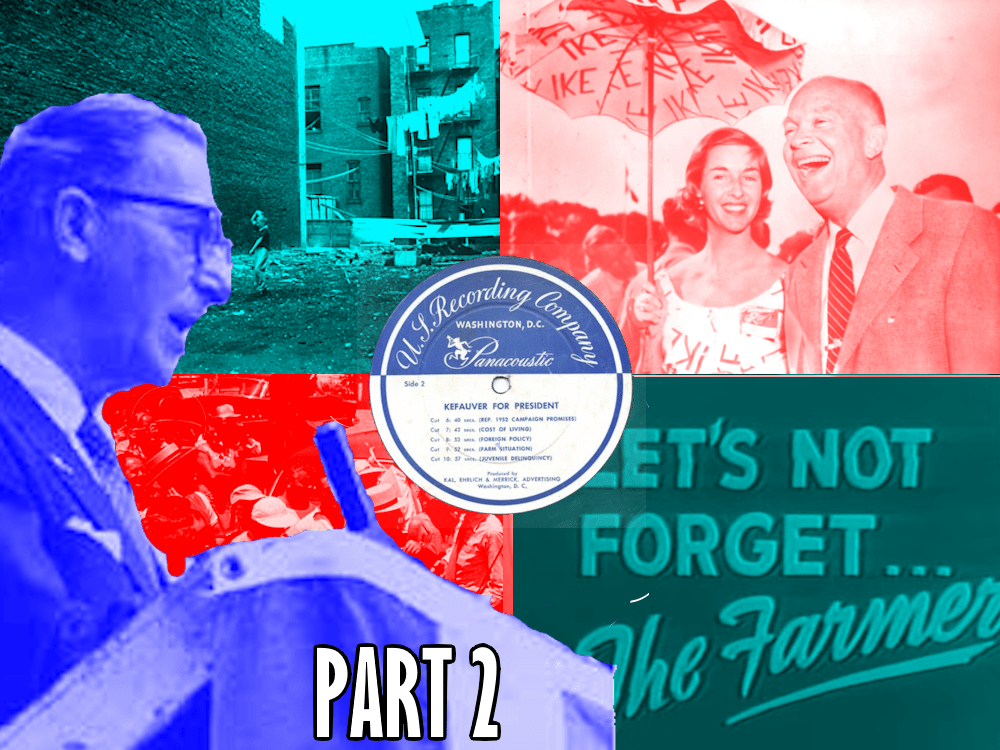
A couple weeks ago, we listened to the first five of a set of ten Kefauver for President ads recorded and released in 1956 by the DC ad agency Kal, Ehrlich, and Merrick. In those ads, Kefauver described his views on small business, the plight of farmers, foreign policy, the Eisenhower administration’s love of big business, and flood control. (If you missed that post, click here.)
This week, we’ll listen to the second set of ads. Some of these covered the same topics as the first set, while others delved into new issues.
The next ad focuses on Eisenhower’s broken campaign promises:
In a preview of the “How’s That Again, General?” ads that the Stevenson campaign would run in the general election, Kefauver accuses the administration of backing away from the promises Ike made in 1952. He claims that the President abandoned promises that he made to TVA, organized labor, and farmers (although he doesn’t say what those promises were).
On the other hand, Kefauver claims, Ike very much kept his promises to big business. He says that “President Eisenhower told the government to get out of business, but opened the doors so that big business had no trouble getting into government.” He even works in a reference to the Dixon-Yates contract (which he didn’t mention by name in the public power ad, oddly).
At the end, he returns to the “even break” slogan that was missing from the last few ads: “It’s time the public gets an even break.”
The following ad goes after the rising cost of living:
The questioner in this ad is again a woman. This isn’t a huge surprise, since women tend to be associated with pocketbook issues, but there’s a twist. Our questioner isn’t a housewife (as she would be in an Eisenhower ad), but a working woman. “I’m making more money now than I made three years ago,” she says, “but I’m deeper in debt. How come?”
Kefauver replies that rising prices can be blamed on the growth of big business. He attacks the strategy of “merge and conquer,” a clever flip of the traditional phrase “divide and conquer.” He claims that the dominance of large corporations is the reason why new car prices, for instance, have risen faster than wages. He says that “our economy is getting dangerously out balance” due to the growing power of big business, and that “we’ve got to do something to stop it in order to keep our free enterprise system,” which is certainly a bold statement.
One other note here: Kefauver refers in his answer to a “third merger trend.” He’s suggesting that America was in the midst of another wave of corporate consolidation, following the previous waves that occurred in the late Gilded Age and during the Roaring Twenties. More recent economic scholarship suggests that his declaration was a bit premature, and that the actual third merger wave began in the mid-1960s, after Kefauver’s death. (I do not think this was a coincidence.)
Next up, we’re back to foreign policy, which was also covered in the first set of ads:
Again, we have a female questioner. (It’s interesting that both of the foreign-policy questioners were women.) She wants to know what Kefauver thinks of our current foreign policy, and how he would improve it.
Instead of picking on Dulles again, he offers some simple principles: “[T]he best thing we can do in our foreign policy is to tell the truth to our friends and to our enemies, to have a straight course in tradition with our own history, and to stick with it.” (Again, the course of the current administration has only confirmed the wisdom of Kefauver’s principles.)
He accuses the Eisenhower administration of “believing their own propaganda.” He then talks about the “Geneva smile,” which is a reference to the summit in the summer of 1955 between the leaders of the US, the Soviet Union, France, and the United Kingdom. The summit led to a (sadly temporary) thaw in Cold War relations, and numerous photos emerged from the summit showing Ike and Soviet leaders smiling.
Kefauver argues that this era of good feeling was largely a PR creation, and didn’t actually bring us closer to world peace. Instead, he argued, alliances like NATO and Atlantic Union and aid programs like the Marshall Plan would bring real peace.
Next, Kefauver returns to farming issues, another topic he covered in the first set:
Our farmer, with a distinct Southern accent, wants to know how Kefauver will ensure that farmers get “a fair share of our economy.” Kefauver replies, somewhat oddly, that “the farm problem will be solved, first, from the heart.” I believe he’s trying to say that an administration that really cares about small farmers, instead of big business, is necessary to address the issue.
As for his policy solutions, they’re the same as in the previous farm ad: rigid price supports and government purchase of surplus crops to feed the hungry. In this one, Kefauver adds the startling fact that farm income had fallen by $4 billion during Eisenhower’s administration. If that’s the case, no wonder farmers were so upset!
The final ad takes on juvenile delinquency:
Given Kefauver’s high-profile hearings on the subject, I figured he’d address it in his ads somewhere. In this one, a woman asks Kefauver about the causes of juvenile delinquency and what the federal government can do about it.
Because the juvenile delinquency hearings have been reduced in historical memory to a show trial about comic books and dirty movies, you might expect to hear Kefauver banging on about the dangers of smut and the need to protect tender minds from pornography and horror comics. But he doesn’t.
Instead, he says that the real cause of delinquency is “our failure as adults to meet our responsibilities to young people.” He argues, incisively, “We cannot be content merely because some children [read: our own children] have good housing, good health facilities, and good schools.”
He promises to work on “opening the doors of opportunity to all Americans, all of our young people in this country, regardless of race, creed, or color.” (That last bit is the only mention of civil rights in these ads.) Most of his answer could be given verbatim by a modern politician, and it would make perfect sense.
So, as I have said before: This idea that the juvenile-delinquency probe was just a dumb moral panic about filthy comics needs to go away. It was a sincere, thoughtful, and multifaceted study of the problems facing young people. And if it failed to produce solutions for the problems it identified… well, we’re still wrestling with those problems, 70 years later.
So, what can we learn from these ads? In a lot of ways, they were a good preview of the campaign that the Stevenson-Kefauver ticket would run in the fall. The ads target farmers and small businessmen, two groups who were presumed to be disenchanted with the Eisenhower administration.
The ads do a good job summarizing the shortcomings of the administration: too beholden to big corporations, betraying its promises to ordinary Americans, and subscribed to a hyperaggressive foreign policy more focused on scoring PR points than on achieving lasting peace.
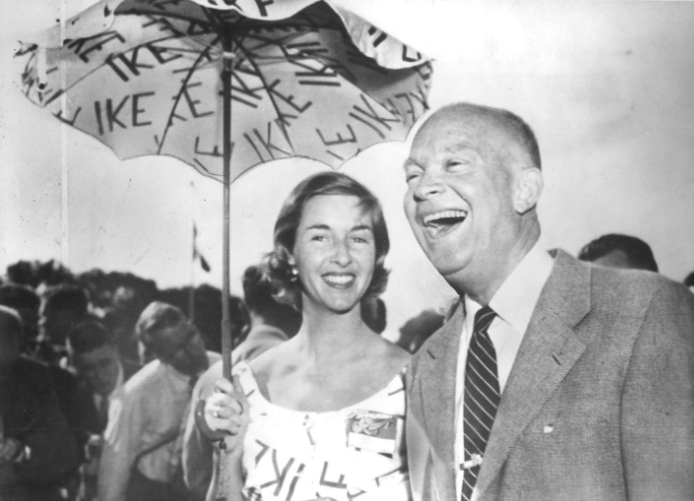
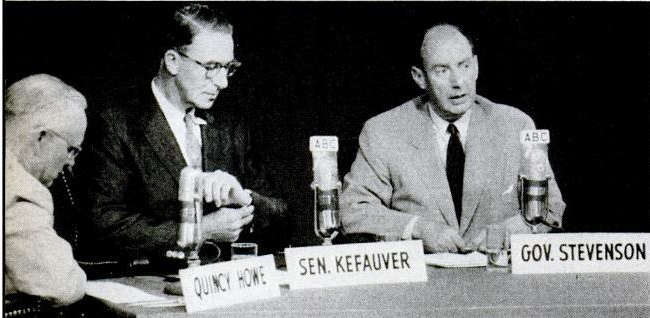
One thing that’s striking to a modern audience: Kefauver doesn’t seem to be trying to draw contrasts with Stevenson, his actual primary opponent. He was considerably more liberal than Stevenson generally, but you’d be hard-pressed to tell that from these ads. You’d also be hard-pressed to tell it from the campaign in general; look at their debate in Florida, in which the two men seemed determined to agree on virtually everything.
Part of this is an artifact of the times; the idea of running an aggressive campaign against someone from your own party would have been frowned upon. (Indeed, when Kefauver made what seems today like a minor attack on Stevenson’s record as governor in Illinois, he received widespread criticism.)
Another part of the reason is that, unlike today, the Democratic primary electorate was not uniformly liberal; calling yourself out as being to the left of your opponent might help you in some states and hurt you in others. As such, both Stevenson and Kefauver had incentives to be vague and generally moderate on many issues (civil rights being a notable example).
That said, looking closely at the ads, there’s one area where Kefauver is openly to Stevenson’s left: on monopoly and antitrust issues. Certainly, Stevenson would never have argued that corporate mergers were threatening the American system of free enterprise, or that concentrating too much power in the hands of large corporation would imperil the political liberty of the people. So even though he didn’t explicitly draw the contrast with Stevenson there, an attentive voter would see the difference.
Also, in comparison to the 1952 campaign, you’ll notice one topic missing: crime and corruption. That was a major theme of Kefauver’s previous run, and yet not one of these ads mentions it.
You might think this is because the Truman administration was notorious for its scandals, while Eisenhower’s administration was clean. There’s something to this, but Ike’s reign was hardly scandal-free; the Stevenson-Kefauver campaign would include an ad in the “How’s That Again, General?” series pointing out the administration’s ethical lapses.
The primary reason, I believe, is that both Kefauver and the country were in a different place than they were four years ago. At the time, thanks to Kefauver’s organized crime hearings and the Truman scandals, there was a lot of public focus on crime and corruption at all levels of government. Also, Kefauver was primarily known to the public then as a crime-buster, so naturally his campaign sought to leverage that advantage.
By 1956, however, crime and corruption were no longer front-of-mind issues for the public, and Kefauver wisely chose not to focus on them. Instead, he focused on issues that the public was concerned about: farm prices, inflation and the cost of living, the Cold War and the risk of nuclear annihilation.
Unfortunately, the ads – and the strategy they were part of – didn’t pay off. Stevenson clobbered Kefauver in California, effectively dooming the Tennessean’s campaign.
For most of the campaign, Kefauver forced Stevenson to compete on his terms: taking to the streets, shaking hands, campaigning actively. But in California, Kefauver had to play against Stevenson’s strengths: namely, money and organizational support. And in those areas, Kefauver just couldn’t compete.
 Estes Kefauver for President
Leave a comment