
All right, it’s time to talk about the juvenile delinquency hearings.
No account of Kefauver’s Senate career would be complete without mentioning his role as chair of the Senate’s delinquency probe from 1955 to 1957. But I’ve been reluctant to write about it, for three reasons.
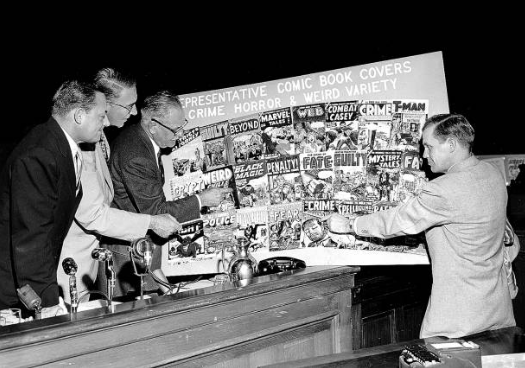
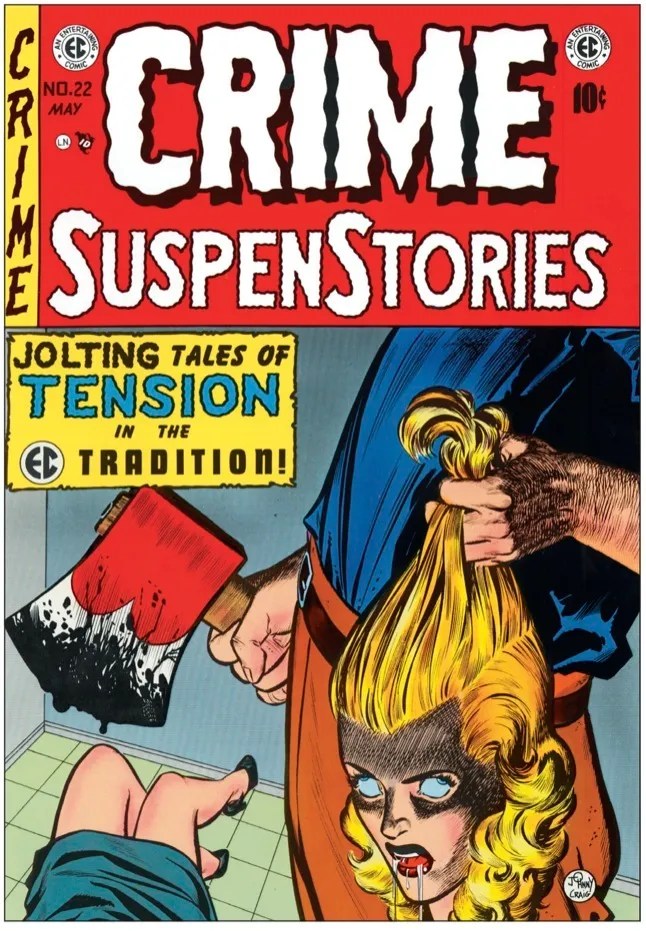
First, the hearings are generally held in low regard today. The prevailing narrative is that they fomented a moral panic over an imagined wave of teenage misbehavior, and led to draconian censorship and harassment of innocent people, particularly in the area of comic books. To the degree that Kefauver is remembered negatively today, it’s mostly from angry comic book fans who blame him for the Comics Code Authority, a regime of self-censorship that the industry imposed as a response to the hearings.
Second, Kefauver’s chairing of these hearings seems to reinforce the primary criticisms of him as a Senator. He took the chairmanship in part to boost his visibility for his Presidential campaign the following year. (The fact that he gave up the chairmanship in 1957, after his bid failed, only furthers this impression.) Those who believe that Kefauver was a publicity hound driven by ambition and a desire to get his name in the media often point to these hearings as evidence.
Finally, the juvenile delinquency probe was so long-running and wide-ranging that it’s hard to write a coherent story about it. The subcommittee continued long after Kefauver’s involvement, and his life; it existed in one form or another until 1986. Given the length of its existence and the broad scope of its topics, the juvenile delinquency subcommittee defies simple answers as to what it was about or what it accomplished.
So rather than writing a traditional article about these hearings, I’ll take a different tack. I’ll describe some of the popular myths about the juvenile delinquency probe, and then explain why those myths are exaggerated or just plain false.
Myth #1: The juvenile delinquency probe was Kefauver’s idea.
Although the hearings are often associated with Kefauver, he did not propose them, nor did he chair them initially. The Senate formed the Special Subcommittee on Juvenile Delinquency in April 1953, adopting a proposal put forth by Republican Senator Robert Hendrickson of New Jersey.
According to Hendrickson, the subcommittee’s primary goal was to study the causes of increased gang activity and drug use among young people. “As a nation, we must find out what is causing this increasingly serious problem and what can be effectively done to prevent it,” Hendrickson told the New York Times.
The subcommittee initially consisted of two Republicans (Hendrickson and North Dakota’s William Langer) and two Democrats (Kefauver and Missouri’s Thomas Hennings). Hendrickson initially served as chair; when the Democrats regained control of the Senate after the 1954 midterms, Kefauver took over. The infamous comic book hearings occurred in 1954, before Kefauver became chairman.
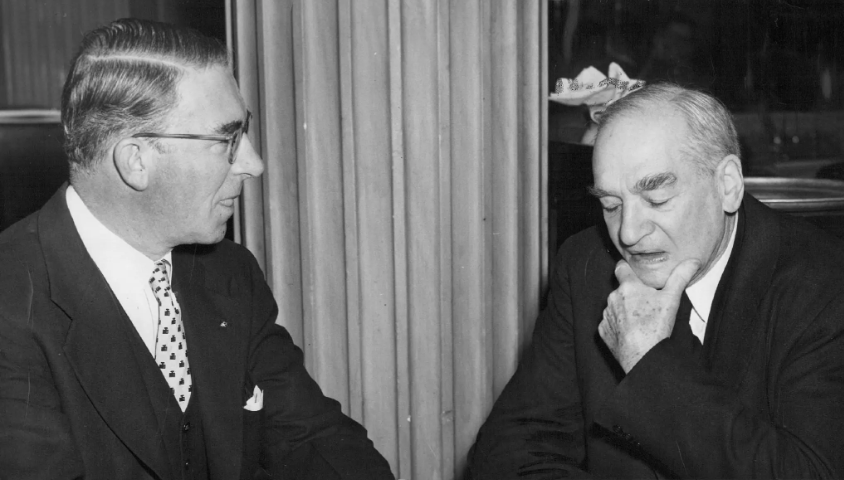
So why is Kefauver so firmly connected to the subcommittee? Well, he was the most famous Senator on the subcommittee, due to his previous work on organized crime and his Presidential run. Also, Kefauver was the most prominent questioner during several hearings – including the comic book hearings – even when he was not the chair.
Myth #2: Kefauver only feigned interest in juvenile delinquency to drum up attention for his Presidential bid.
There’s no question that Kefauver hoped to use the probe to get his name back in the public eye. He had been quiet nationally after being denied the Presidential nomination in 1952 and after the Republican took control of the Senate that same year. Juvenile delinquency was a popular topic in the cultural consciousness, becoming even more prominent after the release of movies like “Blackboard Jungle.”
Citing Kefauver’s involvement in this and other investigations, Time magazine wrote, “Among Washington’s politicians and pundits there is no doubt about what Estes Kefauver is up to. He is running hard for his party’s presidential nomination… and that means that he must keep his name and face before the U.S. over a long pull.”
That said, Kefauver’s interest in juvenile delinquency was sincere. He had begun looking into the topic toward the end of his organized crime probe, when he surveyed local police departments and crime commissions on the possible contributing factors to the rise in crime among young people.
By most accounts, Kefauver worked hard on the probe. And although he did relinquish the chairmanship in 1957 – to become chair of Judiciary’s Antitrust and Monopoly Subcommittee, a post he had long cherished – he remained on the juvenile delinquency subcommittee for several years.
Why was Kefauver so concerned about juvenile delinquency? For one thing, he was concerned that juvenile criminal offenders would grow up to be adult offenders. As he said in one press release, “[W]e must do all within our power to rehabilitate those youngsters who have violated the law and, if not helped, will become tomorrow’s hardened criminals.”
But he also had a wider concern. He described juvenile delinquency as “a symptom of the weakness in our whole moral and social fabric.” The concept of a “moral and social fabric” was important to him. Ever since the crime hearings, Kefauver had expressed his faith in the people to keep America on the right track.
A public with a clear moral sense and the strength and interest to act against injustice and wrongdoing were central to his understanding of America. In his words, “Apathy, the lack of interest on the part of the people of the local community, is the biggest enemy that we have.”
Myth #3: The hearings were focused primarily on the comic book industry.
Virtually every modern story about the juvenile delinquency hearings leaves the impression that violence in comic books was the subcommittee’s sole focus, or at least their primary focus. Even the Wikipedia entry on the subcommittee mentions only the comic book hearings, as though this was their only subject.
But this is a huge misconception. Although the comic book hearings are the best remembered portion of the subcommittee’s work, it was only a small piece.
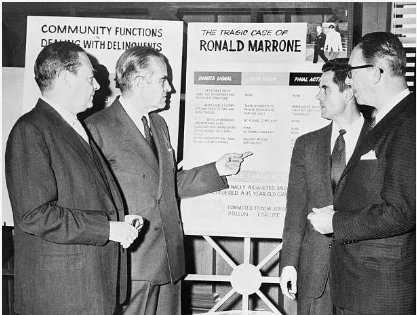
The hearings covered a wide variety of topics. During Kefauver’s tenure as chair, the subcommittee also looked at sex and violence in the movies and television, narcotics use among teenagers, youth employment, delinquency among Native American youths, the rise in gang activity, and the market for illegal adoptions.
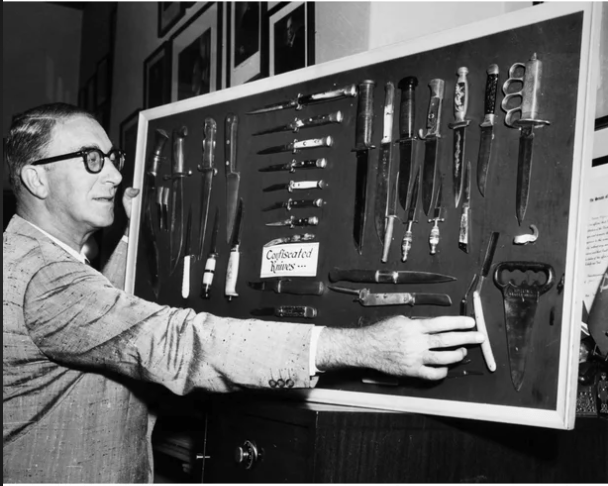
Throughout their run, the subcommittee produced dozens of reports on these subjects and more; only one report was devoted to comic books.
So those who are tempted to think that the goal of the probe was to “get” the comics book industry should reconsider. If anything, the probe covered such a wide swath of topics that it was difficult for them to reach definitive conclusions.
Myth #4: Kefauver and the subcommittee believed that sex and violence in comics and other media were the primary cause of juvenile delinquency.
Related to the previous myth, many people believe that the point of the hearings was to blame crime and horror comics for juvenile delinquency. Essentially, they envision the subcommittee as a bunch of blue-nosed pearl-clutchers, the sort of people who would refer to rock-and-roll as “the devil’s music.”
This is a ridiculous caricature of the subcommittee’s approach to the problem. Both Kefauver and the other members understood very well that juvenile delinquency was a complex problem. As their 1955 report on the comic book hearings stated, “Responsible observers of the American social pattern are in general agreement that juvenile delinquency has many causes, not just one.”
One mistake many people make is to conflate the subcommittee’s views with those of Dr. Frederic Wertham, who is frequently cast as the villain in this saga. Wertham was a psychiatrist whose 1954 book “Seduction of the Innocent” argued that comic books caused juvenile delinquency. He believed that comic books should be illegal for sale to children under 15.
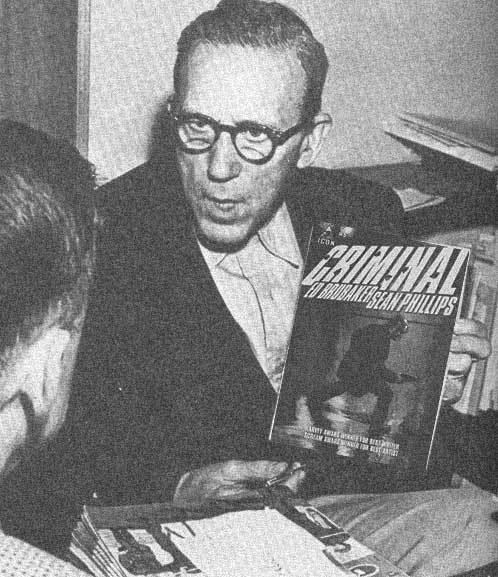
Critics over the decades have pointed out numerous flaws in Wertham’s presentation of his research, and his argument was more than a bit hysterical. (In fairness, his arguments against comics weren’t just about sex and violence; he also called them out for racism and misogyny, criticisms that would be much more warmly received by modern audiences.) He really did say to the subcommittee, “I think Hitler was a beginner compared to the comic book industry,” which is an utterly absurd and hyperbolic statement.
The subcommittee did listen to Wertham’s testimony, and their 1955 report cited his concerns several times. However, they did not just uncritically accept his argument. The subcommittee interviewed numerous other psychologists, many of whom disagreed strongly with Wertham’s opinions, and their views are also included in the report.
The subcommittee report stated explicitly, “Majority opinion seems inclined to view that it is unlikely that the reading of crime and horror comics would lead to delinquency in a well-adjusted and normally law-abiding child.” Wertham would have disagreed strongly with that statement. And in the end, the report does not conclude that comic books are responsible for juvenile delinquency; instead, it concludes that more research is needed.
Some critics acknowledge that the subcommittee’s findings were considerably more nuanced than Wertham’s book, but still blame the subcommittee for calling him to testify, blaming the televised hearings for whipping up hysteria. But the idea that they would not receive testimony from a prominent psychiatrist who had written extensively on the subject of comic books seems far-fetched.
Myth #5: The subcommittee threatened to censor the comic book industry, forcing it to censor itself.
Comic book fans who detest the Comics Code often claim it was forced on the industry by the subcommittee. Essentially, they argue, the subcommittee told the industry that it had to censor itself, or the government would censor them.
Again, this view is badly misguided. Government censorship of comic books was never on the table with the subcommittee.
How do I know this? Because the subcommittee said so, repeatedly.
Senator Hendrickson kicked off the comic book hearings with these remarks: “I wish to state emphatically that freedom of the press is not at issue in this investigation. The members of this Senate subcommittee… are fully aware of the long, hard, bitter fight that has been waged through the ages to achieve and preserve the freedom of the press, as well as all the other freedoms in the Bill of Rights, which we cherish here so dearly in America.”
The introduction to the subcommittee’s comic book report echoes Hendrickson’s opening statement and states explicitly: “The subcommittee has no proposal for censorship.” Later on, in case anybody missed the point, the report states again: “The subcommittee flatly rejects all suggestions of governmental censorship as being totally out of keeping with our basic American concepts of a free press operating in a free land for a free people.”
Speaking to interviewer Paul Coates on the TV show “Confidential File” in 1955, Kefauver also rejected the idea of government censorship of comics. “I think the dangers are that if you start censoring comic books,” Kefauver said, “it might lead onto censoring other things that might encroach on our Constitutional freedom of the press.”
That said, the negative publicity from the comic book hearings clearly led to the creation of the Comics Code Authority, and the subcommittee praised it in their report. But such a code of standards was hardly novel or unique.
The movie industry had been operating under the Motion Picture Production Code (also known as the Hays Code) since the 1930s. And the still-new television industry had developed its own code, put forth by the National Association of Radio and Television Broadcasters, in 1952.
The Comics Code Authority wasn’t even the comic book industry’s first attempt at self-regulation. In 1948, the Association of Comics Magazine Publishers attempted to regulate the content of comic books, also in response to public criticism. But most publishers declined to participate, and those who did just slapped on the seal of approval without going through any review.
Obviously, the strictures of all those codes look quaint and ridiculous today. But the idea that the Comics Code was unusually draconian or restrictive for its era seems off base.
Myth #6: The subcommittee did not actually propose any solutions for juvenile delinquency.
One of the criticisms of the juvenile delinquency hearings was also lobbed at Kefauver’s organized crime hearings in the early ‘50s: that they did a good job dramatizing the problem, but were short of solutions.
But this too is an unfair criticism. One of the goals of the hearings was to encourage public discussion on the many factors contributing to juvenile delinquency, and inspire people and communities to push for solutions. As The Atlantic wrote in 1955, “The value of the current Kefauver committee lies in the spot light it can throw on the problem, in the encouragement it can give those dedicated to meeting it, and in the additional legal weapons it can help forge on both the national and local levels of government.”
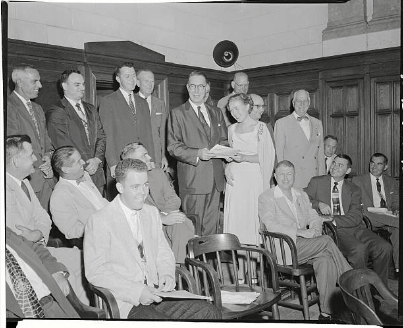
And if fact, the subcommittee proposed numerous potential laws to address issues raised in the hearings. In 1955 alone, they introduced a total of 18 bills. Several of those were aimed at tightening the laws against pornography, but others provided assistance to states to strengthen their anti-delinquency programs, created tax breaks for foster parents, stepped up enforcement of child support orders, and cracked down on illegal adoptions through “baby brokers.”
One bill that Kefauver strong supported would have created a federal Office of Children’s Affairs to increase the visibility of these issues at a national level. Other bills that he introduced or co-sponsored increased after-care for narcotics addicts, provided more federal aid for housing and education, and established forestry camps where young delinquents could be rehabilitated.
Unfortunately, most of the bills were not adopted. The one adopted bill closed a loophole in the laws against sending obscene materials across state lines. But the fact that most of the subcommittee’s bills were not adopted should not be held against them.
And some bills would be adopted later on. For instance, in 1961, John F. Kennedy proposed providing grants to states, cities, public agencies, and nonprofits to fund studies, pilot projects, and training programs aimed at combatting juvenile delinquency. This time, Congress approved the proposal. It was neither the first nor the last time that the Kennedy administration would adopt an old Kefauver proposal as its own.
Conclusion: The Narrowing, Distorting Lens of History
As I’ve mentioned several times before, in the process of converting current events into history, we tend to leave out a lot. Because the juvenile delinquency probe went on for so long and few of its recommendations became law, it’s no surprise that a lot of it has been forgotten. And it’s also no surprise that the part that is remembered is the part that impacted a very passionate subculture (namely, comic book fans).
But when a passionate subculture takes ownership of a piece of history, they tend to remember it in a way that flatters them. That’s a natural human tendency, certainly. But just because someone tells you a story with great passion and conviction, that doesn’t make it entirely true.
As Louis Menand wrote in 2008 in a look back at the comic book hearings, modern audiences tend to find the “outrage and alarm over comic books psychologically simplistic and politically opportunistic. But this is winner’s bias. Other people’s culture wars always look ridiculous.”
Menand is right. In the end, the people who favored a more open and permissive culture won out. And as a result, the very real concerns that many people had about juvenile delinquency in the mid-20th century get collapsed into caricature and their views twisted beyond recognition. The story that comic books fans tell about the probe is, in its way, just as hyperbolic as Wertham’s anti-comics screeds.
Numerous times while researching this piece, I saw attempted parallels between the comic book hearings and McCarthyism. Because those things occurred at roughly the same time, it’s easy for modern audiences to commingle them. But the comparison is, frankly, offensive.
Estes Kefauver was no Joe McCarthy. Not only was he firmly opposed to McCarthy and his Red Scare tactics, but he was firmly on the side of people who questioned the status quo, who championed unpopular ideas, who didn’t fit in with the mainstream.
In May 1954, not long after the first round of comic book hearings, Kefauver gave a speech to the Oklahoma Jaycees on “Youth’s Challenges Today.” If you believed the myths, you might imagine that this speech was about the importance of clean living and avoiding those dangerous, scary comic books that might poison young minds. You’d be wrong.
In fact, he offered encouragement to young people mad about the status quo. “I do not know if anyone ever made a survey of the instances in which great evils of society have been corrected,” he said. “But I am persuaded that such a survey would show that most of the improvements were brought about because youth got mad and did something about it.”
Kefauver also spoke stirringly about the importance of free thinking. “Our survival as a breed of free men demands renewed determination to keep our minds as well as our bodies free from regimentation,” he said. “For that, we need an unquenchable spirit of youthful rebellion.”
He pointed out that intolerance of dissent was antithetical to the American spirit. “I think it is curious that a nation like ours, which owes its birth and its genius to highly unorthodox ideas,” he said, “should be pushed into a position of hostility to any kind of intellectual deviation. Yet, that is what we face today. Men who do not share the narrow views of the noisy minority are pilloried for their thoughts, rather than their actions.”
How could a man who championed youthful rebellion and intellectual freedom, you might think, also be worried about violent comic books? The seeming paradox leads many people to write off the comic-book concerns as political opportunism. But to Kefauver, a society that encouraged free thinking and expression could still uphold standards of decency. If that doesn’t make sense to us, perhaps we’re the ones who don’t understand.


Leave a Reply