
It’s been a while since I did a post on an Estes Kefauver song. Previously, I’ve discussed how Kefauver – during his televised hearings on organized crime and his first run for President in 1952 – was a genuine cultural phenomenon. Numerous groups and artists, whether out of genuine admiration or a desire to latch onto his sudden fame, wrote songs in his honor. (And Kefauver reciprocated, making use of country music acts in his campaigns for office.)
Unlike some past songs I’ve covered, the one I’m writing about today – “The Long Tall Guy in the Coonskin Cap” – became an official Kefauver campaign song. But this isn’t just the story of a song; it’s the story of a spunky singer-songwriter who arguably got more mileage out of Kefauver’s ‘52 campaign than he did. How’d she pull it off? She charmed DC’s movers and shakers in a way that Kefauver himself never could.
Meet Hank Fort.

Born to Be Artsy
Granted, “Hank Fort” sounds like an unusual name for a woman. And the woman whose name it was had a talent for attracting attention.
She was born Eleanor Hankins in 1908 (she acquired the nickname “Hank” in college and used throughout her life). She seemed destined for a career in the arts; her father Cornelius Hankins was a famed portrait artist, while her mother Maude painted watercolors and wrote poems for children.
When Hank was 20, she married an insurance man named Walter Fort and settled down in Nashville. “Settled down” may not be the right word, as Hank was by all accounts a bundle of energy. She directed the local children’s theater and started a ballroom dancing school. And befitting her hometown, she wrote songs.
Most of Hank’s songs were humorous novelty tunes, written from her Southern point of view. For instance, here’s “Put Your Shoes On, Lucy,” which was recorded by Petula Clark in 1949:
And here’s “I Didn’t Know the Gun Was Loaded,” a minor hit for the Andrews Sisters:
Probably her most well-known song – at least at the time – was “Save Your Confederate Money, Boys (The South Shall Rise Again)”:
Hank never thought she’d become famous as a singer; by her own admission, she didn’t have the greatest voice. But during a trip to New York City in her early 40s, she visited a nightclub with some friends, who apparently prodded her to go on stage and sing her songs. (I doubt she needed much prodding.)
As the story goes, Hank’s open-mike performance impressed the club’s owner, who offered her a two-week gig. And from there, she began performing at hotels and clubs along the East Coast.
Hank Hitches Her Star to Kefauver
At the beginning of 1952, Hank was performing the floor show at Washington’s Statler Hotel. Knowing that she had a politically-minded audience, she rolled out a new song, one that paid homage to a rising politician from her native Tennessee.
If there’s more law and order
In each town on the U.S. map
A major reason why
Is a long tall guy
In the coonskin cap.
All the crooks and the hoodlums
Know they can’t ever beat the rap
Because there’s no defyin’
The long tall guy
In the coonskin cap.
Kefauver wants law for us all in the U.S.A.
So the rich and the poor can be sure –
To live in peace the American way.”
When the long struggle’s over
And we find we have breached the gap
Surely you and I won’t let the chance go by
To thank the genial chap
That lovable long, tall guy
In the coonskin cap.”
The song was an instant hit. The audience called for her to sing it again during her second set, and it brought down the house both times.
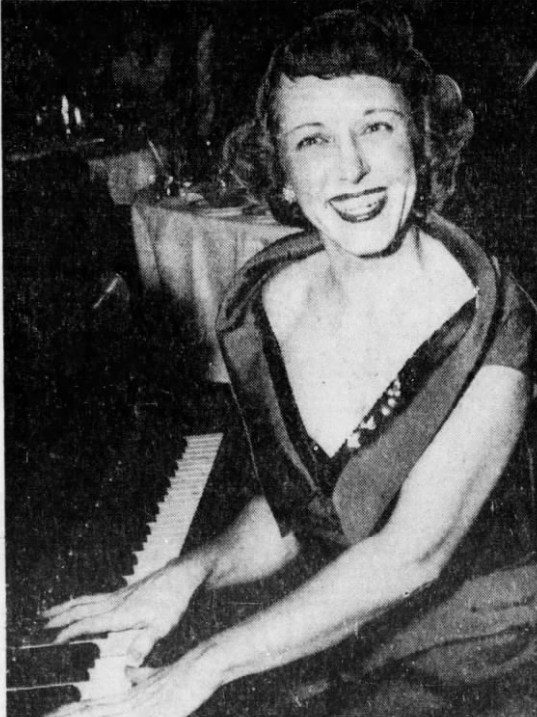
Recognizing the possibilities, Hank sent a copy of the lyrics to Kefauver’s Senate office. Later in the week, he showed up at the Statler with a delegation of fellow Tennesseans to hear the song in person. Clearly, he liked what he heard.
Meanwhile, Hank was already thinking about next steps. “Mrs. Fort is convinced her song can be adapted for campaign purposes,” reported the Chattanooga Daily Times, “and is hoping that her favorite senator is able to make the most of it.”
But how would the song play outside the nation’s capital? Hank found out in February, when she had a two-week engagement at the Radisson Hotel in Minneapolis. She indicated that she’d sing “Long Tall Guy” there “if anyone shows interest in the Kefauver candidacy.”
She found the Minnesota audience was indeed interested in Kefauver, and the song was the biggest hit of her show. But Hank herself was perhaps the greatest hit of all.
“The female fireball has not only a sense of humor but a sense of fun,” wrote John R. Sherman of the Minneapolis Star, “and she isn’t out on the floor two minutes before the audience is rockin’ in rhythm with her.”
As the year rolled on, the fame of Hank Fort – and “Long Tall Guy” – only grew. In April, during a high school band concert in Chattanooga, two local students named Barbara Denney and Betty Brown performed “Long Tall Guy” with their high school’s 20-piece swing band. The following week, they traveled to Nashville to perform the song with Hank on television.
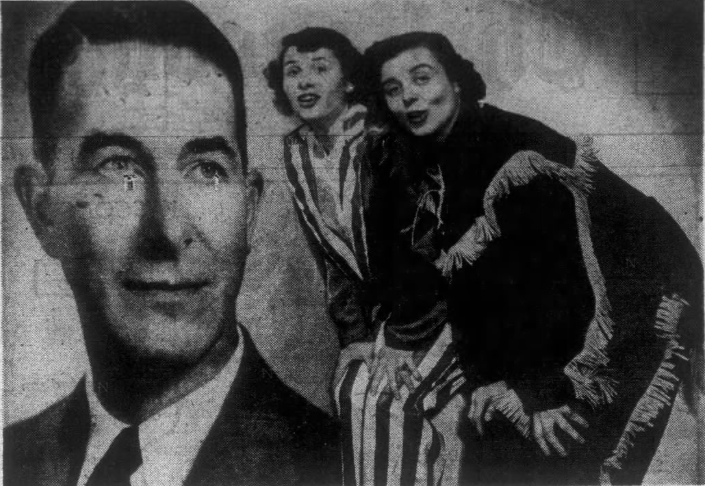
Meanwhile, Hank noticed that Nancy Kefauver was charming the crowds at her husband’s campaign stops. So she wrote a song in honor of Mrs. Kefauver, entitled “Everyone’s Taken a Fancy to Nancy.” Hank’s new song proved just as popular as “Long Tall Guy.”
In early May, Hank went to legendary country producer Owen Bradley’s studio to cut a record of “Long Tall Guy” and “Everyone’s Taken a Fancy to Nancy” along with a 16-piece band. The campaign distributed the records to Kefauver-for-President clubs around the country and played them at campaign rallies (when Hank wasn’t there to perform the songs herself, as she often was).
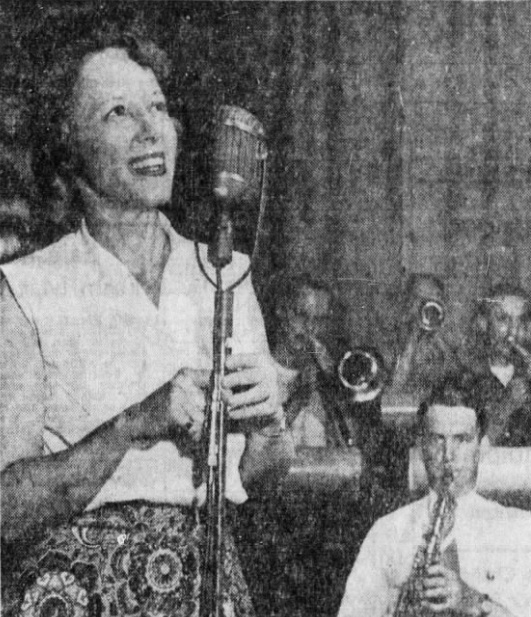
At the Democratic convention in Chicago that July, Hank’s songs were featured prominently at the Kefauver campaign’s hospitality suite at the Conrad Hilton hotel. “Long Tall Guy” and “Everyone’s Taken a Fancy to Nancy,” along with “The Senator from Tennessee,” were played on continuous loop over loudspeakers, and the campaign offered sheet music for the songs as well.
From her box on the convention floor, Hank saw the enormous demonstration that erupted when Kefauver’s name was placed in nomination. The band played both “Long Tall Guy” and “Fancy to Nancy” as Kefauver’s supporters cheered and waved banners with slogans like “We’re Elected – Not Bosses” and “Estes Is Bestes.”
Kefauver’s Star Fades, But Hank Keeps Rising
Sadly, Kefauver’s dreams were dashed when the convention chose Adlai Stevenson. But Hank Fort’s dreams were just taking flight.
As a result of the fame from her Kefauver campaign songs, Hank received bookings at Carnegie Hall, the Hollywood Bowl, and other famous venues. She also made the rounds on radio and TV.
When the campaign was over, Hank didn’t go back to Nashville. Her marriage to Walter Fort didn’t survive her sudden fame and travel schedule. Instead, she got an apartment in Washington… where she became a star of the city’s social scene.
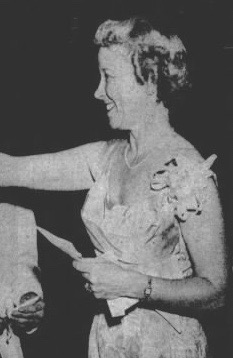
Her parties featured the same boisterous good cheer that she’d brought to her nightclub act. Her apartment became a popular hangout spot for political big shots including Sam Rayburn, LBJ, Albert Gore, Florida Sen. George Smathers, Louisiana Rep. Hale Boggs, and Arkansas Sen. John McClellan.
And Hank kept writing songs. In 1954, at a party held by famed hostess Perle Mesta, Hank debuted a new song, “Protocol,” about a country bumpkin struggling to understand the city’s societal rules:
That same year, she delighted the Washington Press Club by lampooning Joe McCarthy and the Red Scare with “Don’t Tell Joe,” in which she proclaimed her love for various items (like red roses, red-hot tamales, Russian dressing, and Moscow Mules) that might attract attention from the Wisconsin Senator.
In 1960, she hit the campaign trail once again. Her songwriting during the ’52 campaign had earned the notice of Lady Bird Johnson, and she recommended Hank to the Kennedy campaign.
As always, Hank threw herself into the assignment with gusto. She wrote a Kennedy/Johnson campaign song (plus one specifically for Lady Bird) and traveled throughout the South holding “flying tea parties” with Lady Bird and the Kennedy women. She earned notoriety both for her flashy red, white, and blue dress and the bugle calls she used to wake the traveling party every morning.
This time, Hank got to enjoy a winning campaign for a change. She was named chairman of the Music Committee for Kennedy’s inauguration in 1961.
Throughout the ‘60s and into the ‘70s, Hank continued to reign as one of the queens of Washington society, attracting a bipartisan coterie of admirers. Scripps-Howard’s Wauhillau La Hay called Hank “as much a part of the nation’s capital today as the Smithsonian Institution or the Washington Monument.”

Hank had another moment of inaugural glory in 1973, when her song “Look with Pride on Our Flag” played at Nixon’s second swearing-in. Sadly, she wasn’t there to see it; she died the week before, succumbing to cancer at age 64.
Hank Fort’s funeral was attended by a veritable who’s-who from Washington and Nashville alike. Barry Goldwater broke down in tears while delivering a eulogy to her. Liz Carpenter, Lady Bird Johnson’s former press secretary, wrote the obituary.
“She was the girl who loved to dance and sing, the girl with a song for every occasion, the girl who would call you up and sing her latest lyrics over the phone at any hour and from almost any place,” wrote Carpenter, who described her songs as “sheer Hank – the flavor of Southern cooking and Southern habits, a mixture of fried chicken and good manners and love for ‘just everybody, honey.’”
Hank Fort used Kefauver’s 1952 campaign as a springboard to fame, arguably more so than even the candidate himself. But while she was clearly canny about seeing an opportunity and exploiting it, Hank’s success was largely of her own making.
She may have had a limited voice, but she had an unlimited supply of pluck, energy, and good cheer. If Kefauver had had her winning touch with DC’s power brokers, he might well have become President.

 Estes Kefauver for President
Leave a comment