
A few weeks ago, I shared a very interesting pamphlet from Estes Kefauver’s 1960 Senate campaign, which focused on the ways – some large, some quite small – that he had benefitted his state during his tenure in the Senate.
However, a two-term Senator like Kefauver wouldn’t rest his electoral case solely on infrastructure projects and helping constituents get visas and mail service. Voters wanted to know where he stood on the issues. Fortunately, the campaign had a pamphlet for that as well. Here it is:
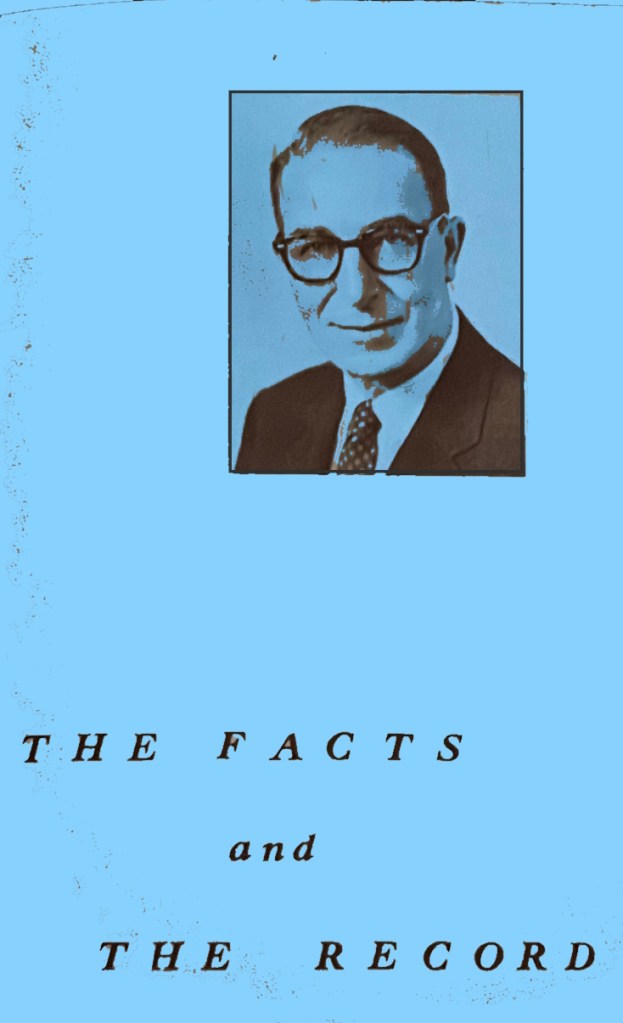
First, note the title: “The Facts and The Record.” Kefauver’s primary opponent, Tip Taylor, based his campaign on the idea that the incumbent was too liberal for Tennessee. “I’m tired of furnishing New York with a third senator,” Taylor fumed.
This pamphlet was designed to counter Taylor’s charges. It runs through a long list of issues, listing “the facts” (that is, Kefauver’s views on the issue) and “the record” (Kefauver’s votes and/or actions regarding the issue).
It’s a lengthy pamphlet – 24 pages! – but it contains a wealth of information about Kefauver’s record and how he presented his views to his constituents. Some of my highlights from the pamphlet are listed below:
- The opening page of the pamphlet leads with Kefauver’s 22 years in office (counting his terms in the House and Senate). Naturally, his seniority is touted as a selling point, particularly his chairmanship of two Judiciary subcommittees (one on monopoly and antitrust, the other on Constitutional amendments) and his seat on the powerful Appropriations Committee (a recent gift from Lyndon Johnson in exchange for Kefauver’s support for his Presidential bid). This section also touts Kefauver’s “record of individual courage and principle.” This is presumably an appeal to voters who might disagree with Kefauver’s views on some issues – especially civil rights – but respect his conviction.
- The first issue in the pamphlet is the TVA (Tennessee Valley Authority) and REA (Rural Electrification Administration). Kefauver touted his support for TVA throughout his career (dating back to his first Senate campaign in 1948, when he used the slogan “Peace and TVA”). The pamphlet touts TVA’s role in reducing flooding along the Tennessee River and sparking economic development. Naturally, it mentions Kefauver’s role in exposing and defeating the proposed Dixon-Yates deal to build a private plant to supply part of TVA’s power.
- The second issue is “public works,” which describes the infrastructure projects that Kefauver brought to Tennessee as a member of the Appropriations Committee. The pamphlet lists a total of 10 projects, a mixture of dams and flood control projects, bridges, federal buildings, and improvements to the Great Smoky Mountains National Park. It’s notable that the pamphlet leads with these two issues, as they both represent tangible goods that Kefauver has delivered for his constituents, both of which benefit from his seniority in the Senate. It’s a practical pitch aimed at voters who might be more conservative on the issues than Kefauver. (The same could be said of the next section, “Industry,” which highlights businesses that Kefauver convinced to set up shop in Tennessee.)

- Naturally, Kefauver’s work on monopoly and antitrust features prominently, rating a mention in multiple sections. Wisely, the pamphlet focuses primarily on two aspects of the issue: protecting small business from being squeezed out by big ones, and protecting consumers from high prices due to a lack of competition. (Kefauver’s battles with the steel industry over rising prices, which came to a head in 1959, come up more than once.) The pamphlet also parries against criticism he received on the issues, insisting that he does not oppose corporate profits (“The right to make a profit is as American as turkey on Thanksgiving Day), nor is he anti-corporation in general (“Senator Kefauver is not against corporations, even big ones”). However, the pamphlet expresses Kefauver’s concern that the growth and increasing concentration of big corporations will imperil small business and family farms, thereby threatening the American system of free enterprise as we know it. The pamphlet also includes a section on Kefauver’s current campaign to bring down the price of prescription drugs.
- I wondered how the pamphlet would address civil rights, a major flash point in the 1960 campaign. Reading through the pamphlet, I got deeper and deeper without any reference to civil rights at all, to the point where I wondered, “Wait, are they just not going to mention it?” The pamphlet does mention it; however, it breaks the issue up into multiple sections (“Public Schools,” “Anti-Bombing Laws,” and “Right to Vote Legislation.”) In these sections, Kefauver’s stances in favor of civil rights are stated honestly, but worded to avoid antagonizing voters who disagree with him. On schools, the pamphlet states, “Senator Kefauver recognizes the need for a peaceful solution which adheres to law and order as opposed to anarchy through mob action.” Similarly, in the section on bombing: “Most certainly all citizens, regardless of race or creed, must be protected to the fullest extent against terrorists who would destroy life and property as a means of addressing their frustrations and hates.” On voting: “Senator Kefauver believes that the right to vote is an American privilege which should not be denied any qualified citizen, regardless of race or color.” In each case, the wording does not explicitly condemn anyone who hold segregationist beliefs, yet it places the pro-civil-rights position on the side of law and order, while associating the pro-segregation side with anarchy and the mob.

- Kefauver was never averse to expanding the federal government for a cause he viewed as important. This pamphlet highlights his support for a creation of a federal Department of Consumers (“charged with protecting the hitherto neglected interests of the consumer against high prices, shoddy goods, and false advertising”) and a Department of Science ( “a means of coordinating the nation’s scientific might”). Another section describes Kefauver’s votes in favor of increased social welfare spending. And yet, the pamphlet also champions Kefauver as a supporter of fiscal restraint (“Federal tax dollars should not be wasted through extravagance or faulty management”). How does he square the circle? Essentially, Kefauver supported government spending if he believed it would help improves people’s lives. This spending was not wasteful, in his view. On the other hand, money spent on pork-barrel projects, bloated sole-source contracts, or profiteering were wasteful and should be cut. (Obviously, Kefauver’s definition of “pork-barrel projects” did not include the items he delivered for Tennessee in the Public Works section.)

- Two sections of the pamphlet deal with Kefauver’s work on the juvenile delinquency probe. One is titled “Crime, and Juvenile Delinquency.” The other, hilariously, is titled “Smut Peddlers” (see above). The first section focuses on measures Kefauver supported to dissuade young people from a life of crime (increased aid to states to study and address delinquency, improved treatment for drug addicts, outdoor work camps, prohibiting the sale of switchblade knives), while also touching on his previous organized crime hearings and his investigation into mob infiltration of professional boxing. The second section focuses on the shipment of obscene literature to minors through the mail, and it absolutely contains several sentences that are hilarious to modern audiences. For instance: “During his service as chairman of the Juvenile Delinquency subcommittee, Senator Kefauver exposed the nation’s sordid pornographic mills.” Also this one: “During the last Congress, Senator Kefauver succeeded in having a bill passe which would permit prosecution of smut peddlers not only at the place where they mail their filth, but also at the place where it is received.” Grandma’s reaching for the smelling salts just reading this. (The great Lehrer had some thoughts on this subject.)
- The pamphlet closes with a reminder that Kefauver’s door is always open to constituents. “An elected representative of the people should never forget his responsibilities to the people,” it says. And it reminds voters that Kefauver’s Senate office is open to the public daily, that Kefauver reads and answers the thousands of letters he receives each week from constituents, and that he frequently holds public gatherings in Tennessee to solicit feedback. Again, for those who may have issues with some of Kefauver’s positions or actions in office, the pamphlet reminds voters that he’s always willing to listen, hear out their concerns, and provide a response.
All in all, the pamphlet is a masterful way to appeal to a diverse electorate that may disagree strongly with the incumbent on some issues. While not shying away from or hiding Kefauver’s positions, the pamphlet is written to appeal to voters whether they agree with him on any given issue or not. It corrects common misrepresentations of his record, and treats the voter as a thoughtful, reasonable person who deserves an honest accounting of Kefauver’s positions and record in office.
You couldn’t campaign like this today, but maybe we’d be better off if you could.


Leave a comment