
Back in March, I wrote about the 1952 movie “The Captive City,” a movie inspired by the Kefauver Committee’s hearings on organized crime, and featuring an appearance from Kefauver himself. I also mentioned that “The Captive City” was one of a series of movies that came out in the 1950s that were directly inspired by the hearings.
Today, we’ll take a look at a crime movie that was not inspired by the Kefauver hearings, but included an appearance by the Senator anyway.
“The Enforcer” is a 1951 film starring Humphrey Bogart as “double-fisted district attorney” Martin Ferguson. The movie was released in the United Kingdom under the name “Murder, Inc.”, and the film is inspired by the real-life prosecution of the New York crime group of the same name. Bogart’s character is loosely based on Burton Turkus, the real-life Brooklyn assistant DA who led cases against the members of Murder, Inc. (Those prosecutions also help launch the political career of New York Governor and two-time Presidential candidate Thomas Dewey.)
The Murder, Inc. prosecutions occurred in 1941, almost a decade before the Senate probe. So what is Kefauver doing in this movie? Well, the Murder, Inc. prosecutions were referenced during the Kefauver Committee hearings in New York, particularly in connection with former Mayor William O’Dwyer’s unwillingness to take action against the gang during his tenure as Kings County DA.
But more importantly, the Kefauver crime hearings became a national sensation while the movie was being made. These hearings had turned Kefauver into an avatar of the nation’s desire to combat organized crime. So even though the Senator himself had nothing to do with the events of the movie, his presence in the prologue to the movie effectively functioned as a seal of approval.
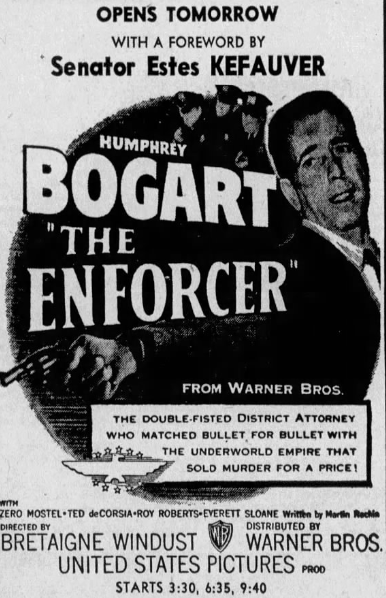
Sadly, as far as I can tell, the Kefauver prologue no longer exists in any available versions of the movie. Warner Brothers, the studio behind the film, took out the prologue at some point during the film’s theatrical run. (No idea whether that was the studio’s decision, or if it was removed at Kefauver’s request.)
As in “The Captive City,” Kefauver’s appearance focused on driving home the moral of the story. He stated that Murder, Inc. was responsible for “an assault upon society by one of the worst criminal elements in history.” He also stated that in real life, the perpetrators of these crimes had been brought to justice “without denying them any of the rights that American citizens are guaranteed,” which is unquestionably not true about the events in the movie. (Kefauver also stressed this point about protecting the rights of accused mobsters in response to critics of his televised hearings.)
When the movie begins, we meet Joe Rico (played by Ted DeCorsia). We learn that he is Ferguson’s key witness against mob boss Mendoza (Everett Sloane). Rico has turned state’s evidence in order to avoid prosecution for his own crimes, but he’s having second thoughts, concerned that Mendoza will try to kill. Sure enough, a couple of Mendoza’s goons shoot at Rico through a window, despite the fact that he’s under police guard. Rico survives the attempt on his life, but later escapes from his police guard and tries to escape out a window, only to accidentally plunge to his death.
(This portion of the story is based loosely on the real-life story of Abe “Kid Twist” Reles, a Murder, Inc. gangster who agreed to inform on gang leader Albert Anastasia. However, before Reles could testify, he “accidentally” fell out the fifth-floor window of his hotel and died, despite the fact that he was supposedly under guard by six police officers.)
Rico’s death puts Ferguson’s case back to square one. So, in a series of flashbacks, Ferguson and his police captain review the case as it evolved, in hopes of finding something they missed.
The investigation starts when Duke Malloy (Michael Tolan) comes into the police station, claiming that “they” made him kill his girlfriend, Nina Lombardo. The police find his story bizarre and suspect he may be nuts, but investigate anyway. The trail leads them to another hood named Babe Lazick (Zero Mostel), who spills the beans.
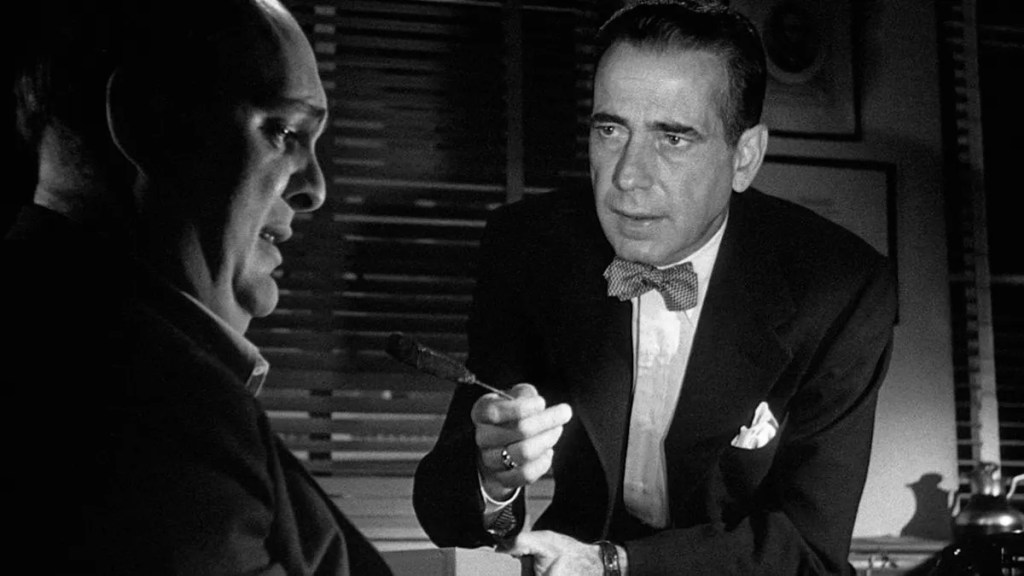
It emerges that Rico was in charge of a nationwide murder-for-hire “troop,” where he would receive calls ordering a hit and then would send a goon to carry it out. Rico was the only one who knew the big boss’s identity.
The police then look into Nina Lombardo, to figure out why someone wanted her dead. They learn from Nina’s roommate that she was living under a fake name; her real name was Angela Vetto, and she’d changed it after her father died ten years earlier.
Meanwhile, Mendoza sends another group of hired goons to kill Rico’s existing group of goons. Rico – deciding that squealing beats death – goes to Ferguson and offers to testify against Mendoza. He says that Mendoza had both Angela Vetto and her father killed because they’d witnessed his first murder. But as we know from the start of the movie, Rico ends up dead before he can testify.
Frustrated and out of ideas, Ferguson and the police captain listen to Rico’s taped confession again. This time, Ferguson notices that Rico mentioned that Angela Vetto had blue eyes. But wait – Nina Lombardo had brown eyes! Her roommate was the one with blue eyes! That could only mean one thing: the goons had killed the wrong woman, and Angela Vetto was still alive.
One problem: Mendoza (thanks to some photographs that Ferguson unwisely left in his cell) figures this out at the same time Ferguson does. He tells his attorney to send a couple of goons to kill the real Angela.
This leads to a dramatic conclusion. Ferguson, the cops, and Mendoza’s goons all head downtown, where Angela is known to be shopping. Commandeering the speakers outside a music shop, he tells Angela to “get off the street” and to call him. She does so, and he finds her a step ahead of the goons. Ferguson shoots one of the goons, and the cops arrest the other. Ferguson whisks Angela away to safety as the music swells. Happy ending! (At least if you ignore the giant pile of dead bodies.)
Honestly, if I were Kefauver, I would never have put in an appearance here. Don’t get me wrong; “The Enforcer” is a captivating noir; Bogey’s world-weariness is a great fit for Ferguson. But the film isn’t exactly an advertisement for the rule of law.
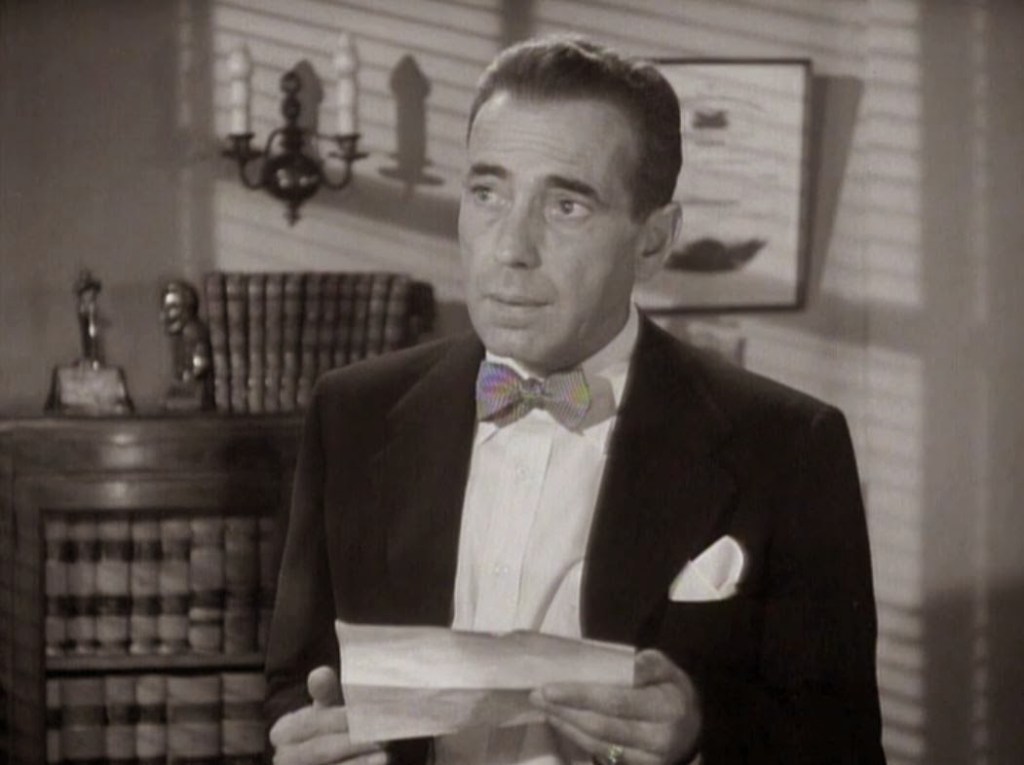
In one scene, Ferguson “subdues” Rico by punching him in the face. In another, he threatens to jail Lazick’s wife and send his son to an orphanage unless he talks (which is 100% illegal). Also, there’s this soliloquy from the police captain: “What’s wrong with the law that we can’t touch [Mendoza]? Oh, I know. Our kind of laws are designed to protect the innocent. It’s not enough that we know a man is guilty; we have to prove it.” In short, the movie’s message is more or less the opposite of Kefauver’s high-minded appeal to the rule of law.
But given that much of America was just learning about the existence of organized crime – “The Enforcer” has to explain what terms like “hit” and “contract” mean – perhaps Warner Brothers figured that the presence of Kefauver’s familiar face would give viewers some reassurance. (Indeed, in some theaters, a viewer might have seen “The Enforcer” running side by side with the Kefauver hearings themselves.)
If you’re so inclined, you can watch the whole movie here:
Postscript: The same year that “The Enforcer” came out, Turkus – the real-life inspiration for Bogart’s character – wrote his own account of the prosecutions, entitled “Murder. Inc.” A movie by the same name came out in 1960, with Henry Morgan plying Turkus, and Peter Falk playing Abe Reles.

 Estes Kefauver for President
Leave a comment