
In previous articles on the Kefauver Committee’s organized crime hearings, I mentioned the degree to which the hearings became a national sensational and turned Kefauver himself into something of a celebrity. For a time, the crime hearings were such a cultural touchpoint that they even inspired several Hollywood movies.
“The Captive City” is one such movie. Directed by Robert Wise, who would go on to direct “West Side Story” and “The Sound of Music,” the noirish film is based on the real-life experience of reporter Alvin Josephy Jr., who helped write the screenplay. As you can see from the poster above, the movie was personally endorsed by Kefauver – which is no surprise, as his crime committee figures prominently in the plot, and the Senator himself makes an appearance at the end.
The movie opens with a quote from Kefauver: “Ordinarily, Americans don’t think much about the existence of organized crime; they know vaguely that it is there, and they let it go at that… UNLESS PRODDED BY SOME UNUSUAL CIRCUMSTANCES.”
Over the next 90 minutes, “The Captive City” provides a lively depiction of such unusual circumstances. John Forsythe plays newspaper editor John Austin in the fictional town of Kennington (standing in for Santa Monica, where Josephy worked as a crime reporter; the movie itself was shot on location in Reno). Kennington is a town of 36,000, and Austin says it “looks pretty much like any other American town.” But as we’ll soon learn, there’s evil lurking under the seemingly tranquil surface.
The story begins with Austin and his wife on the run in their car, fleeing from a mysterious pursuer. When they pull into a small-town police station, Austin demands protection; the confused local cop tells Austin he’ll have to wait for the chief.

Austin, clearly fearing for his life, sits down and begins dictating his tale into a conveniently placed tape recorder.
Austin is used to reporting on the routine stories of small-town life, but a local private investigator upsets his applecart by relaying a wild story of crime and gangsters living right there in town. The editor dismisses him at first, but when the PI turns up dead in a supposed “hit and run,” Austin starts to investigate.
He quickly discovers a web of local bookies operating throughout the town. Worse yet, he learns that a notorious mobster named Dominic Fabretti has moved into town and set up a wire room. As he gets deeper into his investigation, Austin finds that he’s being watched – not only by the local police, but also by a couple of out-of-state cars that he (rightly) assumes to be tied to Fabretti.
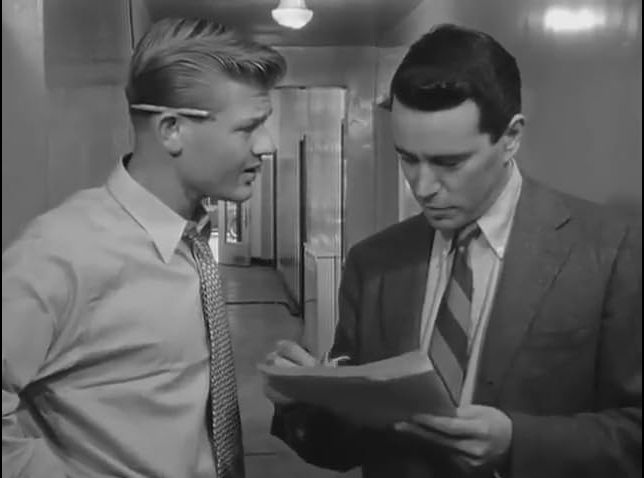
Having read “Crime in America,” Kefauver’s account of the Senate hearings, it’s remarkable how closely the plot of “The Captive City” resembles some of the episodes in the book.
As Kefauver does in the book, Austin has to explain to his wife what the Mafia is. Throughout the movie, several of Austin’s friends and acquaintances – respectable businessmen all – try to get him to let go of the investigation for fear that it will damage Kennington’s reputation or harm innocent people. In the words the local used-car dealer who runs a book on the side, “People are going to bet, and they’re going to bet with somebody.” He warns Austin that if he shuts the local bookies down, then “hoodlums” will take over.
Late in the movie, Austin learns that the local gambling operation had been run by a well-known local businessman, until Fabretti and his associates showed up and muscled in on the operation. This is a story that Kefauver describes repeatedly in “Crime in America.”
The more Austin learns, the more determined he becomes to expose the truth – and the more fiercely the local community resists. The local police chief admits that he’s aware of the mob’s presence in town but is powerless to act. The newspaper’s publisher quashes his investigation after multiple local businesses pull their ads from the paper. Even the local clergy, to whom Austin turns in desperation, refuse to get involved, believing that the forces behind the gambling operation are too powerful to stop.
Just as our hero is about to abandon hope, the Kefauver Committee (referred to by name) appears as a deus ex machina. They happen to be holding a hearing in the state capital the next day! Austin grabs his wife and they flee in the middle of the night, with the bad guys on their tail. Thus, we rejoin the timeline from the beginning of the story.
Fortunately, Austin is able to get a police escort to the capital, and the movie ends with him walking into the hearing room to give his testimony.
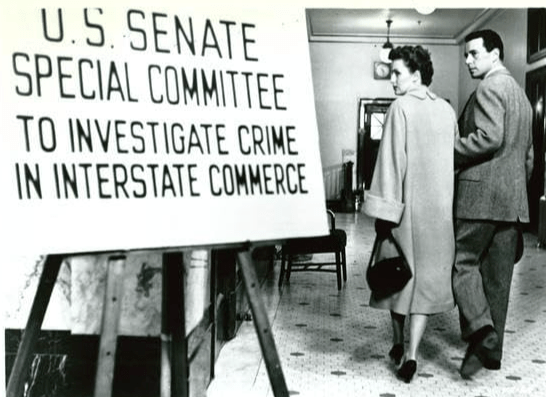
Only the movie doesn’t quite end there. We then cut to Estes Kefauver himself, talking to us from his Senate office. He begins by assuring us that Austin’s real-life counterpart (that is, screenwriter Josephy) survived, and because of his actions, the real-life Kennington now has “an honest and responsible administration.”
Kefauver then proceeds to drive home the movie’s moral, in case it wasn’t already clear. He notes the “vicious cycle” of gangsters paying off local officials to look the other way, allowing “deeper and deeper penetration by the underworld into our political and economic system.”
“Just remember,” Kefauver admonishes the viewer, “there is no such thing as a little harmless local vice, a little organized gambling. Multiply a little organized crime by a thousand and you have a vicious, powerful nationwide criminal syndicate.”
He finishes by noting that rooting out organized crime ultimately requires local action. “Cut off the crime dollar at its source – in your own town – and the syndicate will shrivel and die,” Kefauver says. “But it’s up to you.”
All in all, it’s a pretty solid noirish film. Wood is a good director with a solid eye for cinematorgraphy, and he does a good job depicting the tension. Forsythe is solid as a lone man of integrity surrounded by a town that’s gotten all too comfortable with corruption and vice.
“The Captive City” is one of several films that came out in the early ‘50s that were directly inspired by the Kefauver Committee hearings. I hope to review some of the others here in the future.
If you’d like to see “A Captive City” for yourself, if’s available online in its entirety here.
Postscript: the credits mention that Kefauver donated the payment for his appearance to the Cordell Hull Foundation for World Peace. Hull was a former Tennessee Senator who went on to serve 12 years as FDR’s Secretary of State. He helped create the United Nations, an achievement that landed him a Nobel Peace Prize. His foundation promotes international peace and understanding primary through fostering international educator exchange programs. The foundation, now called the Cordell Hull Foundation for International Education, still exists today.

 Estes Kefauver for President
Leave a reply to Kefauver at the Movies: “The Racket” – Estes Kefauver for President Cancel reply