
Estes Kefauver gave terrible speeches. Or so the press kept claiming.
During Kefauver’s Presidential runs in 1952 and 1956, reporters repeatedly expressed mystification about the fact that voters listened raptly while Kefauver delivered what they considered dull, colorless, simplistic speeches. Douglass Cater, quoting another reporter, described a Kefauver event this way: “It was a drab little speech to a drab little audience… They got it. I didn’t.” E.W. Kenworthy of the New York Times said of Kefauver’s 1956 campaign speeches, “He drones on in flat declarative statements – each one a simple idea starkly put[.]”
A lot of the reporters’ disdain was a matter of performance. Kefauver’s oratorical style – as even his biggest supporters admitted – was subpar. He mumbled, he often spoke in a monotone, and he frequently mixed up his words.
But if reporters had bothered to look past the delivery at the content of the speeches themselves, they might have understood why voters listened. Whatever Kefauver’s shortcomings as an orator, his speeches were often far more sophisticated and interesting than he got credit for.
In July 1959, Kefauver spoke at the dedication ceremony for the Carter County Memorial Hospital in Elizabethton, Tennessee. The hospital’s construction was made possible through federal funding, which Kefauver had helped secure.

This was a big deal to the people of Carter County, but for a United States Senator, it was a minor event. The New York Times wasn’t covering this speech. Heck, there weren’t even reporters from Memphis or Nashville there. This was strictly an event for a very local audience in northeast Tennessee.
Most politicians, if they’d bothered to show up for this event at all, would have given a short throwaway speech. Offer a few platitudes about the wonders of the new hospital, say a couple kind words about the town, and – most importantly – make sure you claim credit for getting the hospital built. Everyone applauds, you shake a few hands, and you’re on your way.
Kefauver went a completely different route. He explained how this small-town hospital was an example of America’s generosity, humanitarianism, and care for its citizens. He tied the hospital to America’s efforts to improve health care around the world. He made a compelling case that the spirit that got this hospital built was one of the country’s best weapons in the Cold War struggle against communism. All this in a speech that wouldn’t be heard or remembered beyond this small corner of Tennessee.
Kefauver may not have been a great orator. But there’s a reason people responded to his speeches anyway.
Government With A Heart
Kefauver’s speech opened with a striking idea that framed the rest of his remarks. “America is a great nation.” He said, “because its people affirm the goodness of life.”
He drew a contrast to ancient Egypt, which devoted its national resources and energy to the worship of death, building pyramids and towering monuments to glorify the pharaohs. In America, on the other hand, “[w]e have been trained to think constructively, and to erect structures of this kind for the benefit of the living.”

This was the sort of sophisticated rhetorical move that Kenworthy believed Kefauver was unable to perform, writing: “He seems utterly incapable of a metaphor – even a hoary one – or so much as an image.” Here, Kefauver deployed a vivid metaphor that was not hoary at all, but genuinely illuminating.
In Kefauver’s framing, this hospital was more than a practical means to provide health care to the local population. It was a shining example of what he liked to call “government with a heart,” which cared about its citizens and sought to help meet the needs they couldn’t provide on their own.
The federal funding for Carter County Memorial was provided through the Hill-Burton Act, a bill passed in 1946 to provide grants to construct community hospitals, which were in short supply following the twin shocks of the Depression and World War II. Kefauver called the act one of the greatest pieces of legislation to come out of Washington in the past two decades.
He pointed out that 52% of the hospital’s $1.4 million construction budget had been provided through Hill-Burton grants. Kefauver, who had a seat on the powerful Senate Appropriations Committee, had played a key role in obtaining those funds.

Rather than claim credit for his actions, though, he gave thanks to the community for their part. He likened legislation to a wheel that “can only be set into motion through the efforts of responsible people. In your case, members of the medical professional joined with city and county officials and the general public to put the wheels in motion.”
This was an example of Kefauver’s theory of democratic participation in action: the people come together to present their needs and wants to the government, which responded by providing the resources to fulfill them. Another politician might have told the people of Elizabethton: Aren’t you lucky to have such a powerful Senator who can get things done for you? Instead, Kefauver delivered the message: Isn’t it great that you have the power to tell your government what you need, and the government will listen?
This was the same message he gave to the voters during his Presidential campaigns. “What a wonderful thing that we live in a country where the people can decide,” he told the people of Florida in 1956. That was the crux of his message: In America, the people have the power, and that’s what makes us great. It was a powerful message that resonated with people, in Tennessee and across the nation.
If Kefauver had stopped there, it would have been a good speech. But he didn’t stop there. He was about to extend his idea about affirming the goodness of life from a national scale to a global one.
Leading By Example
The Cold War was a hot topic of conversation in 1959; it seeped into a lot of corners of American life. Still, you wouldn’t expect it to come up in a speech dedicating a community hospital.
Kefauver, though, saw a genuine throughline between the construction of a hospital in small-town Tennessee and the global struggle against communism. As he told the people of Carter County, the same humanitarian spirit that led the government to help build local hospitals was the spirit that would combat the Soviet threat.

“Books and medicine, not missiles,” he said, “are America’s most effective weapon against the threat of Russian imperialism.”
To say the least, this was a bold statement for the time. If there was one area of bipartisan agreement in 1959, it was that we should devote as much money as possible to the defense budget in order to secure freedom and democracy. If we had to sacrifice in other areas to spend more on missiles, it was worth it.
Kefauver turned that idea on his head. While he told his audience that it was important to put money into defense and foreign military aid, he argued that “[a]t the same time, we must explore new avenues which might eliminate Cold War differences through non-military means.”
One of those avenues, he said, was providing scientific and medical aid to other countries – democratic and communist alike.
He praised the recent “light thaw” in Cold War tensions that had allowed for cultural and scientific exchanges between the West and the Soviet bloc. For instance, America had recently made the Salk polio vaccine available to the Soviet Union, a move that Kefauver predicted “will sow many seeds of good will behind the Iron Curtain.”
Even more important, he felt, was appealing to countries that were not aligned with either Western democracy or the Soviet bloc. He pointed out that a billion people lived in non-aligned countries, and said, “It is our obligation to affirm to them the goodness of our democratic way of life.”
He mentioned the concept of the New Great White Fleet, which had been discussed in an article in that week’s Life magazine. As Kefauver described it, the fleet “will put to sea on worldwide missions of mercy. This fleet will move into action and teach modern methods of health, education and agriculture to those who live in underdeveloped countries of the world.” The Senator argued that “[i]n doing so, we will gain new allies in our persistent struggle against communism.”

Kefauver presented a radically different geopolitical vision than the hardline view of people like John Foster Dulles.
Dulles saw the Cold War through the lens of power: spheres of influence, military alliances, stockpiles of weapons. He believed that projecting strength was the best way to win friends and influence people. He considered it necessary to counter the Soviet threat as aggressively as possible. He saw the battle between democracy and communism as a dark, zero-sum struggle – he openly stated that neutrality was immoral – and he was willing to do whatever it took to win the struggle, including secretly planning coups against leaders considered too sympathetic to communism.
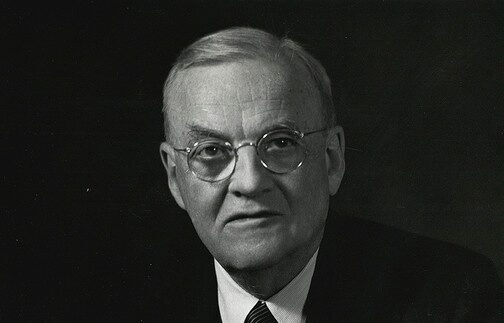
Kefauver, meanwhile, viewed the Cold War as a contest of legitimacy. To him, the way to win was to demonstrate that life in a democracy was better than under communism. He believed that rather than trying to pressure and intimidate non-aligned nations into siding with the West, the best approach was to be a better, more morally admirable, and more internationally helpful nation than the Soviet Union.
Dulles would have scoffed at the idea that funding hospital construction in Tennessee had anything to do with the Cold War. But Kefauver saw them as linked. A nation that can provide for the needs of its citizens – and is generous and humanitarian enough to provide help to the world – is one that can inspire the allegiance of other nations.
Kefauver believed that an America that affirmed the goodness of life was not just good for its people, but a powerful and shining example for people around the world. And whether that affirmation was as grand as a fleet on a worldwide mission of mercy or as small as a new hospital in a rural town, it all demonstrated America’s goodness – and greatness.
That’s the message he delivered to Carter County: that the hospital and the New Great White Fleet and sharing the polio vaccine to the Soviets were all expressions of the same democratic spirit, and that the democratic spirit was America’s most powerful Cold War asset.
Hearing the Messenger, Ignoring the Message
I don’t know what the people of Elizabethton were expecting to hear from Kefauver that day. I’m sure they weren’t expecting to hear an ode to democratic participation in the legislative process, or a case that building a hospital in Tennessee was connected to winning the Cold War. But that’s the speech that Kefauver gave. And as always, he had faith that the people would grasp and appreciate his message.

That’s what the reporters kept missing about Kefauver. They were focused on his monotonous speaking voice and his lack of soaring oratory, but they didn’t notice that he was delivering sophisticated messages to the people in plain English.
They didn’t notice that he wasn’t just saying that the people had the power in a democracy, but he was demonstrating – by asking for their votes and making his case to them directly, by going to the small towns that most politicians ignored, by treating the funding of a new hospital as a tribute to the power of average citizens working together instead of his own legislative prowess – that he really believed it. And he believed it was an idea powerful and attractive enough to counter the Soviet threat.
The reporters listened to Kefauver and they heard a boring, stumbling, unimpressive speaker. The people listened and they heard the message that they mattered, that a famous high-profile politician was coming to them and asking for their support. They heard a man who didn’t treat them as a bunch of uneducated yokels to be dazzled by fancy rhetoric or whipped up by demagogic rants, but as intelligent citizens capable of understanding and responding to thoughtful arguments stated straightforwardly.
The reporters didn’t get it. But they could have if they’d bothered to talk to the people who listened to Kefauver and understood him. Or if they’d paid more attention to what he was saying and less to how he was saying it.


Leave a Reply