
In last week’s post about the 1952 Kefauver-Russell televised debate in Miami, I mentioned that Kefauver was involved in another televised Miami debate. In fact, it was on the same night as his clash with Russell. It might not be fair to call it a “debate,” though, since there was only one participant.
This one is going to require some explanation.
Florida Governor Fuller Warren wasn’t the sharpest knife in the drawer. He’d harbored an ambition to be governor ever since he was a kid. When he was elected in 1948, it was the high point of his life… at least until he found out that the job was not just about ribbon-cuttings and parades. Seems no one had bothered to explain to him that governors were expected to, you know, govern.
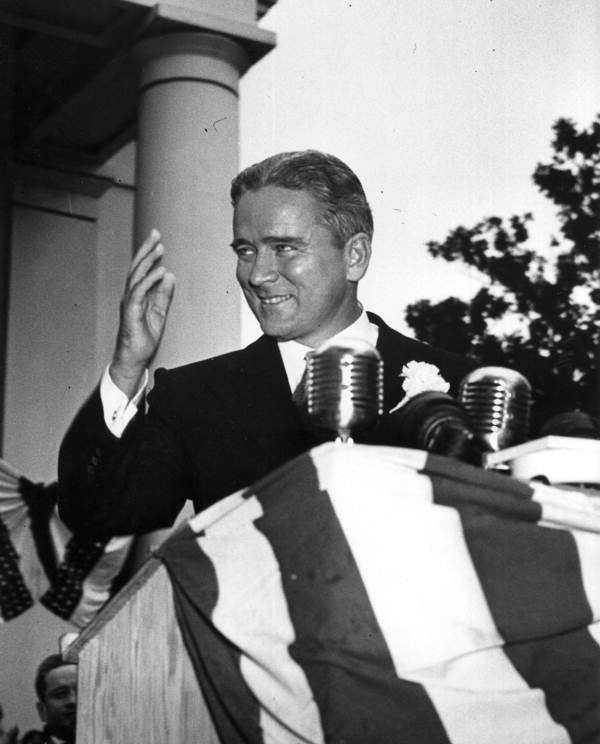
“I must confess that I almost overmatched myself when I got hold of this governorship,” he moaned to the Miami Herald just over a year into his term. “It has been the roughest, toughest, most terrifying task I ever confronted.”
Governor Warren had had it out for Kefauver ever since the organized crime hearings. The Kefauver Committee not only exposed the fact that illegal gambling was widespread in Florida – with the tacit cooperation of law enforcement – but that Warren’s own campaign for governor had been bankrolled by gambling interests.
In reaction to this embarrassment, the governor reacted poorly. He refused to testify before the committee, claiming that it was a violation of state’s rights. He denounced Kefauver as an “ambition-crazed Caesar” and a “headline-hungry hypocrite,” likening the Tennessean’s actions to those of Hitler and Judas Iscariot. (I am not making this up.)
When Kefauver planned a run for President in 1952, Warren saw an opportunity – he thought – to get revenge.
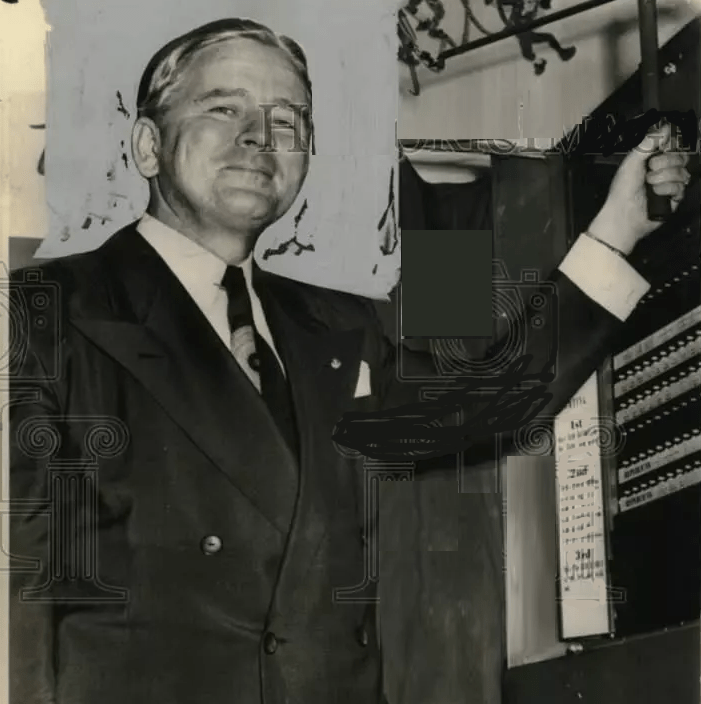
He challenged Kefauver to a debate, providing a list of 21 questions he planned to ask. These “questions” accused Kefauver of playing favorites during the crime investigation, consorting with known gamblers in Tennessee, and more.
Warren charged that Kefauver had “perverted and prostituted the chairmanship of the Senate crime investigating committee to promote himself for president.“ (Subtle he was not, but Warren at least had a flair for rhetoric.)
Since he was headed down to Florida to campaign in the primary anyway, Kefauver agreed to the debate, on the condition that it be limited to 30 minutes. Warren – who was clearly looking for an exit route at this point – balked at the restriction, claiming that a half-hour wasn’t “sufficient time to tell… what I know about him.”
Undaunted, Kefauver sent a telegram laying out his campaign itinerary and inviting the governor to meet him for an in-person debate anywhere along the route. Everywhere he stopped, he called out, “Is Governor Warren here? If he is, he can have this time with me. If he doesn’t debate, then the people of Florida know the reason why.”
Warren, sensing that he had been ensnared in a trap of his own design, tried to wriggle free. “I have tried for nearly a year to get Sen. Kefauver to meet me in free and unrestricted public debate,” the governor complained to the Miami Herald. “He has never agreed to do so.”
Despite the governor’s reluctance, WTVJ scheduled a televised debate between Kefauver and Warren on the same night as his confrontation with Russell. The governor again claimed that “a 30-minute question and answer quiz on TV” was insufficient, apparently figuring this would be enough to get the station to drop it. He figured wrong.
Since Warren was a no-show, Kefauver “debated” against an empty chair with Warren’s nametag on it. There had been some talk beforehand of WTVJ new director Ralph Renick acting as a stand-in for the governor, but in the end they let Warren’s absence speak for itself.
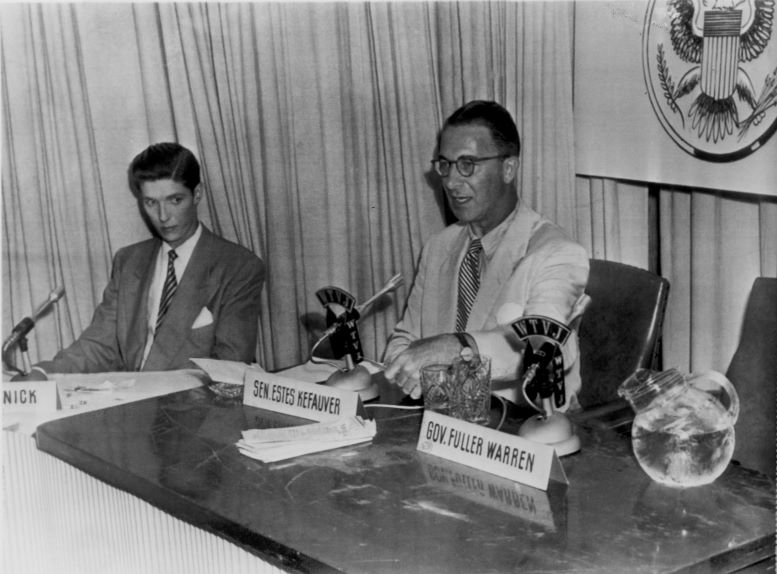
“I’m here,” Kefauver said by way of an opening statement. “I’m sorry he’s not here… I suppose the people of Florida know the reason why he’s not here.”
Kefauver then read through Warren’s list of 21 questions and provided answers to each of them, straightforwardly denying the governor’s charges and innuendoes. This included the ridiculous assertion that Kefauver had made a “deal” with the Miami mob to promote his Presidential run. The Senator puckishly noted that his campaign was “poorly financed.”
In a clever bit of stagecraft, Kefauver had Rudolph Halley, chief counsel from the crime committee, fly down to join him. In response to a Warren accusation that the committee excused rich people from testifying in the crime hearings, Kefauver asked Halley: “Were any witnesses excused because of their wealth?” Halley replied, “Absolutely none, Mr. Senator.”
Kefauver said that he had brought some questions to ask Warren, but given the governor’s absence, he didn’t read them. He wisely heeded Napoleon Bonaparte’s dictum about never interrupting your enemy when he is making a mistake.
In the aftermath of the “debate” fiasco, Warren spluttered that Kefauver and WTVJ had “tricked him” by holding the debate, even though he had started the whole thing.
If Warren was hoping to sink Kefauver’s chances for the Presidency, he failed. But he did succeed in making himself look like a witless clown. He came off like Yosemite Sam loudly proclaiming his willingness to fight, while ignoring the sound of Bugs Bunny sawing a trap door in the floor beneath his feet.

Luckily for Warren, the Florida constitution at the time limited governors to a single term, which meant that he was spared a re-election race he surely would have lost. After leaving the governor’s mansion, he decided to – of all things – host a TV talk show in Miami. (It was actually pretty popular; Warren was always a good talker.)
In 1956, having thoroughly failed to learn his lesson, Warren decided to run for governor again. He ran as an avowed segregationist, despite the fact that he had run in 1948 on a theme of racial harmony. (In fact, one of the few good points of his administration was a 1951 bill that effective outlawed Klan demonstrations in the state.) Unsurprisingly, he was crushed in the Democratic primary by LeRoy Collins.
Why am I sharing this story? For two reasons: First, I think it’s funny. Second, Kefauver’s detractors considered him an empty-headed fool driven solely by burning ambition. In Fuller Warren, they had a prime example of what such a person actually looked like.


Leave a Reply