
I’ve mentioned before what a cultural phenomenon the Kefauver Committee on organized crime was in early 1950s America. It spawned a wave of movies, some including appearances from Kefauver himself. (One even proposed to include Kefauver in an acting role, though he declined to appear.)
But there were also many movies clearly inspired by the organized crime hearings, even if Kefauver himself didn’t make an appearance. Today’s film falls into that category.
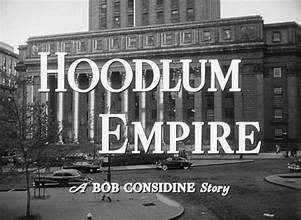
“Hoodlum Empire” premiered in New York in March 1952. The script was written by Bob Considine, a reporter for the International News Service. Considine based the script on articles he’d written eposing the world of racketeering, and covering the Kefauver Committee hearings. Republic Pictures rushed the film into production in order to capitalize on the public’s fascination with the hearings.
There’s no question that Considine’s script took direct inspiration from the hearings. Several of the characters were thinly-veiled analogues of real-life figures, and several scenes in the movie referenced actual events from the hearings.
The film opens with our Kefauver stand-in, Senator Bill Stephens (played by Brian Donlevy), his crime hearings in New York. Stephens’ committee is particularly interested in one mobster, Nick Mancani. They attempted to subpoena Mancani, but learned that he was “out of the country.”.
We then cut to an elegant penthouse where Mancani arrives in a limousine. (Played by Luther Adler, Mancani sports a dreadful “It’s-a me, Mario” fake Italian accent, in case the character’s last name didn’t tip you off to his ethnicity.)
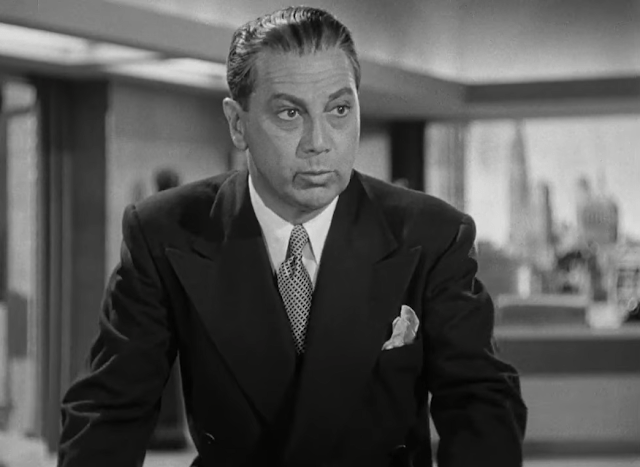
Apparently, he really was out of the country on the advice of his lawyer, but came back when his nephew and surrogate son, Joe Gray, was subpoenaed to testify.
Nick’s hot-headed lieutenant, Charley Pignatalli (Forrest Tucker), afraid that Joe will talk, wants to kill him to ensure his silence. Nick is not on board; he tells Charley that Joe is not to be killed, “unless of course it’s… absolutely necessary.”
Unbeknownst to Nick and Charley, however, they’ve been overheard! Connie Williams (Claire Trevor), a “family friend” of Nick’s, has bugged the room and is recording the conversation from the study upstairs.

(Connie’s role in the family is a bit unclear; she lives in Nick’s building, but is definitely not his girlfriend. Also, why she’s recording Nick’s conversations is unclear – and what gangster worth his salt doesn’t sweep his office for bugs? – but suffice it to say this will be important later.)
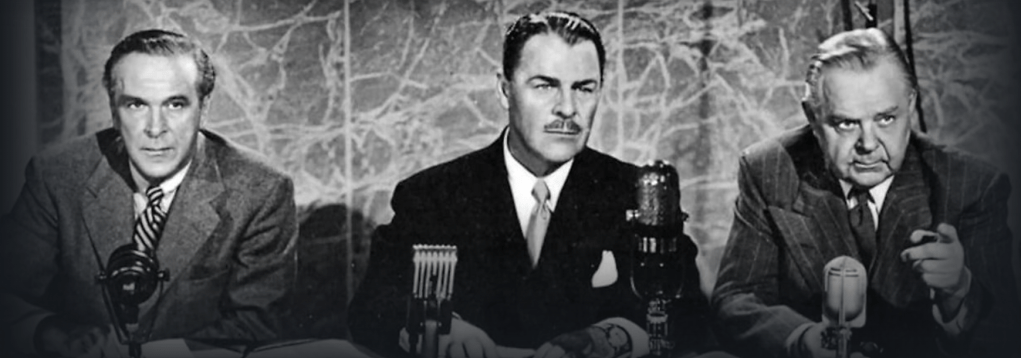
We then cut to the opening of Stephens’ committee hearings. Joe (John Russell) enters the room; a newsman helpfully identifies him as Nick’s nephew and explains, “It is believed that he’s still second in command of Mancani’s gangster organization.” Joe is accompanied by a blind man, who we later learn is Rev. Simon Andrews (Grant Withers).

Stephens calls Nick to the stand, only to be told by his lawyer that he hasn’t be able to locate the gang kingpin. So they call Charley to testify instead.

Charley claims to be a retired businessman, but Sen. Stephens notes that he still has a healthy income. Where is his money coming from? “Investments.” What kind? “Different kinds.”
We then hear from Stephens’ colleague, Senator Tower (Gene Lockhart), clearly a stand-in for real-life New Hampshire Sen. Charles Tobey. Tobey became famous during the actual hearings for his moralistic diatribes directed at various gangsters. Tower lets loose on Charley in a manner very reminiscent of Tobey. “The truth is that you and Mancani are still in a lot of illegal businesses, aren’t you?” Tower snaps. “Businesses that are dirty and rotten! And you use the same violent methods that you used selling booze, isn’t that right?” Charley seems unruffled by Tower’s attacks.
Stephens then asks Charley about Joe, and Charley plays dumb, saying he’s not familiar with Joe’s business, but believes that he partnered up with some “kids” he met in the Army.
This triggers a reverie from Rev. Simon, who takes us into a flashback. (This movie uses a lot of flashbacks.) We’re transported to the French countryside during World War II. Joe is fightingnext to Rev. Simon, his chaplain, as they’re taking fire from German snipers hiding inside a house.
Joe bravely charges forward and lobs a grenade inside the house, apparently killing the snipers. But when he goes in, one German is still alive and shoots him. As Joe writhes in pain, the German raises his gun to finish the job – only to be killed by French farm girl Marte (Vera Ralston), who was apparently hiding in another part of the house and is fortunately handy with a hunting rifle.
Marte comforts and nurses Joe until Rev. Simon comes to load Joe into an ambulance. There, a delirious Joe starts spouting gangster lingo, and the camera pulls back to see that he’s next to… Bill Stephens, who served in the same unit. The company largely consists of young National Guardsmen from the same town, Central City. (Joe is also in their unit because… reasons.) Rev. Simon is the pastor back home.
Stephens and Rev. Simon chat as they wait for the ambulance to pull away. Stephens admits that he joined the Guard to boost his political career, but he still looks down at Joe. “I guess he couldn’t fix the draft board,” Stephens snarks. Rev. Simon stands up for Joe, saying he’s a good soldier.
The ambulance leaves, and Rev. Simon walks away, only for a shell to explode right next to him, blinding him. The war is over for the good chaplain, but before he heads home, Joe hints that he plans to marry Marte and bring her to America with him.

Back to the present, and Charley’s still giving his smirky non-answers. Nick and his mob buddies are watching Charley testify on TV. With them is Connie, and now it’s time for her flashback.
We’re now in New York, where Joe and his unit arrive home on a troop ship. His friends are heading to Central City, and so is Joe… but first, he’s got some business to take care of here.
Part of that business arrives in the form of Connie, who welcomes him with a big hug and a kiss. She’s expecting Joe to marry her, and she’s confused when he doesn’t return her affection.
Before Joe can explain, though, they arrive at Nick’s penthouse, where the mob king has arranged a big welcome-home party with all his gangster friends. Nick takes Joe to his inner office, which is full of additional gangsters whom Joe has never met.
Turns out that Nick has been busy while Joe was away! He turned his small-time New York gang operation into a nationwide syndicate that controls casinos, slot machines, and the racing wire. (Hilariously, he illustrates the growth of his enterprise with a U.S map, lighting up all the cities now part of his operation.) He convinced the gang leaders in those cities to join forces. They all have legitimate cover businesses (or as Nick explains charmingly, “Everybody wears a nice clean front”). The syndicate even has an army of lobbyists in state capitals and in Washington “to make sure some Honest-John politician doesn’t throw us a curve.” Nick wants to hand the whole operation over to Joe, as his “inheritance.”
Nick then hands Joe back to Connie, who again tries to warm her man up with kisses. Joe finally tells her the bad news: he’s marrying Marte, the French farm girl. Nick enters with a tray of champagne to celebrate Joe’s “inheritance” of the family business, but Joe has bad news for him too: he’s “going legit, straight” and moving to Central City. It’s hard to tell whether Connie or Nick takes things harder. Joe does at least promise Nick that he won’t squeal about the whole mob thing.
Back to the present day, where Charley is still testifying. Charley strategically denies any knowledge of Joe’s activities in Central City, while subtly implying that Joe is involved in evil doing there. After another tongue-lashing from Senator Tower (“Come on, you! You were the chief nickel-nurser of this outfit… What was the amount of silver you sold your soul for?”), the hearings adjourn for the evening.
Joe goes back to his hotel with his wife and Rev. Simon, but is lured outside and kidnapped at gunpoint. He’s taken to Nick’s penthouse, where Charley tells him he’d better keep quiet or else. He tricks Joe into standing on the balcony, and is running forward to push Joe over the edge just when Nick walks in.
Nick prevents his lieutenant from killing Joe, but warns Joe that he’s “on the hook” and will be turned into the fall guy if he testifies. But, Nick cheerfully points out, it beats plunging 20 stories to your death, right?
When the hearings resume the next day, Connie takes the stand. She proceeds to do a pretty hilarious send-up of the testimony of Virginia Hill, Bugsy Siegel’s girlfriend, at the real-life hearings. (This, it turns out, is why Trevor affected a dodgy Southern drawl throughout the movie: she was imitating the Alabama-born Hill.)

Nick and Charley told her to throw Joe under the bus; they figured she’d happily do it since he broke her heart and all. But she still loves the big lug, and she protects him! She truthfully tells the committee that she hasn’t talked to him or received any money from him since he got married.
Irritated, Nick takes matters into his own hands. He tells his lawyer to tell the committee that he “miraculously” turned up, and wants to testify. He appears the next day, and Stephens asks him about the gambling operations in Central City.
This means it’s time for another flashback, from one of Nick’s henchmen in the audience. He recalls the day he trucked slot machines into Central City to set up operations. He stops at Joe’s gas station, where the attendant (one of Joe’s Army buddies) fills his tank and notices the machines.
The attendant relays the news to Joe, mentioning that he plays the nickel slots on occasion. Joe responds with a set-piece lecture on the ways that gambling corrupts a community, and how those nickels add up to big bucks for the gangsters.
That night, the henchmen try to install slot machines in Joe’s gas station. But our hero drives the henchmen out of his store with his fists, then goes home and relays the news to Rev. Simon, who tells him to call the police. Joe responds that he won’t be a stool pigeon.
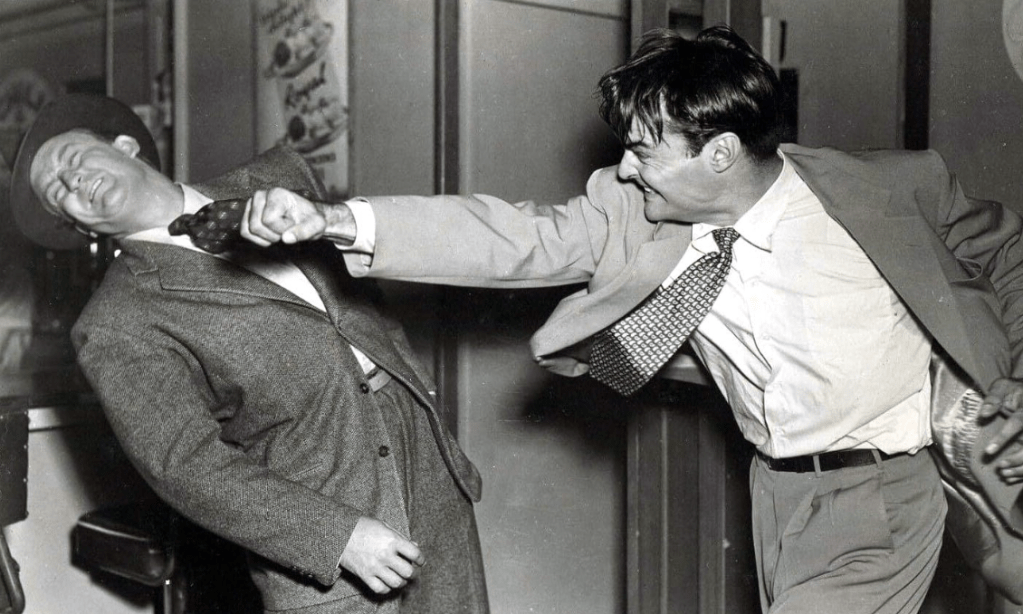
The confused henchmen go back to Charley, who tells them that Joe’s the boss of the whole operation, and thus has to appear clean to keep the cops off his back. The henchmen buy this, for some reason.
Back to the hearings, where Nick is still testifying. He claims that he last saw Joe just after the war, and that he’s never visited him in Central City.
We soon learn that Nick is lying, courtesy of – yes! – yet another flashback, courtesy of Marte.

She remembers Nick coming to their house and warning Joe not to interfere with his operations in Central City. Joe says he wants no part of Nick’s dealings, to which the boss mutters, “You got a lot to lose… don’t stand it my way.” (At least Marte’s flashback is short.)
We get one more flashback, this time from Joe. He remembers Stephens’ kickoff event for his Senate campaign. Stephens gives a very Kefauver-esque speech about the ways organized crime can corrupt a community. (“These people deal in evil and murder. They do it for money.”)

After the speech, Joe congratulates Stephens and offers him a campaign contribution, but the politician gives him the cold shoulder. When Joe asks why, Stephens accuses him of running gambling parlors and whorehouses around Central City. Joe departs in a huff.
On his way home, Joe stops into one of the establishments Stephens mentioned, where the staff greet him by name. He discovers that he’s listed as the owner, and supposedly even gets a cut of their operations (he’s never seen a dime, of course). They’ve even forged his signature on checks. He goes to the police chief to complain; the chief snarls that he’d arrest Joe on the spot if he and his department hadn’t been bought off already.
Defeated, Joe declares that he’s going to leave town, but Marte won’t hear of it. She doesn’t want to live as a hobo, and tells Joe that his friends will stick up for him if things get rough.
We return again to the present day, where Stephens adjourns the hearings (although not before Senator Tower berates Nick, calling him “a slimy, tricky man of cleverness and cupidity”).
At a restaurant with Marte and Rev. Simon, Joe bemoans his plight. If he cooperates with the committee, the gang will kill him. But if he remains silent, the community will assume he’s guilty. And with all the (forged) evidence against him, how could he prove his innocence?
Suddenly, Rev. Simon excuses himself and heads off to Nick’s penthouse, where he tells Charley that he’ll blow the whistle on the gang unless they publicly exonerate Joe. Charley pretends to acquiesce, cheerfully leading the pastor over to the open service elevator shaft, where he pushes the holy man to his doom.
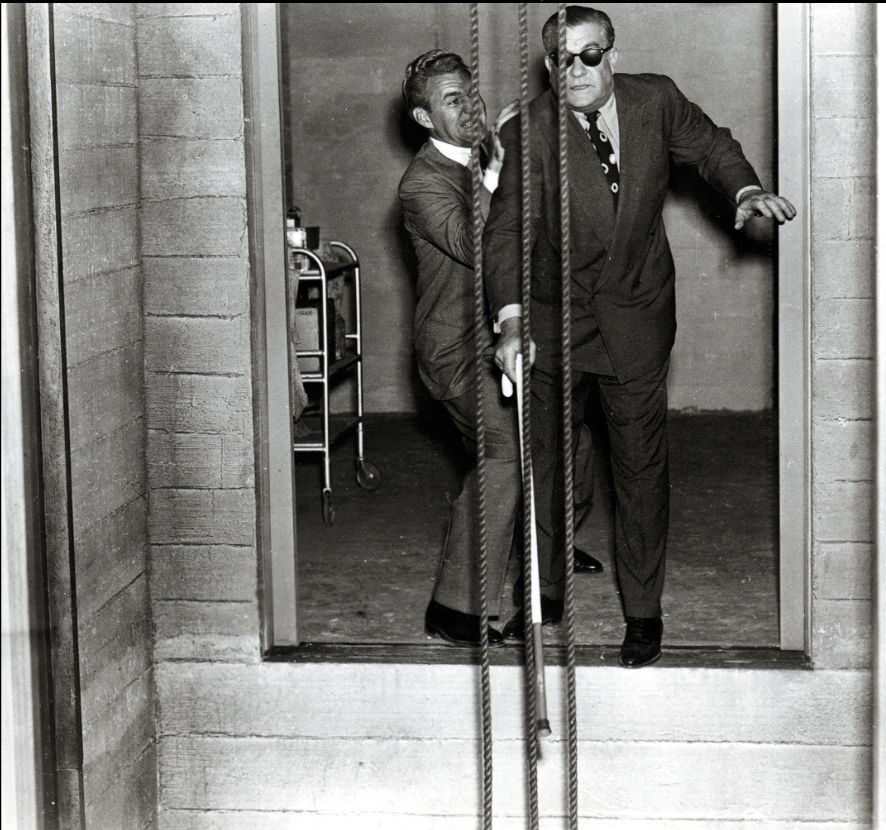
When Joe hears of Rev. Simon’s “accidental” death, he storms off to the penthouse, confronting Nick and Charley and accusing them of murder. He threatens to tell the truth to the committee. The gangsters react poorly, as you’d imagine.
Things get heated, and it’s looking bad for our hero. But Connie runs upstairs and turns on Chekhov’s tape recorder, then calls Stephens and asks him to send help. The senator has his hands full, as Marte has come to his office and asked to testify to her husband’s innocence. Stephens is appropriately dubious about this offer, but when Connie says her recordings prove Nick and Charley set Joe up, he reconsiders.
Connie runs downstairs to save Joe; however, she unwisely reveals that she’s been spying on Nick this whole time, so he shoots her. The three men struggle, and Charley accidentally shoots Nick just before the cops come running in.
The movie ends in the hearing room, with Stephens (who evidently listened to Connie’s tapes overnight) publicly clearing Joe’s name and apologizing for doubting him. Happy ending!
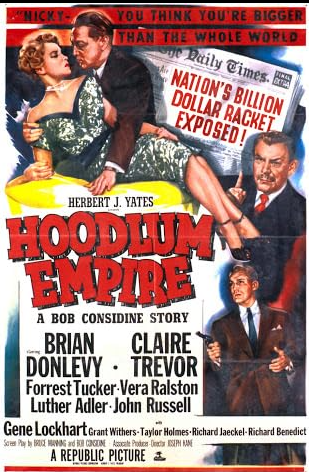
“Hoodlum Empire” received good reviews at the time. Howard McClay of the Los Angeles Daily News called it “plainly the best film entry yet in Hollywood’s race to capitalize on the [Kefauver Committee] hearings.” He noted that “the film also does a pretty fair job of displaying the octopus-like hold the crime syndicate has upon the nation.”
Inez Robb of Considine’s own International New Service said the film was “abrim with noble sentiments s well as gore,” and noted that it was “definitively agin sin, corruption and man’s general cussedness.”
How does it hold up today? It’s pretty good, in my view. The overuse of flashbacks is ridiculous and the plot is full of contrivances, but there’s some good acting (particularly from the actors playing Charley, Connie, and Senator Tower). It has enough action to keep the audience engaged for its 92-minute run time.
To me, the most interesting part is the direct references to people and events from the real-life hearings. The movie presumes that the audience is not only knows the hearings generally, but has followed them closely enough to recognize references to Charles Tobey’s harangues or Virginia Hill’s camera-hungry testimony.
It reminds me of the O.J. Simpson murder trial in the 1990s. The trial was a huge national sensation, and people regularly made references and jokes based on figures and moments that wouldn’t make sense if you hadn’t followed the trial. (For instance, “Seinfeld” had a character named Jackie Chiles, a parody of Simpson defense attorney Johnnie Cochran. And don’t get me started on all the “If the glove don’t fit, you must acquit” jokes.)
This just demostrates that the Kefauver Committee hearings were as big a cultural sensation in their era as the Simpson trial was in the ‘90s.
If you’re so inclined, you can watch the movie here:

 Estes Kefauver for President
Leave a comment