
The hearings held by Estes Kefauver’s Senate subcommittee on organized crime were a national sensation. They were nationally televised; however, as many Americans in the early 1950s didn’t yet have TVs, movie theaters also ran the hearings, advertising them just like the latest Hollywood blockbuster, as in this ad from March 1951:
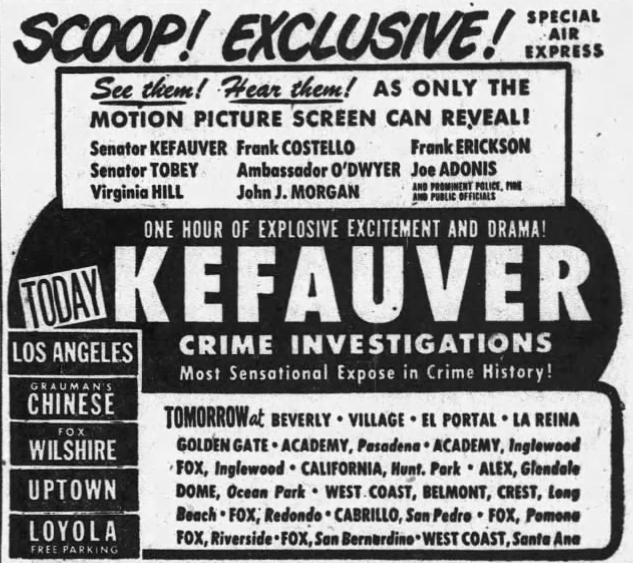
The hearings sparked a national wave of interest in organized crime, and Hollywood responded with a string of pictures about that subject. I’ve been running an occasional series of these movies.
First, I wrote about “The Captive City,” a movie whose plot was built around a crusading reporter attempting to testify to the Kefauver Committee before the mob could rub him out; that film featured an appearance by Kefauver himself at the end, reminding Americans of the importance of standing up again gambling and vice in their own cities, to keep criminal syndicates out.
Last month, I wrote about “The Enforcer,” which featured Humphrey Bogart as a district attorney trying to prosecute a case against Murder, Inc., provided he can keep them from bumping off his witnesses. It was based on events that happened a decade before the Kefauver hearings – but since the movie came out during the height of Kefauver-mania, the studio convinced the Senator to film an introduction, allowing them to tie the film to the hearings.
Today, I’m writing about “The Racket.” Like “The Enforcer,” it came out in 1951 amid the wave of public interest in Kefauver’s crime hearings. Also like “The Enforcer,” it was based on events that had happened years earlier, but the producers sought to tie it to the popularity of the Kefauver hearings through an appearance by the man himself.
Unlike “The Enforcer,” however, they wanted the Senator to appear in the movie… as an actor.
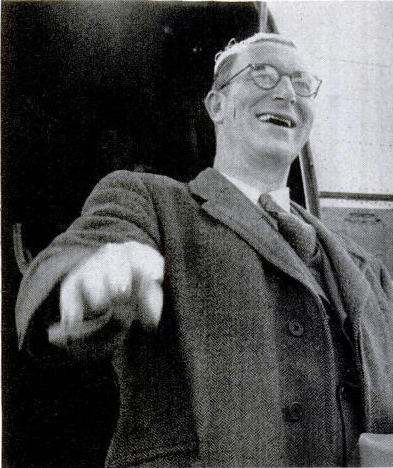
“The Racket” was a remake of a 1928 silent film by the same name, which itself had adapted by writer Bartlett Cormack from his Broadway play of the year before. That play had helped launch the career of Edward G. Robinson, who played a gangster of the sort he would play countless times in movies for decades to come.
Both the play and the 1928 movie were a fictionalized version of real-life events in Chicago, with characters appearing as stand-ins for Al Capone and Chicago mayor “Big Bill” Thompson. The 1951 remake essentially retained the plot of the 1928 version, but with some additions.
From the beginning, the producers of the 1951 remake made no secret of the fact that they hoped to capitalize on the popularity of the crime hearings. Producer Edmund Grainger admitted to AP’s Bob Thomas that “the hearings hurt the picture business, because people stayed at home and watched their TV sets instead of going to the movies.”
Still, Grainger felt that the hearings would be beneficial for Hollywood in the long run, because “people are now more aware of and concerned about gambling and gangsterism.” Grainger clearly expected that the public’s new awareness of gangsterism would lead to a new interest in films like his.
The producer also credited Kefauver’s hearings for clearing the way for “The Racket” with the Johnston Office (the film industry’s morals censorship office, also known as the Hays Office). Grainger said that the Johnston Office originally objected to the movie’s implication of a tie-up between criminal gangs and politicians. “Then the Kefauver hearings came along and showed the connection of crime and politics in many areas,” said Grainger. “After that, I didn’t have any trouble with the Johnston office.”
The film’s marketing made numerous attempts to connect “The Racket” with the Kefauver hearings. For instance, here’s one of the film’s posters, making explicit reference to the Kefauver Committee:

Or take a look at the trailer, with its line “More SHOCKING than a government probe!”
In March, before filming even began, Grainger told newspapers that he had the cooperation of the Senate subcommittee in making his film. Part of that cooperation, he hoped, would include Kefauver playing an acting role.
Grainger apparently discussed the idea of the Senator appearing in the movie, playing a fictionalized version of himself. Kefauver turned down the idea, pleading a lack of time. Grainger later asked him about filming a foreword, similar to the one he had done for “The Enforcer.” That also fell through; possibly, the Senator had second thoughts after his speech was excised from “The Enforcer” during the film’s run.
Watching the movie, it’s clear how Grainger would have worked Kefauver into the film. At the beginning and end of the film, they shoehorned in a bit about a “crime commission” that’s investigating official corruption. Once Kefauver declined to participate, the commission was changed into a state crime commission. Veteran radio announcer Les Tremayne played the head of the commission, the role that presumably would have gone to Kefauver.
Grainger also claimed that the Senate hearings affected the portrayal of the gangsters themselves. In the hearings, he said, “[p]eople were able to see firsthand what gangsters really look like and how they operate. Now you can’t fool them with anything phony.”
No longer, Grainger said, would the public buy the portrayal of gangsters as tough-talking hotheads like Robinson’s Johnny Rocco in “Key Largo” or ruthless maniacs like James Cagney’s Tom Powers in “Public Enemy.” “We can’t get away with that sort of thing any more,” he said.
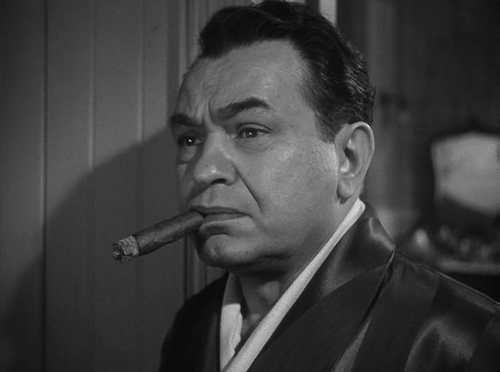
In “The Racket,” the primary crime boss is Nick Scanlon (played by Robert Ryan), who has a short temper and a great fondness for violence, much like Johnny Rocco or Tom Powers. However, these qualities which do not endear him to the nationwide syndicate that has apparently moved in on his action.
Scanlon’s nemesis is Police Captain Thomas McQuigg (Robert Mitchum, playing against type). McQuigg is the lone honest cop battling against the criminal element.
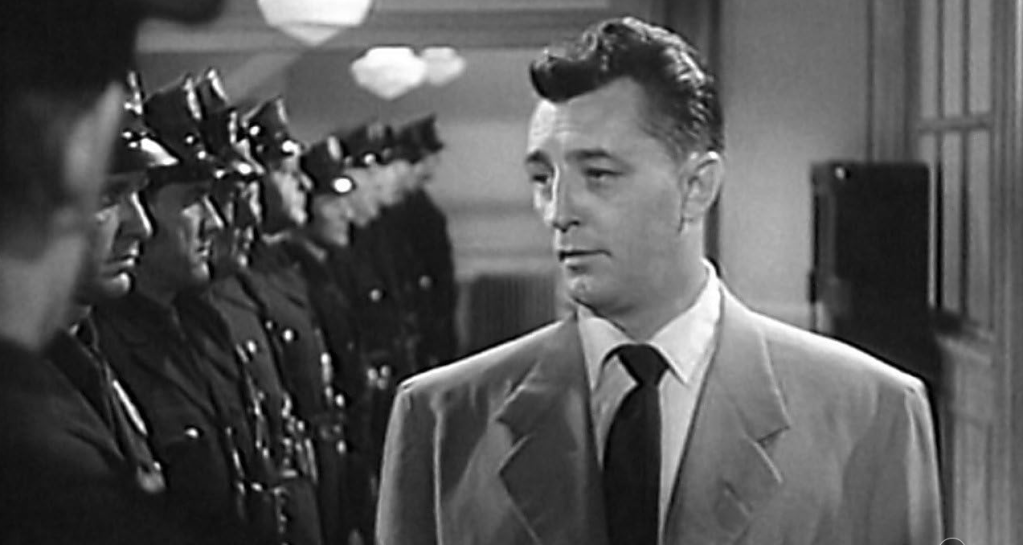
(One thing all of these movies have had in common is the lone-wolf hero, taking on the corruption and criminality all around him. Thanks to the hearings, Kefauver represented such a figure to many Americans at the time. The irony there is that Kefauver kept pointing out that took a whole community – not a lone hero – to effectively fight against organized crime.)
Because the police department is so corrupt, McQuigg keeps getting reassigned to different precincts in hopes of containing him. In his latest precinct, he finds a fellow honest cop, Officer Bob Johnson (William Talman). Together, they aim to take down Scanlon, who McQuigg suspects of being behind the killing of Roy Higgins, who was going to testify to the crime commission.
McQuigg has Johnson arrest Scanlon’s younger brother Joe along with his girlfriend, nightclub singer Irene Hayes (Lizabeth Scott), who McQuigg holds as a material witness. When Joe tries to pin his crimes on Irene, she gets mad and (with some prodding from McQuigg) agrees to testify against both Scanlon brothers.
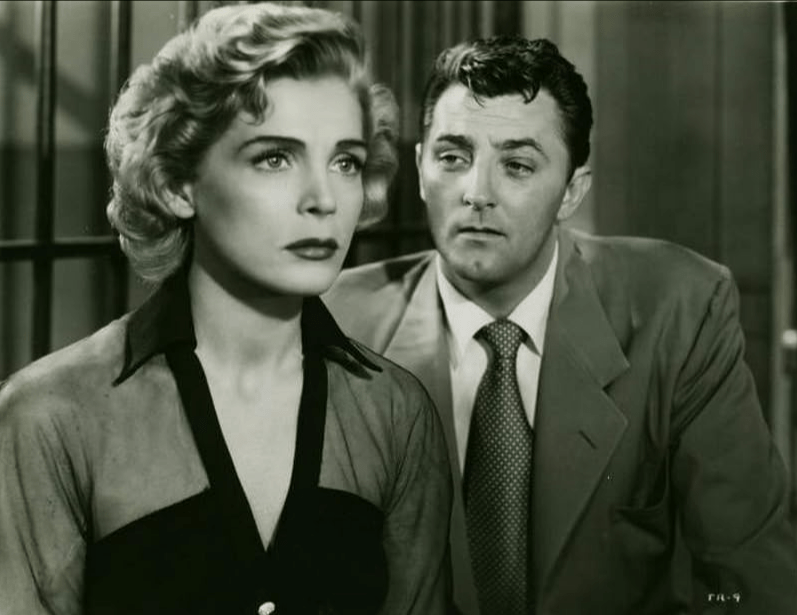
Nick comes to the police station hoping to free Irene, but winds up shooting and killing Officer Johnson. McQuigg then arrests Nick for Johnson’s murder; Nick tries to shoot his way out, but McQuigg had emptied the mobster’s gun of bullets, so Nick is shot dead instead. In walks Craig, head of the crime commission, with subpoenas for everybody. Happy ending!
As these sorts of films go, “The Racket” is solid but unspectacular. The plot is fairly predictable, and it’s hard to buy Mitchum as a cop, honestly. Ryan makes a convincingly nasty bad guy, and Scott is lovely as always (if underused).
The problem is that the plot doesn’t make a ton of sense. Although there’s only one credited director (John Cromwell), IMDb lists a total of six directors, including producer Grainger, who apparently filled in one day. Perhaps the number of directors involved (along with the rumored frequent rewrites and reshoots) are why the movie feels so choppy and incoherent. Or maybe it’s the fact that they bolted the whole “crime commission” subplot in there in order to connect to the Kefauver hearings.
Whatever the cause, the movie doesn’t seem clear on what story it wants to tell. Also, the whole political-corruption angle is underbaked. They obviously made a deliberate choice never to show the audience the “Old Man,” the guy pulling the strings. But it feels a bit like there’s nobody behind the curtain. (Also, why the syndicate, with its clearly-stated preference for maintaining a respectable public face, is willing to put up with a violence-loving hothead like Nick is beyond me.)
I can’t embed the movie here, but you can rent or buy it on YouTube if you’re so inclined.
Both “The Enforcer” and “The Racket” were movies with existing stories that attempted to capture the public fascination with the Kefauver hearings. Next time, I’ll look at a movie that – like “The Captive City” – was inspired directly by the hearings themselves.

 Estes Kefauver for President
Leave a comment