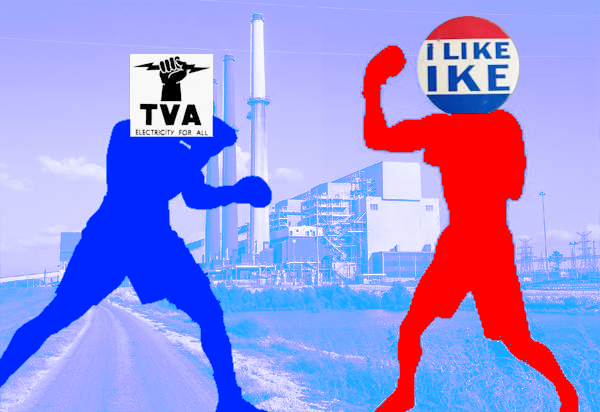
Estes Kefauver and the Tennessee Valley Authority were a match made in political heaven. Kefauver made defense of the TVA one of the pillars of his Congressional career. In Part 1 of this series, we looked at the early days of the agency, and how Kefauver led a bloc of House members to protect the TVA from a home-state Senator who wanted to turn it into his personal patronage machine. In today’s Part 2, Kefauver and the TVA face their stiffest challenge yet.
Here Comes the General
When Dwight Eisenhower was first running for President in 1952, he had some kind words to say about the TVA. But once he was elected, he quickly made clear that he was not a fan. His initial budget proposal slashed the appropriation for TVA by about 25%.

Worse yet, Eisenhower appointed several members to his administration – such as Clarence Manion, chair of the Intergovernmental Relations Committee – who called for TVA to be sold off to private companies.
In prior years, Kefauver and other TVA supporters in Congress had to fight off attacks from conservative critics would-be bosses like Kenneth McKellar. But throughout its life, the TVA had been able to count on support from friendly Democrats in the White House. With a skeptical GOP in control of both the executive branch and Congress, the agency – along with the prospect of public power in general – now faced what Kefauver considered a battle for survival.
Heading into his reelection campaign in the 1954 midterms, Kefauver was geared up for the fight. He denounced Manion’s remarks as “just another example of what those being appointed to various ‘study’ commissions by the Eisenhower Administration have in store for public power.” He defended public power as “a traditional American policy” and said that its opponents would be “electrocuted at the polls, or at least seriously shocked.”
Democrats had a successful election cycle in 1954, winning back control of both houses of Congress. But the threat to TVA wasn’t over. Kefauver continued his battle with the White House, this time in a proxy battle that involved the atomic bomb and briefly made two obscure power company executives into national names.
Mayhem in Memphis: The Battle Over Dixon-Yates
Like many political scandals, the war over the Dixon-Yates contract is a bit complex to understand in hindsight. What follows is a brief (and hopefully understandable) summary.
In the early ‘50s, the city of Memphis (which got its power from the TVA) was booming. It growing population led to a need for more power, more than the TVA could supply with its current capacity. In his final budget, outgoing President Harry Truman included a line item for the TVA to build a steam plant just north of the city to address the shortfall.
When Eisenhower took office, however, he removed the funding for the Memphis plant from the budget. He wanted the city to build its own power plant, but the city balked. TVA direction Gordon Clapp proposed a solution: The TVA was under contract with the to provide 600,000 kilowatts of power annually to the Atomic Energy Commission’s (AEC’s) uranium enrichment plant in Paducah, Kentucky. If the AEC could find somewhere else to get its power, then the TVA would have plenty of excess capacity to supply Memphis and other growing cities in its service area.
The administration agreed to this approach, but what happened next was fairly strange. The AEC contracted – supposedly on TVA’s behalf – with two private power companies to build a steam plant in West Memphis, Arkansas, just outside of the TVA boundaries. The plant would generate the 600,000 kilowatts needed by the AEC, but it would connect to the TVA grid. This contract became known as “Dixon-Yates” after Edgar Dixon and Eugene Yates, the executives of the two companies who would partner to build the plant.

This arrangement naturally led to a number of questions. Why was the AEC negotiating for power on TVA’s behalf? Why weren’t any representatives of TVA included in the negotiations? And if the AEC needed power in Paducah, why weren’t they building the plant there instead of near Memphis, hundreds of miles away?
The administration wasn’t particularly interested in answering any of these questions. But given that they had a majority (albeit a slim one) in both houses of Congress, their odds of pushing the contract through seemed good.
On the campaign trail in Portland, Oregon, Kefauver – who viewed Dixon-Yates as the first step in an attempt to privatize the TVA – attacked the deal, saying that “the government has officially abandoned to the whims of a little group of power barons… the opportunity to decide how much power will be produced and what they will charge for it.” Meanwhile, in the Senate, his Tennessee colleague Albert Gore led a 13-day filibuster to modify the Atomic Energy Act to prohibit the Dixon-Yates contract, but the effort failed.
Just when it seemed that the administration might be in the clear, the deal faced scrutiny from an unexpected quarter. The Senate Antitrust and Monopoly Subcommittee – where Kefauver would later do his greatest work – was still in GOP hands. However, its chair was Senator William Langer of North Dakota, a noted maverick who found common cause with Kefauver on several issues. He was just as suspicious of Dixon-Yates as Kefauver, and he announced that he would hold hearings into the deal.
The GOP leadership moved quickly to quash Langer’s probe, voting against funding for the hearings. Undaunted, Langer used funds from his own office to hold the hearings instead, and said he would fund them out of his own pocket if necessary. (They didn’t call the man “Wild Bill” for nothing.)

However, although Langer’s hearing lasted until the end of October, they failed to turn up enough evidence to halt the deal. And once Democrats regained the majority in the midterms, Eisenhower rushed to get the contract approved in the lame-duck session. Ignoring a mandatory 30-day review period, the Joint Atomic Energy Committee approved Dixon-Yates on a party-line 10-8 vote. After a drawn-out battle, the Eisenhower administration had won.
Or had they? Neither Kefauver nor the incoming Democratic Congress was about to let the matter drop. The Senator fired a salvo in the pages of The Atlantic in January 1955, denouncing the Dixon-Yates deal. The article detailed the ways in which the contract represented what we would today call crony capitalism – and noted that the proposed power plant site was located in a flood plain. Ultimately, Kefauver argued that the deal was merely a first step toward the real goal, that it “sets the stage for the future liquidation of the TVA and the elimination of public competition. If the Dixon-Yates deal goes through, a lot of municipal and rural coöperatives are in for devouring, and consumers all over the nation will feel the digestive pains.”
Senate Judiciary Committee chair Harley Kilgore set up a special committee, headed by Kefauver, to pick up where Langer’s hearings left off. Kefauver’s investigation turned up a key piece of information.
Adolphe Wenzell, a vice president with First Boston, one of the banks financing the Dixon-Yates deal, had also served as an unpaid consultant to Eisenhower’s Budget Bureau on TVA matters including the Dixon-Yates contract. The administration, when asked to provide a chronology of the deal, had made no mention of Wenzell.
The scandal deepened when the committee discovered that Wenzell had been in Budget Bureau meetings discussing TVA’s financing at the same time that he was negotiating with Dixon and Yates over the power plant contract. It was a classic conflict of interest. (Wenzell did himself no favors when he was hauled before the committee and derided the TVA as “galloping socialism.”)

As Wenzell’s conflict of interest became known, the scandal threatened to engulf the administration. Kefauver’s committee called former budget director Rowland Hughes and AEC Chair Lewis Strauss to testify; asked whether they had discussed Dixon-Yates with President Eisenhower or his chief of staff Sherman Adams, both declined to answer, citing executive privilege. (For those who thought that President Nixon made up that concept, think again.) Even so, it was clear that the President and his senior staff were either ill-informed or engaged in a coverup.
It was increasingly clear that President Eisenhower needed an out from the situation; fortunately, he soon found one. In June 1955, the city of Memphis announced that it would work with the TVA to build its own power plant after all, contracting with another group that had not been permitted to bid on the Dixon-Yates deal.

Based on this announcement, new TVA chair Herbert Vogel recommended that Dixon-Yates be canceled, since the power was no longer needed. Two weeks later, President Eisenhower ordered the cancellation. (The AEC later ruled that the contract was invalid due to Wenzell’s conflict of interest. Dixon and Yates had the gall to sue for damages; the Supreme Court slapped them down.)
For his part, Kefauver kept on holding hearings into the deal that he called “bad business, bad government, and bad morals” until Democratic leadership forced him to call off the dogs at the end of 1955.
TVA Is Here to Stay

The TVA received permanent relief from future Dixon-Yates-style shenanigans in 1959, when they were permitted to fund itself by floating bonds. Never again would they need to rely on bruising appropriations battles or the whims of cranky Congressmen. Kefauver had helped secure TVA’s future as an independent agency and save them from the threat of privatization.
Although Kefauver remained a champion of TVA for the rest of his life, Dixon-Yates was the last major battle he fought on the agency’s behalf. The TVA did figure into another key moment in his career, however.
In the fall of 1958, the TVA solicited sealed bids for a generator at one of its plants. They received virtually identical bids from multiple American companies – along with a much lower bid from a foreign company. Internal investigations within the agency turned up a pattern of nearly-identical bids for a range of electrical products.
Kefauver’s Senate Subcommittee on Antitrust and Monopoly held a series of hearings into the matter. Those hearings sparked a Justice Department investigation that led to 30 electrical companies (including GE and Westinghouse) receiving over $2 million in fines, and seven executives being sent to prison. (More on that story in this article.)
Today, the TVA is the largest public utility and sixth-largest power supplier in the US. They provide power to over 10 million people and almost 60 large companies and government installations in the valley. They also maintain 29 hydroelectric dams, which provide flood control along the Tennessee River and its tributaries. And they don’t take a dime in taxpayer money.
If not for the stalwart efforts of Estes Kefauver, the TVA might have fallen apart years ago, converted into a patronage machine or broken up and sold off for parts. Instead, it has endured for over 90 years, and the residents and businesses of the Tennessee Valley reap the benefits.

 Estes Kefauver for President
Leave a comment