(featured image source: the author’s deranged mind, with an assist from paint.net)
Estes Kefauver was never afraid to stand up for what he thought was right. In a letter to a class of 6th-graders in New Jersey in 1959, Kefauver offered this advice:
Keep in mind that you do not have to agree, at all times, with a majority of your associates. Many of our great patriots sometimes disagreed with the majority; not because it was ‘smart’ to disagree but because they had honest convictions which in the long run proved to be to the best interests of the nation.
Kefauver’s “honest convictions” frequently got him into hot water with Senate colleagues and his opponents back home, but that didn’t deter him from standing by his principles. No issue more clearly illustrates Kefauver’s devotion to principle than his stances on civil liberties. In an era of Cold War hysteria, when Americans feared that World War III was imminent and would go to any length to stop the communist menace, Estes Kefauver was a consistent voice in support of Americans’ rights and freedoms – even when he had to fight those battles alone.
HUAC is Un-American
Kefauver first attracted attention on this issue when he opposed the House Un-American Activities Committee (HUAC). During his time as a Congressman, he cast multiple votes against it. In 1945, he voted against making HUAC a permanent committee. In 1946, he voted against appropriating funds for the committee, making him one of only two Southerners to vote “no.” Later that year, he voted against HUAC’s attempt to hold the Joint Anti-Fascist Refugee Committee in contempt of Congress for defying HUAC’s subpoenas.
These votes were used against Kefauver when he ran for Senate in 1948, when E.H. Crump and other opponents accused him of being soft on communism. Kefauver defended his votes stoutly, stating that HUAC “was smearing the names of innocent people” and that the contempt citation against the Refugee Committee “clearly violated their Constitutional rights and liberties.”
As to the general charge of Communist sympathies, Kefauver replied:
Mislabeling the bottle never changes the contents. There are a few who define “Communism” as “anyone who opposes their candidates” – in other words, anyone who opposes Government by political dictation… I have never believed in and I am unarguably against any ‘ism’ except AMERICANISM.
“Violence to the Constitution”: The Internal Security Act
As a Senator, Kefauver remained firm in his commitment to civil liberties, even as Cold War tensions continued to rise. In 1950, he was a leading critic of the Internal Security Act. The act was a truly unconstitutional abomination. It required Communist organizations to register with the Attorney General, established a Subversive Activities Control Board to investigate people alleged of anti-American activities. It tightened alien exclusion and deportation laws, and allowed the Attorney General to detain anyone believed to be a threat to national security.
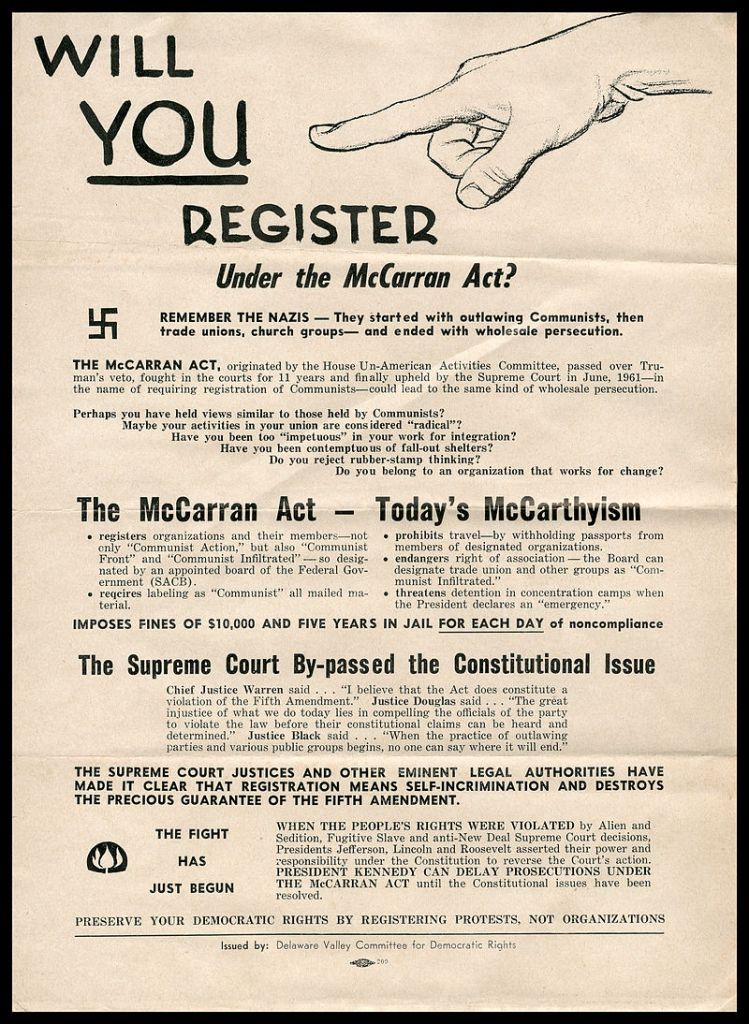
Kefauver was one of only seven Senators to vote against the bill. A disgusted President Truman vetoed the bill, correctly terming it “a mockery of the Bill of Rights” and a “long step toward totalitarianism.” The House overrode Truman’s veto the same day. Meanwhile, Kefauver took to the floor of the Senate to urge his colleagues to uphold the veto.
He started his message by calling out the motivations behind the bill:
Fear and hysteria are powerful moving forces, and cause men to do things which in calm course they would never even consider doing. Were it not for the insidious threat of communism, and were we not in the very shadow of world war three, virtually no thinking American would ever consider asking Congress to enact laws to control the thoughts of any of its citizens.
Kefauver pointed out the bill’s blatant unconstitutionality:
Any intelligent layman who will read the Constitution and then read the bill will have a feeling that it endangers many basic rights we Americans hold so dear – freedom of speech, press, assembly, thought, and the right not to have to give evidence against one’s self.
He concluded that he was standing firm on principles – American principles.
When I entered this body I took an oath to support the Constitution. I could not live with my conscience if I gave my approval to a bill which does violence to the Constitution, to the Bill of Rights, and which I think destroys many of those freedoms which make America the great land of the free.
In spite of Kefauver’s valiant efforts, the Senate overrode the veto the next day, 72-10. As was often the case, however, time proved Kefauver right. A series of Supreme Court decisions in the mid-1960s held that the Act’s provisions preventing communists from getting passports, requiring Communist Party members to register with the government, and prohibiting communists from working for the federal government were all unconstitutional. And in 1971, President Nixon signed the Non-Detention Act, repealing the provision that allowed emergency detention of suspected national security threats.
Two years later, Kefauver took up his sword again to oppose the McCarran-Walter Immigration Act. In addition to maintaining existing immigration quotas that favored Northern and Western European immigrants, the law made review and naturalization procedures more strict, banned the immigration of anyone declared a “subversive” by the government, and made Communist Party and “communist front” group members subject to deportation.
While speaking on the campaign trail in Michigan, Kefauver expressed his opposition to the bill, saying “I am certainly inalterably opposed to any immigration law motivated by bias, discrimination against certain racial stocks or religions and which violates our Democratic tradition.” Despite his efforts, Congress passed the bill. When President Truman overrode the bill (again, only to see the veto overridden), Kefauver sent him a telegram saying, “I am grateful for your strong defense of American decency and fair play.”
Fighting the Red Scare Alone
With Republican taking over both the White House and Congress in 1953, the Red Scare only amped up, with the notorious Senator Joe McCarthy of Wisconsin leading the way.
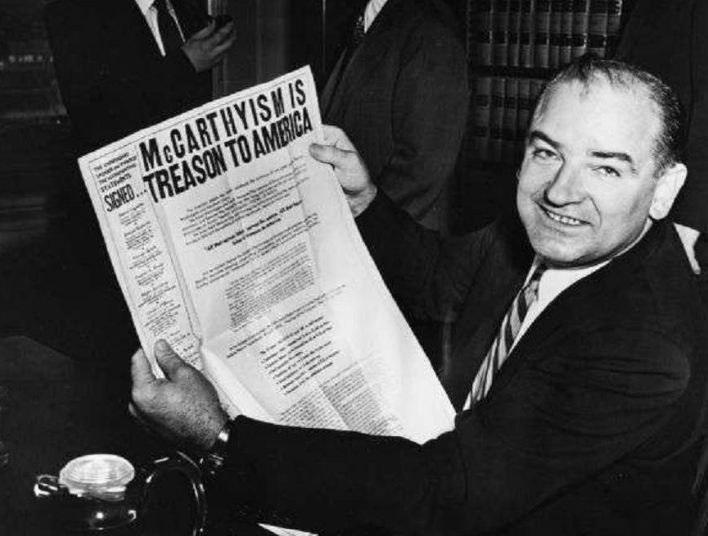
A distraught Kefauver wrote a letter to then-Minority Leader Lyndon Johnson deploring the “excesses to which various committees of Congress have gone in the fields of so-called subversive investigations” and noting that “[o]ur personal liberties are not safe under the present arrangement.”
As the hunt for suspected communists gained national attention, though, the Democrats began to panic. With the mid-term elections of 1954 approaching, the party feared that soft-on-communism charges might lead to an electoral wipeout, and were desperate for some way to demonstrate their bona fides on the issue.
This led them to propose an amendment to the Communist Control Act, then under consideration in Congress, that would make membership in the Communist Party a criminal offense. This might as well have been called the “Hubert Humphrey Re-Election Protection Amendment,” as it was clearly intended to protect the electoral fortunes of the Minnesota senator, who was facing a tough race that year. The fact that a liberal lion like Humphrey was sponsoring such an amendment gives you a sense of just how fevered the atmosphere was at the time.
The Democrats were all on board with this plan. All except one, that is: Estes Kefauver. The man from Tennessee – who, I should point out, was also facing a tough campaign that year – couldn’t swallow this gross offense against civil liberties. He took to the floor of the Senate to express his concern about “the precedent of outlawing a particular group. Perhaps next year Congress will not like some other group… In the history of our Nation, has any group ever been outlawed or condemned as illegal by legislative enactment?”
To those who said the Republican’s Red Scare smears justified the amendment, Kefauver replied:
“The Democratic Party is the traditional defender of civil liberties – we have fought efforts to deprive men of freedom of thought, religion, and speech. A grievous wrong inflicted on us by Republicans does not justify our inflicting an even greater wrong upon the protections given our people by the Bill of Rights.
Democratic leaders in the Senate were apoplectic about the revolt. So were the members of Kefauver’s campaign staff. They all begged Kefauver to just shut up and let the amendment pass. But he refused, saying: “I can’t. It’s a bad bill. I’ve got to oppose it.”
In the end, the amendment passed the Senate 81-1, with Kefauver alone in his opposition. His brave stand, however, led some of his liberal colleagues to check their consciences, which prompted second thoughts. In the end, the amendment was dropped from the final version of the bill. Meanwhile, the people back home praised Kefauver for his convictions.
As for McCarthy, he threatened to come to Tennessee and go on the war path against Kefauver’s re-election. Unintimidated, Kefauver went to Wisconsin and gave a speech blasting McCarthy. When it came time for ol’ Tailgunner Joe to hold up his end of the bargain, he was too busy getting censured by the Senate to make the trip. Kefauver cruised to another Senate term.
In times of fear, whether over war or over seismic cultural changes at home or abroad, it can be all too easy to abandon our commitment to the bedrock liberties and rights that make America a great nation. We’re so scared about the threat that we’re willing to toss the Constitution overboard to stop it.
In times like that, we need shining examples like Estes Kefauver – people with the courage to do the right thing, even when it’s hard. We need people like Kefauver to remind us what we really believe in.

 Estes Kefauver for President
Leave a comment