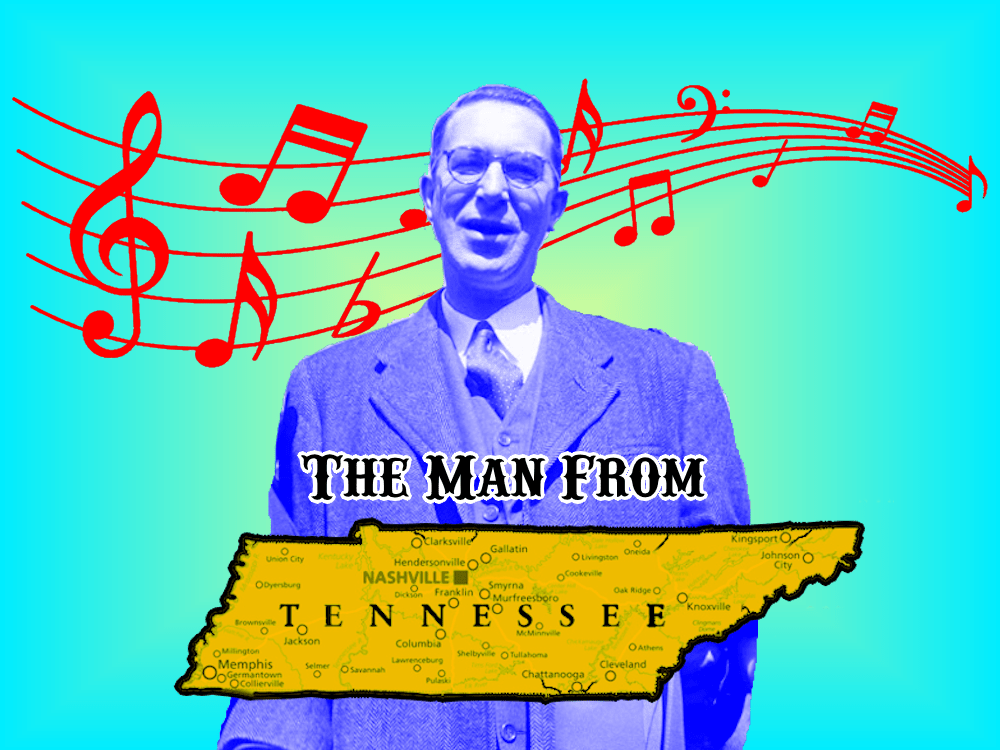
I’ve mentioned before what a huge cultural phenomenon Estes Kefauver was in the early 1950s. His widely popular televised hearings into organized crime inspired a wave of movies inspired more or less directly by his hearings and the criminal activity they uncovered. And his 1952 Presidential campaign inspired a number of songwriters who hopes to capitalize on his fame to boost their own careers.
Previously, we’ve written about Hank Fort, the Nashville singer-songwriter who catapulted to fame on the strength of her Kefauver campaign songs, eventually settling into life as a prominent DC hostess and sort of proto-Mark Russell.

Today, we’ll look at another songwriter who hitched his wagon to Kefauver’s rising star – although less successfully than Fort did.
Hampton P. Carter was born in 1914 in Madison, North Carolina, a small town not fear from the place that inspired “The Andy Griffith Show’s” Mayberry. Like many Americans of his generation, he enlisted in the Army during World War II. However, his dreams of heroism were derailed when he was badly injured while practicing parachute jumping at night.
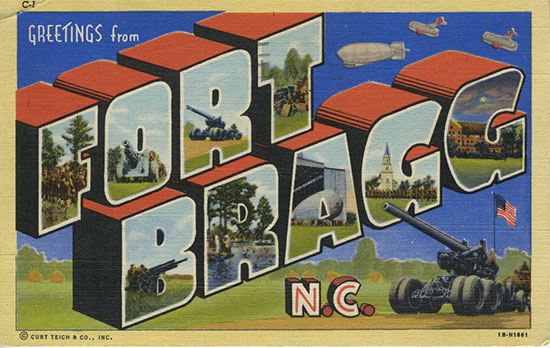
He was hospitalized at Fort Bragg for almost a year while recovering from his injuries. During his recovery, he began jotting down ideas for song lyrics to pass the time.
Once Carter got out of the hospital – and the Army – in 1945, he rejoined civilian life, but he couldn’t shake the songwriting bug. In 1949, while working in Santurce, Puerto Rico, he teamed up with a local musician to develop melodies for his lyrics.
When he returned to the mainland after his Puerto Rican stint, Carter went to New York and attempted to find a publisher for his songs, but he struck out. So he moved back to his home state and got a job with the NC State agriculture department. At night, he kept writing songs and trying to sell them, unsuccessfully.
In 1952, he got married and moved to Greensboro, where he took a job as a freight checker for a trucking company. That spring, he finally succeeding in selling one of his songs, “Honeymoon Bay,” to a publisher in Philadelphia. The song evoked his romantic memories of Puerto Rico.

That June, Carter picked up his songwriter’s pen and wrote “The Man From Tennessee,” an ode to Kefauver. He worked with a Greensboro musician named Howard Crook, who supplied the music to go with Carter’s lyrics.
The song attracted the attention of the local paper, the Greensboro News and Record. The paper reported that Carter “pins a lot of his hopes for the climb to Tin Pan Alley fame” on the song, hoping to benefit from “the booming Kefauver presidential bandwagon.”
“With his ‘The Man From Tennessee,’” the paper reported, “Carter combines his admiration for Senator Kefauver with his love for song-writing.” They added that “[h]e hopes it’s the campaign song fans everywhere will soon be singing.”
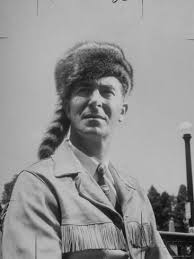
Given his difficult history with the publishing business, Carter wasn’t about to leave his song’s success to chance. He circulated his song around Greensboro and got the town’s Kefauver supporters to sign it. He then slapped a coonskin cap on his head and, with his song/petition in hand, hitchhiked up to DC with plans to deliver the song to Kefauver personally.
This seems like an unlikely plan for success, but Carter somehow succeeded in getting the tune in the hands of the campaign, and they adopted it. “Man From Tennessee” was one of the songs playing on continuous rotation in Kefauver’s campaign suite at the Democratic convention in Chicago, along with two Hank Fort songs, “Long, Tall Guy in the Coonskin Cap” and “Everyone’s Taking A Fancy to Nancy,” as well as “Senator From Tennessee.”
Carter’s supporters back in Greensboro did their part. According to the News and Record, a couple of “radio men” climbed about the Tar Heel Special, the train taking the North Carolina delegation to Chicago, and distributed the sheet music for “Man From Tennessee” to everyone on the train. (Reportedly, no one tried to sing the song.)
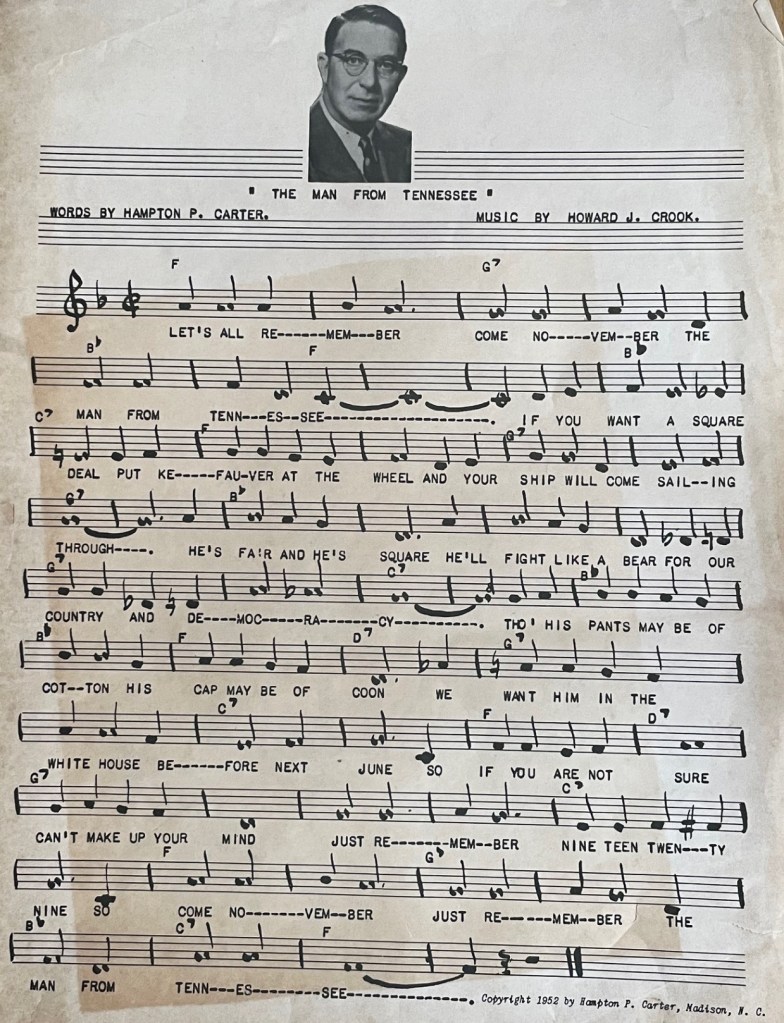
Unlike Hank Fort, alas, Carter’s Kefauver tune didn’t launch him into a successful songwriting career. As for why that might have been… well, let’s take a look at those lyrics.
Let’s all remember
Come November
The man from Tennessee
Okay, a decent enough start. “Remember” and “November” isn’t the world’s most original rhyme, but hey, Carter didn’t choose what month Election Day was in. Moving along:
If you want a square deal
Put Kefauver at the wheel
And your ship will come sailing through
This metaphor… doesn’t exactly land. The idea of comparing a President to a ship’s captain is all right (ask Walt Whitman), but what exactly will the ship “come sailing through”? And why is it “your ship” and not “our ship”? (I should also point out that the “sailing through” line does not rhyme with any other line in the song.)
He’s fair and he’s square
He’ll fight like a bear
For our country and democracy
Using the word “square” twice in the space of two verses is not exactly top-notch songwriting. (And of course, there’s the fact that “square” is slang for an uncool person. In fairness to Carter, that particular bit of slang hadn’t made it to mainstream white culture in 1952.) Kefauver did indeed “fight like a bear” for democracy, but when “bear” comes on the heels of “fair” and “square,” it kind of sounds like he’d run out of words.
Tho’ his pants are made of cotton
His cap may be of coon
We want him in the White House before next June
This is the point where the song really goes off the rails. The bit about the cotton pants is, I suppose, meant to symbolize Kefauver’s status as a man of the people, but lots of men of all income brackets wore cotton pants in that era, especially in the summer. June has nothing to do with the election schedule, other than the fact that it rhymes with “coon.” And why did the song suddenly switch from rhyming the first and second lines of the verse to rhyming the second and third?
So if you are not sure
Can’t make up your mind
Just remember 1929
That’s your argument for Kefauver – that Republicans gave us the Great Depression? (In fairness, this was also a campaign them for Stevenson in the fall.) Additionally, I have serious issues with the scansion of this song.
So come November
Just remember
The man from Tennessee
We wind up back where we started, albeit with a flip of the first and second lines.
In summary, this is one of the weaker entries in the Kefauver song canon. But nonetheless, I tip my (coonskin) cap to Hampton Carter, who had the pluck and self-promotional genius to ride the Kefauver bandwagon to his 15 minutes of fame. I hope he enjoyed the ride!
 Estes Kefauver for President
Leave a comment