It’s easy to overdo the parallels between history and the present. Too often, claims that some historical episode or figure is “just like” something or someone in today’s world rely on a shallow understanding of the past, stripping out vital context and important differences.
That said, we can learn some useful lessons from history that apply to the present day. One reason I’ve spent so much time studying Estes Kefauver’s career is that I think his approach to politics has much to teach us today. In particular, today’s politicians could benefit from adopting Kefauver’s approach to controversial issues.

I thought about Kefauver during a recent social-media argument over trans rights. The Argument, a Substack devoted to arguing for liberalism, published a poll showing that Americans have adopted sharply more conservative views on trans and gender-related issues in the last couple years.
The poll drew fire from trans activists and pro-trans journalists, who claimed that it would encourage Democratic politicians to abandon support for trans people. (Some accused The Argument of deliberately encouraging Democrats to throw trans people under the bus.)

The Argument’s founder Jerusalem Demsas published a thoughtful response to the criticism. She acknowledged that some politicians might read the poll as a sign to abandon trans rights; however, she said that would be a foolish reaction (calling it “thoughtless moderation”). At the same time, she asserted that ignoring or attacking polls showing voters turning against trans issues was politically irresponsible.
Instead, Demsas encouraged both politicians and activists to look more closely at the poll and engage with voters’ actual positions, rather than mindlessly concluding that Americans are now anti-trans.
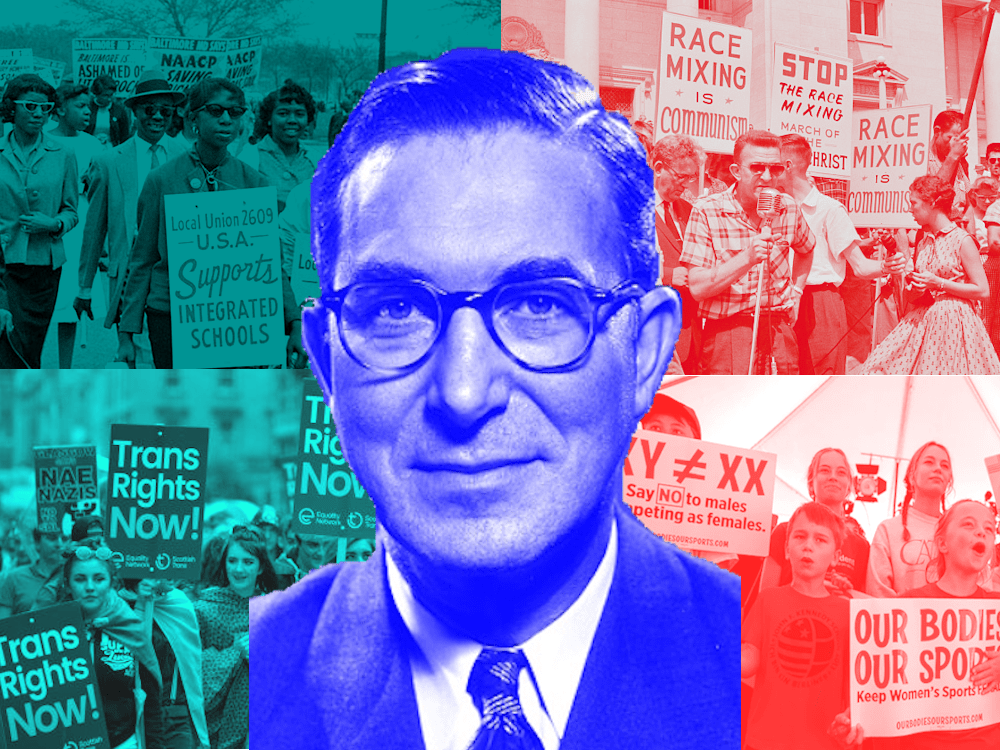
There were several hot-button issues in Kefauver’s era that echoed today’s culture-war battles. The fight over civil rights for black Americans had some resonance with the struggle for LGBTQ rights today. And the Cold War-era fight over restricting civil liberties in the name of fighting Communism parallels today’s arguments over free speech, the ability to suppress unpopular views, and the degree to which we should punish or stigmatize holders of those views.
Kefauver didn’t have access to today’s detailed, high-quality polling. But he spent a lot of time talking – and listening – to average Americans. He knew what voters thought, and he understood how to talk to them about difficult issues, even when they disagreed with him.
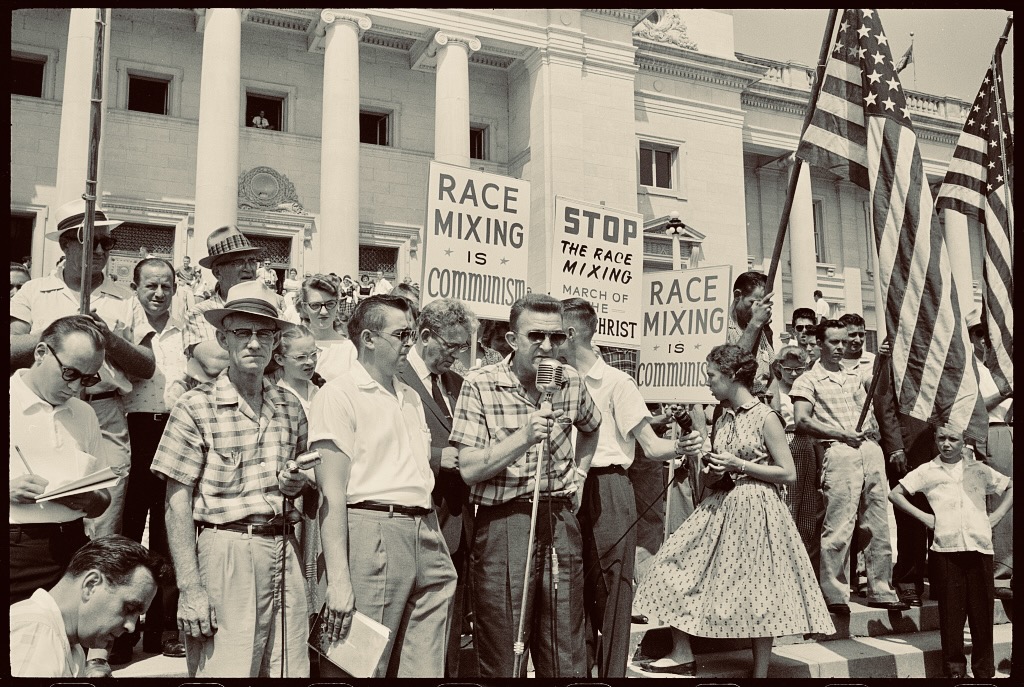
Reading Kefauver’s 1956 Orlando address on civil rights with modern eyes, it feels simultaneously inspiring and a bit disappointing. You’re glad to see him defend the Supreme Court’s authority and state that school integration is the law of the land. But you wish he’d state definitively that segregation is wrong, or that black Americans are entitled to the same rights as white Americans.
Similarly, it’s stirring to see Kefauver defend civil liberties in the face of Red Scare hysteria. But you wish he didn’t feel the need to stress his opposition to Communism every third sentence.
In both cases, however, Kefauver spoke that way because he understood his audience. He knew that if school integration was going to succeed in the South, it would need to be accepted by white people who were still prejudiced against blacks and supported segregation. And he knew that if America was going to protect the civil liberties of alleged Communists, it would require support from people who considered Communism dangerous and evil.
Kefauver didn’t call out voters or tell them their views were wrong. Instead, he sought to bring them together with him on areas where they agreed.
Instead of challenging Floridians’ views on segregation, he invited them to join him in support of the idea that the South was a forward-looking region, or in support of the American system of government. He allowed that reasonable people might disagree with the Court’s ruling in Brown v. Board of Education, but argued that attempts to defy or nullify the decision would lead to anarchy.
Most other Southern politicians, by contrast, chose to appeal to the segregationist leanings of their voters, even if they privately felt otherwise.
George Wallace was endorsed by the NAACP during his first run for Alabama governor in 1958, but adopted an extreme pro-segregation stance after losing that race. Florida Senator George Smathers privately helped LBJ strategize on passing the Civil Rights Act of 1964, but voted against it on the floor. Even Kefauver’s colleague Albert Gore, who was generally liberal on civil rights, tended to back off those commitments in reelection years.
These examples may seem extreme, but in the context of the times, they’re akin to the “thoughtless moderation” Demsas decries. These officials recognized that their (white) constituents supported segregation, so they soft-pedaled, abandoned, or outright reversed their support of civil rights accordingly.
Kefauver stood by his views. But instead of attacking those who disagreed, he evoked more broadly popular ideas (like support of democracy and the people’s right to vote) or condemned more extreme actions (like bombing black churches or integrated schools). He gently guided voters toward support (or at least acceptance) of black civil rights.
Similarly on civil liberties, Kefauver resisted the urge for “thoughtless moderation.” Demsas’ article cites the Laken Riley Act as an example of sloppy (and potentially dangerous) legislation that a lot of Democrats supported in reaction to voter anxiety about illegal immigration.
The Communist Control Act of 1954 was a similarly poorly-drawn bill, featuring numerous blatantly unconstitutional provisions aimed at “outlawing” the Communist Party in America. As with the Laken Riley Act, this bill drew a lot of support from Democrats desperate to respond to voter anxiety, in this case to avoid losing the ’54 midterm elections.

Kefauver, even though he faced a tough re-election race that year, cast the lone Senate vote against the Communist Control Act. He believed that voters would respect his principles; if they didn’t, he believed that he could persuade them to his side. He was right.
A major problem Democrats face today is the belief that they’re out of touch with average voters on cultural issues. Another is the perception that they lack core beliefs and don’t stand for anything other than being less extreme than Republicans.
Democrats may succeed in the midterms, and perhaps in 2028, due to widespread revulsion at the excesses, cruelty, and incompetence of the Trump administration. But if they hope to build a long-term coalition, they won’t do it by swinging like a weathervane at every shift in popular sentiment. Nor will they do it by ignoring public opinion and adopting the most extreme positions of the activists in their base.
Instead, they should follow Kefauver’s example: stand on your principles, and figure out to how advocate for them in a way that takes public opinion seriously.
Demsas lays out some possible approaches in her article. On immigration, Democrats should stand up for legal migration and against the demonization and abuse of immigrants, while proposing solutions to address the public’s concerns about uncontrolled flows of illegal immigration.

On trans issues, Democrats should forcefully oppose anti-trans discrimination in housing and employment, while perhaps moderating on more controversial ideas, such as medical transition for minors or trans athletes competing in high school and college women’s sports. Perhaps more importantly, they need to find a way to talk about trans issues that can attract support from people who aren’t fully comfortable with the idea, much as Kefauver could win votes from pro-segregation Southerners.
In addition to reading – and understanding – public opinion polls, Democrats would benefit from spending more time with voters, as Kefauver did. Instead of overreacting to the loudest shouters on social media, they should get out and listen to their constituents, understand what animates them, learn about their hopes and fears.
Is this a magic bullet? Absolutely not. It’s hard work, and it’s not guaranteed to succeed. But it’s worth a shot.
 Estes Kefauver for President
Leave a comment