
Once upon a time, summer was the slow season in Washington. In the days before air conditioning was common, Congress would wrap up sometime around Memorial Day and then escape the capital before the temperatures soared and the humidity grew oppressive. Downtown DC – at least around the federal buildings – would empty out until September.
Because there generally wasn’t much going on in summer, bored reporters frequently latched on to some minor story to until the autumn rolled around. In 1957, it was the great Senate debate over whether catfish or trout was the superior eating fish. The following year, a scandal erupted because a Senator’s wife dared to be photographed wearing – gasp! – a bathing suit.
Let’s dive in, shall we?
A Fashion-Show Fundraiser Sparks Fireworks
In late May 1958, the Democrats held a fundraising dinner at Washington’s Sheraton-Park Hotel. Among those providing entertainment were Minnesota Rep. Coya Knutson, who played a few tunes on the accordion, and Estes Kefauver, who amused the audience with a series of rope tricks.
But that’s not why the dinner became a story.
The highlight of the evening was a fashion show, in which Senators’ wives modeled clothes made in their home states. One of the models was Maurine Neuberger, wife of Oregon Sen. Dick Neuberger.
Maurine was a former dancer and gym teacher, and she was devoted to exercise and staying fit. Given that Oregon was home to several sportswear manufacturers, it seemed only natural for her to model sports apparel. She appeared in two different outfits. One was a ski suit made by Portland-based White Stag. The other was a one-piece black swimsuit made by Jantzen.
Guess which photograph went public?

Newspapers around the country ran AP wire-service photos of Maurine Neuberger, walking a recalcitrant donkey while wearing the bathing suit. Time magazine helpfully fanned the flames by running the picture with a short item stating that the “leggy” Mrs. Neuberger “slithered out on stage in a figure-hugging one-piece bathing suit.”
With that, the critics were off to the races. It was unbecoming, they said, for the wife of a Senator to appear like that in public, with bare arms and legs and all.
“I don’t know how the voters will like to have their senator’s wife running around at a big dinner in such a skimpy outfit, even if it was made in the home state,” said Sen. Olin Johnston of South Carolina.
One of those voters, Henry Dixon of Portland, wrote to the Oregonian that the swimsuit picture “brings discredit upon the party of Jefferson and Jackson. Some close friend should explain the use of proper discretion in matters of public exhibition to Mrs. Neuberger.”
“[L]ook at the complaints that have come from it,” said Rose Wilcox in her letter to the editor. “She doesn’t consider her age and her size and build. The pose… was really disgusting – too much nakedness.”

Another angry constituent wrote to Mrs. Neuberger directly, fuming that “this is the sort of cheesecake photography that is corrupting the morals of our youth.”
Both Senator Neuberger and his wife were flooded with letters. Many of them were positive and encouraging, but there was enough anger that the Neubergers felt it necessary to reply publicly.
In early June, Maurine Neuberger took over her husband’s syndicated column in Oregon newspapers to respond to her critics.
“I am informed by the Department of Commerce that approximately 12,000,000 women’s swimming suits were sold during 1957,” she wrote. “If it is permissible for all these women to wear bathing suits, then it is equally right for the wife of a U.S. senator to do so.”
She noted that the Jantzen swimsuit was identified by name at the dinner. “Perhaps some of the 1,800 present were induced to buy a Jantzen’s suit,” she suggested, “furnishing employment to Oregon workers.”
She also pointed out that the Oregon Highway Department advertised the state’s beaches using brochures featuring “men and women on the clean white sands in bathing garments.” She added wryly, “I would hate to feel that this was used to lure Oregon’s visitors, yet not regarded as discreet for the wife of one of Oregon’s senators!”
Dick Neuberger also jumped to his wife’s defense. “If Maurine wants to model a bathing suit, it doesn’t make any difference whether I’m a senator or not,” he said. “I want her to be herself.”
The Neubergers’ response was picked up by the AP – which, of course, gave newspapers around the country an excuse to run the pictures again, ensuring that the controversy continued to rage.
The Pols and Pundits Weigh In
Lyndon Johnson responded exactly how you’d expect. “I don’t think it’ll do Dick a bit of harm politically,” he said. “In the first place, the bathing suit was manufactured in Oregon and gave jobs to Oregon workers. Secondly, Maurine looked very tip-top in it!”
The Minneapolis Star-Tribune asked the wives of Minnesota’s Senators and Congressmen about the issue.
Hubert Humphrey’s wife Muriel offered sympathetic support. “I agree with her completely,” she said. “But I’m sure she didn’t expect or want a picture to get into the papers.”
Republican Rep. Walter Judd’s wife was a bit more critical. “In a fashion show anything goes,” she posited. “But I don’t think Mrs. Neuberger would say that these 12 million women who bought bathing suits should wear them on the streets.”
Perhaps the best response came from Gisela Blatnik, wife of Democratic Rep. John Blatnik. “I’m sure Mrs. Neuberger modeled in the spirit of fun,” Mrs. Blatnik said. “There’s no harm in that. If someone asked me, I probably wouldn’t mind doing the same thing.”
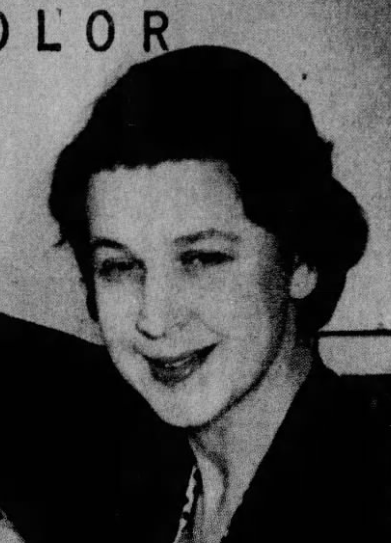
As the weeks went on, the coverage shifted in the Neubergers’ favor – although many of Mrs. Neuberger’s supporters adopted an unfortunate leering tone in their defense.
Take, for instance, syndicated columnist Fred Othman: “One of the most beautiful women hereabouts, in a bathing suit or otherwise, is Mrs. Richard L. Neuberger, wife of the Democratic senator from Oregon. Even the bluenoses, who take a dim view of feminine legs, can’t argue with that… [T]he Senator and his lovely Maurine now are in the midst of defending legs, particularly hers. As an admiring bystander I don’t think they need defense.
Or take Newsday columnists Hal Levy and Bonnie Angelo, who noted that “Maurine’s gams… could be appreciated by any political party.”
Or how about A. Hoyt Ellis of Portland, who wrote in to the Oregonian: “Desiring to be of help in settlement of the controversy now raging, I’d like to state that I have made a careful study of the photos of Mrs. Neuberger in her pose in a modern bathing suit, and it is my sincere conviction that she is fully qualified in every way to appear publicly in that costume; I know of no one else in public life so well qualified.”
More Than Just A Pretty Face
What comments like these missed was that Maurine Neuberger was indeed well qualified for political life, for more reasons than her looks.
The Neubergers had been deeply involved in Oregon politics ever since their 1945 wedding. Maurine served two terms in the Oregon State House while Dick was serving in the State Senate. She resigned her seat in the legislature when Dick was elected to the U.S. Senate in 1954, but she remained a key advisor and strategist to him. On Capitol Hill, the Neubergers were regarded as a legislative team.
Dick Neuberger made Americans aware of this in a column for Parade magazine that served as a combination commentary on the scandal and love letter to his wife and political partner.

“Of one thing I am sure,” he wrote. “My wife is going to be her own normal self, without regard to politics… She wouldn’t have it any other way. If the voters don’t want us as the kind of people we actually are, then Maurine sincerely believes they should elect somebody else.”
He pointed out that that wasn’t the first time Maurine had faced a swimsuit-based controversy. When both Neubergers were running for election in 1954 – she to the State House, and he to the U.S. Senate – she was photographed in a swimsuit.
When people complained then, he pushed back: “Am I not being completely unfair to expect my wife to give up her swimming just because I have political ambitions? Would you want a senator who is that selfish?”
He concluded with some advice for aspiring politicians. “Men with political ambitions frequently wonder how their wives can help their careers,” he wrote. “My own experience has convinced me that many of these couples try too hard. The wife exaggerates in public her awe and admiration for her husband. The husband, conversely, often exhibits too ostentatiously his affection and solicitude for his wife. The average voter is not a fool. If he decides that the couple seeking his vote is acting a staged role, then the outcome on election day may be disastrous indeed.”
Senator Neuberger’s admiration and appreciation for his wife’s spirit and independence shone through, and it largely put the controversy to bed.
After Dick’s Death, Maurine Takes the Torch
Sadly, the Neubergers’ partnership wouldn’t last much longer. That fall, Dick was diagnosed with testicular cancer. Treatments were ineffective, and the cancer spread. In 1960, he ran for re-election despite having received a terminal diagnosis, keeping his condition a secret.
When his campaign manager expressed concern about his apparent unwillingness to campaign actively, the Senator told him, “Remember, there’s always another Neuberger.”
Dick Neuberger died of a cerebral hemorrhage in March 1960 at the age of 47. Maurine won the special election for the remaining months of her husband’s term, and she won a full term that November.
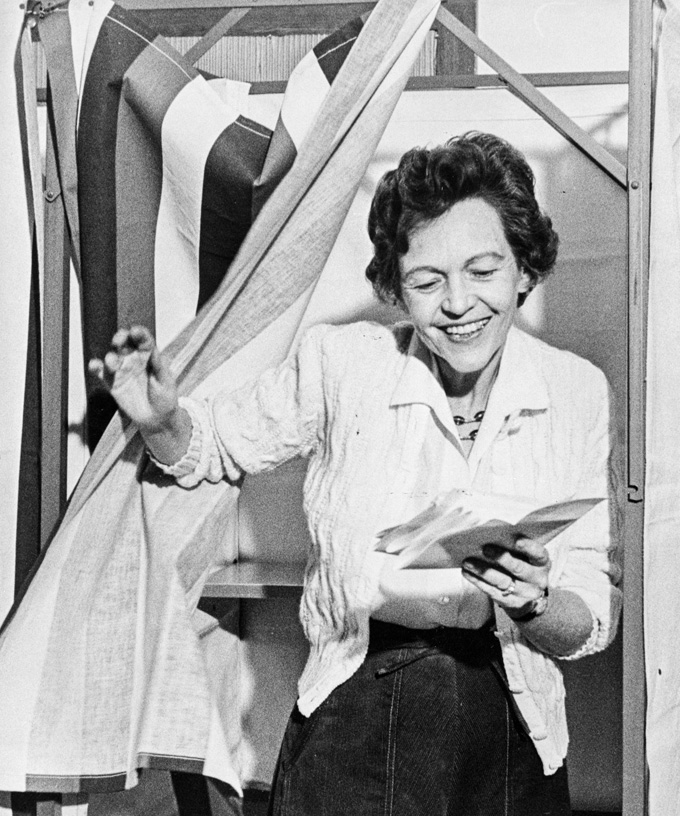
She served six years in the Senate, declining to run for re-election in 1966. During her term, she focused on environmental and consumer issues, becoming a crusader against the cigarette industry. (She was a former smoker who had kicked the habit.) She sponsored one of the first bills to require warning labels on cigarette packs.
During her term, Maurine Neuberger allied closely with Kefauver. In an oral history interview, she described him as “a very good mentor to me,” and noted his persistence in fighting for seemingly lost causes, even when no one seemed to listen. “But he kept at it,” she said. “He never let up. I watched him… [I]t was that dogged determination.”
She leaned on Kefauver’s example during her battles against the cigarette industry, and earned a reputation as a tenacious fighter – just like Kefauver, and just like her late husband.
In the end, the controversy over Maurine Neuberger’s legs faded away with the summer heat. It was her brain and her guts that made a lasting impression.

 Estes Kefauver for President
Leave a comment