
The Kefauver family really loved animals. To call them a pet-friendly household would be an understatement. I’ve written in the past about the Kefauvers’ love for dogs. But while canines clearly held a special place in their heart, they kept other pets as well. At times – especially when their children were young – the Kefauver home was a veritable Noah’s Ark. Their menagerie included cats, birds, mice, and even… a pet skunk.
The skunk, whose name was Shanghai, was a gift from friends in McMinnville, Tennessee, where the Kefauvers had a summer home. Like most pet skunks, Shanghai was deodorized – apparently, it’s a fairly simple operation to remove the odor-producing glands when the animals are young.
Most accounts indicate that Shanghai was primarily the pet of Kefauver’s son David, although a couple stories indicated that his eldest daughter Linda also claimed ownership.

Having a skunk for a pet was unusual enough that it frequently rated a mention in profiles of Kefauver’s family and home life during his run for President in 1952. Shanghai was photographed for a Newsweek profile on the Kefauvers that ran in March. The skunk even turned up in Jack Anderson and Fred Blumenthal’s campaign biography, The Kefauver Story.
However, for all those who found Shanghai quirkily charming, there were those who did not view the idea of a skunk in the White as not exactly… presidential. (Many of those same people probably viewed the idea of Kefauver in the White House as similarly unpresidential.)
This prompted a concern that if Kefauver were elected, Shanghai might not be welcome at 1600 Pennsylvania Avenue. (This could be a real problem: once their scent glands are removed, skunks are helpless in the wild.)
One of those concerned was young David Stevens of Shawnee, Oklahoma. David – a fifth-grader whose father Tom was an Oklahoma state representative – owned a pet skunk of his own, named Stinkey. He was delighted to learn that the Kefauvers were fellow skunk owners, but he was concerned for Shanghai’s potential future.
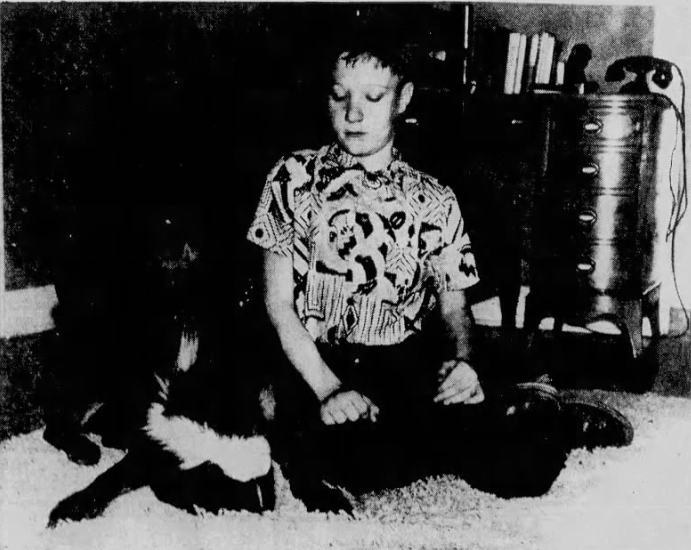
“Well, since they redecorated the White House,” David explained to his hometown paper, the Shawnee News-Star, “I thought maybe there wouldn’t be a place for a skunk. So I decided to do something about it.”
Young David wrote to the Senator, offering to take Shanghai off Kefauver’s hands should it become necessary. Kefauver, ever faithful in keeping up with his mail, sent off this reply:
Dear David,
I have your note of April 18 and think it is mighty nice of you to offer to take care of [Shanghai] for us.
I’ll certainly keep your generous offer in mind.
With good wishes, sincerely, Estes
As we know, Kefauver never did get the call to the White House, and presumably did not need to take young David Stevens up on his offer.
But that didn’t mean Shanghai stuck around the Kefauver home. The skunk stopped making headlines after the ’52 primaries, and this was no accident. According to Anderson and Blumenthal, Kefauver was never a huge fan of having a skunk – even a deodorized one – around the house.
He eventually convinced his children to give Shanghai up with the (frankly dubious) story that skunks attract rats. Once that was done, Anderson and Blumenthal reported, he made arrangements to rehome the skunk at a local zoo. (I’m glad to know that Shanghai was not released back into the wild.)
As a postscript, later in the 1950s, owning pet skunks turned into something of a fad. They never became as popular as dogs or cats, but they became a quirky alternative option for a lot of families.
While the stories I read did not credit the Kefauvers for the pet skunk boom, I can only imagine that seeing Shanghai in Newsweek and the papers at least planted the idea in some people’s minds.
While Kefauver will forever be associated with the raccoon, there’s another wild animal that held a place in his family’s heart – if not his own.

 Estes Kefauver for President
Leave a comment