
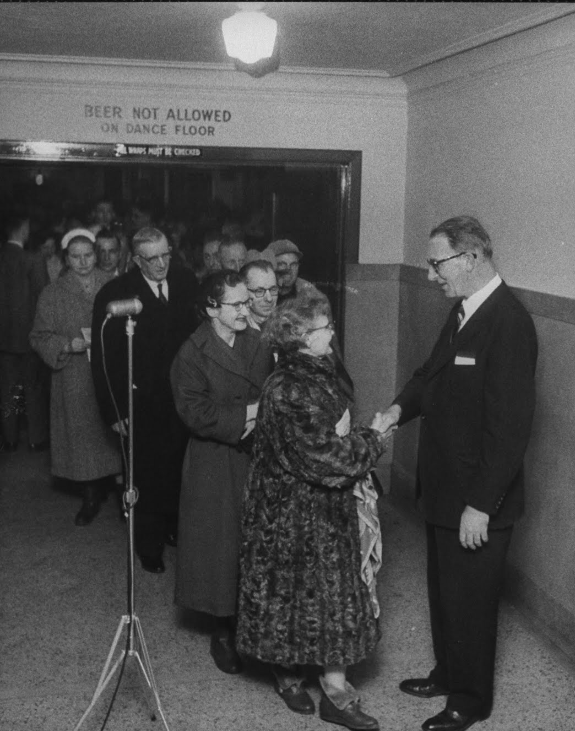
Estes Kefauver was famous for his handshakes: his legendary ability to spend hours greeting one voter after another, to the point that campaign staffers had to tear him away to get him to the next event on time or to ensure that he got a bit of sleep.
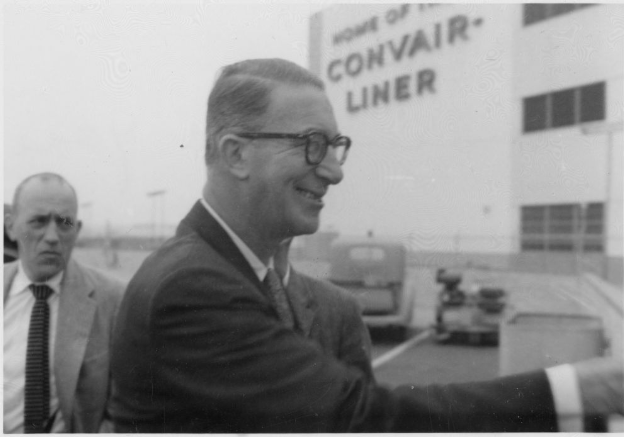
Given stories like this, you might assume that Kefauver loved making personal contact with voters, like Bill Clinton. However, I recently read two accounts of Kefauver that reached the same surprising conclusion: he may have shaken a lot of hands, but he didn’t enjoy it very much.
E.W. Kenworthy and Russell Baker were political reporters for the New York Times, and they each covered the 1956 Democratic primary in Florida between Kefauver and Adlai Stevenson. I read Kenworthy’s profile for the Times Magazine, “Shall the Best Handshaker Be Nominated?” Meanwhile, Baker’s account came from his 1989 autobiography, The Good Times.
Here’s Kenworthy:
The word which reporters have applied to Kefauver’s handshaking is “folksy.” That’s for want of a word that will adequately describe it. But it isn’t folksy – at least not in the Southern or Western tradition. Kefauver does not go swinging down the street like [Kentucky governor and former baseball commissioner] Happy Chandler, putting out his hand and slapping the voters on the back, saying “Ha’yah, old soldier?”
On the contrary, there is a kind of courtliness, even shyness about the Kefauver handshaking – “Ah’m Estes Kefauver, ma’am, and ah’d appreciate your he’p.” But it’s a dogged shyness. Kefauver has his eye on the goal, he is sure this is the way to it, and he plows ahead with his hand out. But he does not seem – at least so far as reporters can observe – to enjoy it. He goes through the routine, not in a daze exactly, but mechanically, abstractedly, and he usually has nothing but the bare greeting – there is rarely an exchange, a pleasantry, an inquiry.

This is Baker’s reminiscence of “watching Estes Kefauver try to shake hands with the whole world”:
Getting out of his chartered Greyhound at a central Florida prayer meeting, he stood at the front step, rigid as a cigar-store Indian, and let the people come to him to shake that famous hand, and murmured a little something to each. “Ah’m Estes Kefauver and Ah’m runnin’ for president. Will you he’p me?” “You’ll he’p me, won’t you?” “You gonna he’p me?” “Estes Kefauver, ma’am. I need your he’p.”…
Kefauver’s strategy was to go into primary states and shake hands with each and every one of the millions who constituted the people and ask for their he’p…
Whatever the explanation, there was no joy in Kefauver in Florida that spring. Maybe there never had been.
Baker believed Kefauver “was punch-drunk with fatigue and so groggy he was running on pure reflex.” He tested this by joining the handshake line himself. He’d traveled with Kefauver for several days and had interviewed him over lunch earlier that day, so Baker figured that Kefauver would recognize him.
Instead, Baker wrote, “there wasn’t a flicker of recognition in those eyes when I laid my hand in his paw and said, ‘An honor to shake your hand, Senator.’ Looking through me at something five thousand miles away, he said, ‘I hope you’re going to he’p me,’ then dropped my hand and reached for the next one.”
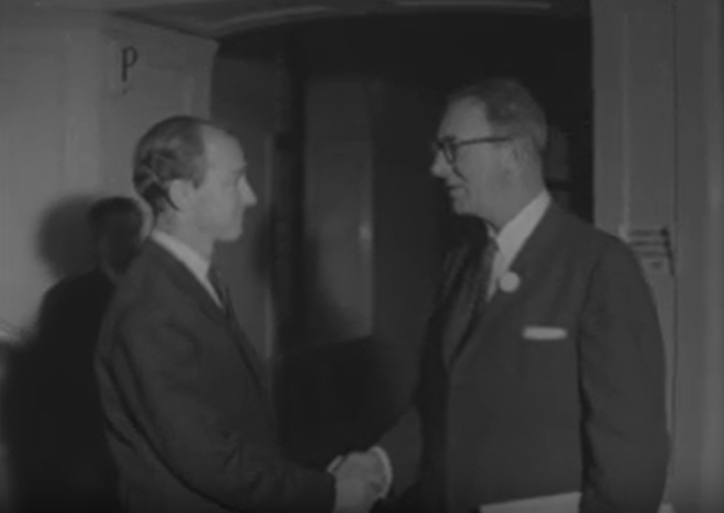
By contrast, both Kenworthy and Baker said that Stevenson – the elitist who generally acted as though person-to-person campaigning was beneath him –seemed to enjoy it more than Kefauver did. As Kenworthy wrote:
The Governor does not like this wholesale handshaking… because he feels it is undignified in a man seeking the Presidential nomination and demeans the office… But he likes to meet people and talk to them. Let someone with an interesting face come up to him, and he will grasp him by the elbow and pump his hand vigorously – especially if he is an elderly man who says, “You’re the second candidate for President I’ve had the pleasure of shaking hands with. I shook hands with William Jennings Bryan.”
So what gives? Why did Kefauver shake so many hands if he didn’t enjoy it? And if Kefauver’s handshakes were such a mechanical and perfunctory experience as Kenworthy and Baker describe, why were they so effective?
Both Kenworthy and Baker believed that the motivation behind Kefauver’s handshaking was ambition. He wanted so desperately to be President that he would endure anything – even an endless gantlet of handshakes – to get there.
Kenworthy described Kefauver as a “solitary [man], consumed with an inner cold fire of ambition.”
Baker wrote, “I was fascinated by Kefauver, I suppose, because he was the first politician I’d ever seen up close when the terrible, destructive heat of ambition was on him so intensely that he seemed to be killing himself.”
Kefauver did indeed have an enormous ambition to be President; this was apparent to everyone. And he’d long believed in the power of shaking hands as a key to campaign success, dating back to his first Senate campaign in 1948, when he promised a prominent backer that he would shake at least 500 hands a day.
But it’s also likely that Kefauver was just… tired. He and Stevenson were competing simultaneously in the Florida and California primaries, which were just a week apart. Long days of campaigning and cross-country plane flights were surely exhausting for both candidates.

Why didn’t Stevenson seem as exhausted as Kefauver did? Well, for one thing, Kefauver had been at it a lot longer: he’d been doing his handshake tours since New Hampshire, while Stevenson had been campaigning much less actively until his upset loss in Minnesota. So Kefauver had been hopscotching around the country for months, while Stevenson had only been in high-intensity campaign mode for a few weeks.
Add in the fact that Kefauver was clearly more introverted than Stevenson, which meant that these handshaking sessions were more draining for him, and his exhaustion makes more sense.
Also, based on his experience in ’52, Kefauver knew that decisive wins in the primaries were his only shot at the nomination. Even then, the party bosses might still pick somebody else. Stevenson faced a lot less pressure; as long as Kefauver didn’t completely drub him in the primaries, he stood a good chance at the nomination.
But what was it about the Kefauver handshake that left voters so entranced? As Kenworthy put it, “Where then is the magic? That is what has mystified reporters who have followed the Senator around.”
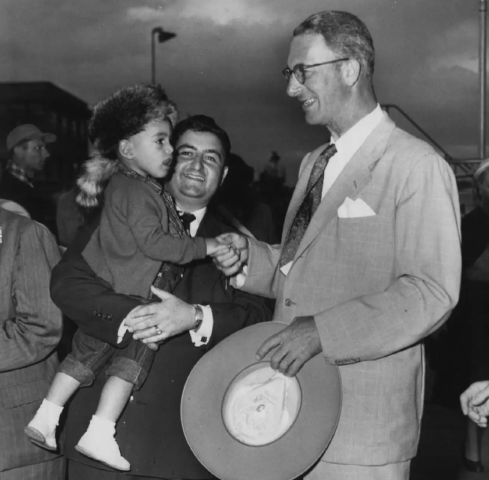
Kenworthy floated a few theories in his piece. One carried more than a whiff of condescension: “Some think it is no more than an elemental gratitude that rises in the voter on being sought out by a man running for President, and the resulting feeling of importance.” Those dumb rube voters, foolish enough to think that a Presidential candidate might care about them!
His second theory was closer to the Kefauver campaign’s preferred narrative. “Others think that the magic lies in the appeal to the voter’s sympathy – here is a big, strong, shy and somewhat bumbling man of good instincts, fighting to become President and hedged around and thwarted by big city bosses,” Kenworthy wrote. “This is the underdog theory, and there is probably a good deal in it.”
Kenworthy also noted that “a good part of the power in the Kefauver handshake lies in the follow through.” Kefauver’s secretary took down the names and addresses of every person whose hand he shook. “Within a few days,” Kenworthy wrote, “friendly form letters, hand-signed, start flowing back to voters in remote towns like Panacea and Sopchoppy, Fla.”
Personally, I think a couple factors were at work. First, Presidential candidates were more accessible than ever before. Jet travel made it possible for them to visit a lot more stops than in years past, and television brought the candidates into voters’ living rooms. These developments were recent enough to feel novel; millions of people now had the chance to meet a famous face in person. Also, we hadn’t yet reached the point where candidates were surrounded by security barriers and Secret Service entourages, so the voters really could get close.
But the real magic, I believe, is that Kefauver treated voters as though they mattered.
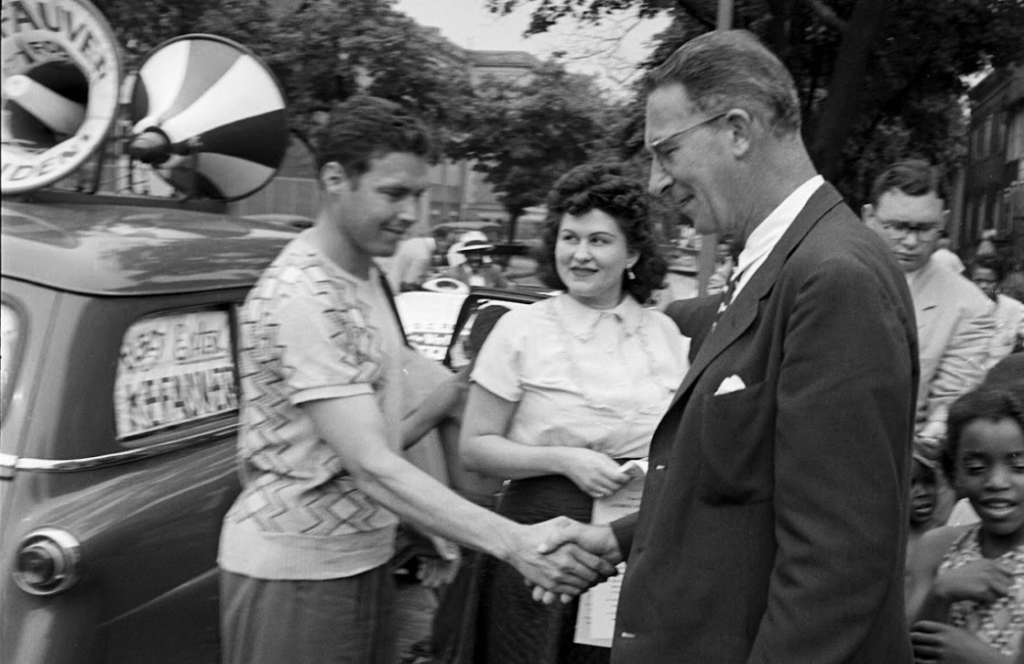
Stevenson was a hit with reporters because he was in many ways like them: quick-witted, clever, a bit cynical, apt to crack wise about the numerous absurdities of life on the campaign trail. Kefauver rarely made jokes while campaigning, especially when there were voters around. He treated it with a sense of solemnity. Reporters wrote him off as humorless, but he wasn’t; he was just didn’t want to make fun of voters or the places he visited.
When he shook hands and gently said to voters, “I need your help,” they knew that he meant it. If he seemed a little shy or reticent, it demonstrated his sincerity. And when they got a letter from him a few days later saying that he’d enjoyed meeting them, that mattered. They felt a connection to Kefauver, one that the reporters often missed.
Kefauver understood the importance of that connection. “Shake every voter’s hand you can shake – but you really have to mean it,” he advised prospective candidates. “Personal contact is priceless, but if you don’t really like people and your association with them, it will show through.”
Kefauver’s approach may have seemed dull or simple-minded to reporters, but voters appreciated his sincerity and rewarded him for it. Even if he couldn’t shake hands with the whole world, they knew he was trying.
 Estes Kefauver for President
Leave a comment