
While researching last week’s article on Kefauver and country music, I came across a well-reported profile by E.W. Kenworthy for the New York Times Magazine on the 1956 Florida Democratic primary. The article was fascinating, offering a good look at both Kefauver and Adlai Stevenson as well as some commentary on the primaries themselves at a time before they were a fixture of the Presidential nominating process, and I’ll return to it in the future.
Today, however, I’d like to focus on one part of the article, discussing a speech Kefauver gave on civil rights.
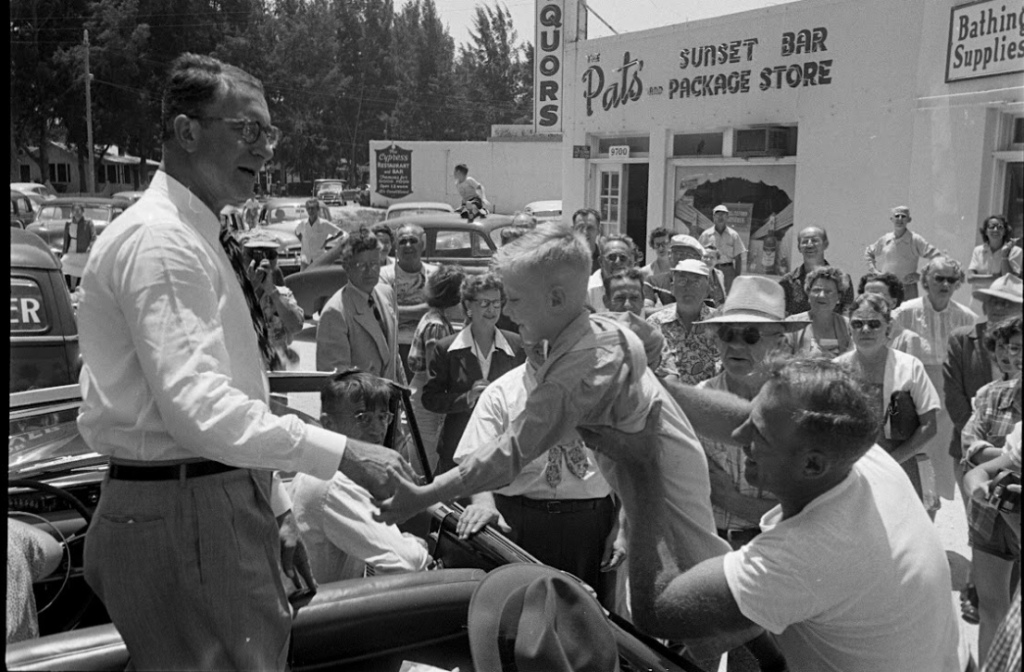
Like most reporters, Kenworthy considered Kefauver to be a poor public speaker. Kenworthy pointed out that the Tennessean’s speeches generally consisted of “flat declarative statements – each one a simple idea starkly put,” delivered in “a somewhat nasal monotone.” There was rarely soaring rhetoric in Kefauver’s speech, and very little humor or color.
Particularly compared to Stevenson, whose speeches were famed for their wit and eloquence, Kefauver’s remarks seemed painfully homely and utilitarian. Kenworthy was hardly the only reporter to be baffled about why voters seemed to like Kefauver so much.
Despite his generally low opinion of Kefauver’s speaking abilities, Kenworthy did note that the Senator could “rise to a tough occasion,” describing a speech he gave in Warrington, Florida in early May. Warrington is located in the Florida panhandle near Pensacola, one of the more traditionally “Southern” areas of the state.
On that May evening, as Kenworthy wrote, “A crowd of perhaps 400 was gathered in a dusty school yard under the arc lights.” Kefauver was the last speaker of the evening, following a slate of candidates for local and statewide office. I’ll let Kenworthy pick up the story from here:
Every speaker, whether he was running for county commissioner or sheriff, warmed up on the “race-mixing” issue. “Do we want our silver and gold coasts to turn black?” “If you integrate schools, there will be intermarriage.” “If we stick together, there won’t be enough jails to hold us.”
When Kefauver got up, he did not duck the issue. “The Supreme Court is a part of this Government. The court has handed down a decision. It is the law of the land. Any one who is elected must take an oath to uphold the Constitution.”
Angry murmurs ran through the crowd. Kefauver went on. “I think our own people have the intelligence and the sense of justice to settle this without violence.” The murmurs quieted down, and he went on with his speech. No one could doubt his courage – or his skill.”
Kefauver’s courage in that moment might not be quite as obvious to a modern audience, so let me provide some background.
Florida was the only Southern state to hold a Presidential primary in the 1950s. When Kefauver ran for President in 1952, the Florida primary was one of the only races he lost, as pro-segregation Senator Richard Russell of Georgia beat him handily, largely on the civil rights issue. Kefauver further antagonized the South at the 1952 convention, as his campaign opposed the seating of the Virginia delegation unless they took an oath vowing to support the Democratic candidate in November.

Kefauver’s refusal to sign the anti-integration Southern Manifesto in 1956 only made him even more of a pariah with many Southerners.
In the 1956 Florida primary, Kefauver and Stevenson both had similar views on civil rights; by the standards of the era, they were be considered moderates. They both agreed that the Supreme Court’s decision in Brown v. Board of Education was the law of the land whether the South liked it or not. They both opposed Massive Resistance and condemned pro-segregation violence. But neither of them believed that Southern schools should be required to integrate immediately; instead, they both generally favored gradual integration, with good-faith dialogue between the races to ease the transition.
Even though Kefauver and Stevenson generally held the same views on civil rights and school integration, Southern voters were generally warmer to Stevenson on the issue, because he was a Northerner and therefore “didn’t know any better.” Meanwhile, Kefauver was reviled by segregationists as a traitor to the South.
In addition, the Florida primary was a must-win for Kefauver in ‘56. The only shot he had at the nomination was to knock Stevenson out during the primaries. To do that, he probably needed to win both the Florida and California primaries, which were within a week of each other. Stevenson had a huge advantage in money and institutional support in California, ratcheting up the pressure on Kefauver to do well in the Sunshine State.
Given all that, and given the anti-integration mood of the Warrington rally as established by the previous speakers, it would have been easy for Kefauver to choose not to address civil rights that day.
But Kefauver knew that civil rights were an important issue, and audiences like the one in Warrington needed to hear what he had to say about it. He couldn’t let the cheap race-baiting provocations of the speakers that came before him carry the day.
So he stood up and told the audience what they didn’t want to hear. But as Kenworthy noted, it took real speaking skill to get the crowd on his side, or at least not actively against him. And his statement that “I think our own people have the intelligence and the sense of justice to settle this without violence” was a brilliant rhetorical move. It was both an invitation and a challenge to his audience.
Kefauver knew that plenty of Southerners looked the other way when pro-segregation activists turned to violence; they might not approve of violence, but they were at least sympathetic to the segregationists’ motives, if not outright supportive. Kefauver wasn’t openly shaming those Southerners for looking the other way, but he was giving them a nudge: Hey, we’re better and smarter than that. Aren’t we?
Essentially, he was gently pushing his audience to make a choice: either openly endorse violence as a solution, or stand with Kefauver on the side of intelligence and justice. It was enough to quiet the crowd in Warrington that night. And it was the sort of rhetoric that allowed Kefauver to roll up huge margins of victory in one statewide election after another in Tennessee, even as his constituents grew more conservative.
There’s a lesson here for our current contentious times. If we hope to win converts to our side in the culture wars, we can’t do it by proclaiming that those who disagree are too dumb or brainwashed to know better. Perhaps we take a page from Kefauver’s playbook, and speak to them as fellow citizens with dignity and respect, and offer them the opportunity to embrace the better angels of their nature and reject the extreme reactions of the other side.
Is that easy? Not in the slightest. After all, Kefauver lost the Florida primary, albeit narrowly. But it’s worth a shot.

 Estes Kefauver for President
Leave a comment