
While researching another topic, I came across a videotaped interview. In 1988, during the run-up to the Democratic convention that year, C-SPAN ran highlights of all the modern-era Democratic conventions back-to-back, interspersed with interviews from people who had been there in person.
For the 1956 convention, C-SPAN’s Carrie Collins interviewed John Hoving, a former Estes Kefauver staffer and longtime friend of the Senator. Hoving had worked for Kefauver’s presidential campaign in 1952; in ’56, he was there on behalf of the Air Transport Association (a trade association for the airline industry), but he “wore a second hat” as a Kefauver supporter who helped round up votes for his Vice Presidential nomination.

The primary topic of conversation was Adlai Stevenson’s dramatic decision to let the convention choose his running mate, but Hoving also talked about his experience working with Kefauver and his impressions of the man.
A few highlights from the interview:
- Hoving believed that Stevenson threw the choice of running mate to the convention because he was afraid of alienating supporters of any of his potential choices. Hoving believed that Stevenson didn’t really like Kefauver (Estes “just wasn’t [Stevenson’s] kind of person”) or want him as a running mate. In Hoving’s estimation, Stevenson would have preferred to run with John F. Kennedy, particularly since he believed that weakness with traditionally Democratic Catholics had cost him in ’52. But by letting the convention make the choice, he avoided the wrath of those who backed Kefauver or other candidates. “I think it was a very dramatic gesture,” Hoving said, “but I think he really didn’t want to make a decision.”
- Hoving confirmed that “most of the regulars” in the party were still firmly opposed to Kefauver, “because he was a reformer, a loner, an independent, a liberal, and a maverick.” Chief among those opponents was convention chairman Sam Rayburn. Hoving noted that Rayburn had humiliated Kefauver in 1952 by making him sit through the final roll call instead of allowing him to withdraw; in 1956, Hoving believed that Rayburn tried to pressure the convention into picking Kennedy for the VP slot.

- While Kefauver was not popular with party leaders, he had a hidden strength, according to Hoving: a lot of the delegates had supported him in 1952 (and a number had done so again in 1956). Hoving believed that Kefauver’s strength with rank-and-file delegates was “not quite visible to everybody,” but was a key to his ultimate triumph.
- Stevenson’s decision to open up the VP nomination set off “a lot of frantic running and jumping and scrambling,” as candidates tried frantically to line up support. Hoving noted that the decision caught the Kefauver camp by surprise (and indeed, Kefauver’s initial impulse was to leave the convention, figuring he was going to be screwed again, until Stevenson talked him out of it).
- Hoving said it was clear from the beginning that the decision would come down to Kefauver vs. Kennedy. That didn’t stop several other candidates from giving it a shot. “The rest were in their hoping that maybe [Kefauver or Kennedy] would break, and then you might have it,” Hoving said.
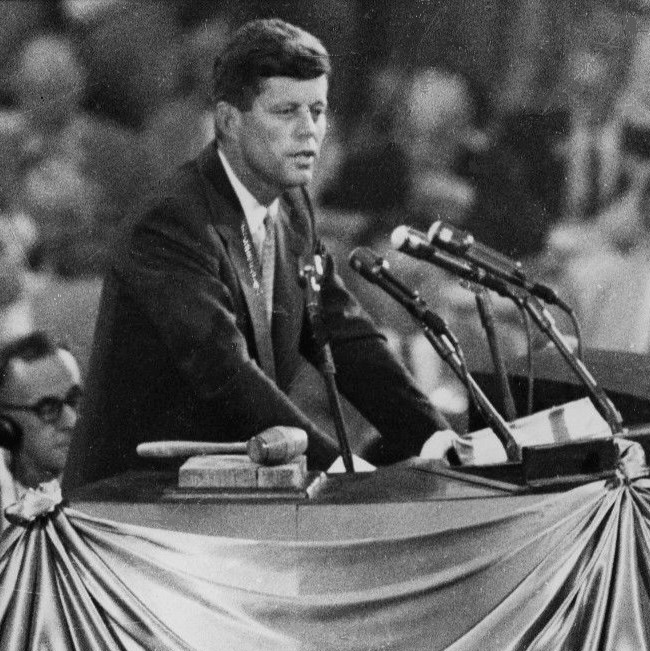
- One of the other contenders was Hubert Humphrey. Hoving believed that Stevenson may have promised Humphrey (among others) the VP slot before the convention. But Humphrey was kneecapped by his own Minnesota delegation; Kefauver had won the state during the primaries, and Hoving said that delegation leader Bob Short held them for Kefauver in the VP race. Hoving later encountered Humphrey sitting underneath the platform crying. (By most accounts, Humphrey was one of the most tear-prone politicians in history, at least until John Boehner came along.)
- Another lower-tier contender was Albert Gore, Kefauver’s fellow Tennessee Senator. Hoving remembered standing next to Gore’s wife Pauline, watching the convention proceedings on TV. “I heard her say, ‘Well, Albert’s got to stop this,’” Hoving recalled, “and off she went.” Gore dropped out of the race shortly thereafter.
- Hoving felt Kefauver was going to win once the Missouri and Oklahoma delegations switched their support to him. Their decision surprised Hoving, since they both had a reputation for voting with the party regulars. But he learned later that in each case, one of Kefauver’s fellow Senators was responsible for the switch. Oklahoma’s Mike Monroney believed that Kennedy didn’t understand farm issues (“which, of course, he didn’t,” Hoving noted wryly, “he wasn’t terribly interested in ‘em”). Meanwhile, Missouri’s Thomas Hennings opposed Kennedy because he believed JFK would not support repeal of the anti-labor Taft-Hartley Act (Kefauver’s pro-labor bona fides were already well established). After that, Hoving said, “In spite of all the pressure from… Sam Rayburn and the strong regulars, all of a sudden Estes crept up” and defeated Kennedy.
- Hoving felt that the VP race was very exciting and gave a jolt of drama to a convention that had sorely lacked it. He felt that in a convention, “it’s very important somehow to produce the theater where the white hats succeed over the black hats… both to capture attention. but also to energize all the players.” He cited Humphrey’s pro-civil rights speech in 1948 and the Stevenson/Kefauver and Eisenhower/Taft showdowns in 1952 as examples of dramatic excitement. By comparison, the 1956 convention “had no fight. They diddled around, there wasn’t much going on.” Until the VP selection fight, that is.
- Reflecting on his long association with Kefauver, Hoving had a lot of complimentary things to say. He praised Kefauver as “a very thoughtful, gentle person in many ways.” He also admired the Senator’s courage of his convictions. “I remember time and time again where he would come down on an unpopular side, because he felt it was right,” Hoving recalled. “And he would say, ‘John, that’s the way I want to do it.’” And he was never afraid to be the lone vote in the Senate for his position.
- Kefauver’s anti-crime crusade was one of the themes of his career, and many critics accused him of focusing on the issue for attention. But Hoving said that Kefauver sincerely had a “dedicated interest in what he felt to be clean, good, decent government,” and was “outraged by corruption.” That anti-corruption streak extended to Kefauver’s “resistance to bosses.” Hoving noted that this mentality could hurt Kefauver politically. “I used to have a problem with Estes when I wanted him to work with governors or senators or other people… he really didn’t like people of authority over him. He was an independent, and whenever there was a problem, he’d go back to the people.”
- Kefauver’s one personal flaw, according to Hoving: his drinking. “Like a mountain man, he would drink until he fell over,” Hoving said. Fred Strong noted Kefauver’s thirst for alcohol in my interview with him, and numerous friends and acquaintances have told similar stories. What’s perhaps most remarkable is that Kefauver’s heavy drinking rarely seemed to affect his ability to do his job.
- Hoving noted what a shoestring operation Kefauver’s 1952 campaign was. “We campaigned all over with no money,” he remembered. Comparing it to Jesse Jackson’s famously cash-strapped 1988 effort, Hoving said “the Jackson campaign looks like a lush, expensive operation compared to what Estes ran in ’52.” Unlike many of Kefauver’s friends and staffers from that campaign, Hoving didn’t seem bitter about the outcome. “We went into the convention leading, but the regulars were able to beat us,” he said. “It was a good fight, and it was very healthy.”
Hoving went on to a lengthy career as a political strategist and corporate executive, working for many years with Federated Department Stores. (In 1989, the board at DC’s Corcoran Gallery of Art hired him to handle crisis communications after they canceled a planned exhibit by Robert Mapplethorpe, the controversial photographer whose worked was considered obscene by some.) He died in 2010 at age 87. Political analyst Stuart Rothenberg wrote a fond remembrance of Hoving here.
If you’d like to see the C-SPAN video for yourself, you can view it here.

 Estes Kefauver for President
Leave a comment