
Have you ever had a bad flying experience? Maybe a flight delayed for hours for no apparent reason, or being stuffed in an “economy” seat that seems designed for a malnourished child rather than a full-grown adult, or battling the kind of turbulence that gets passengers reaching for the airsickness bags.
If so, chances are you wanted to complain. Perhaps you vented your spleen at a hapless gate agent or flight attendant. Maybe you filled out an online survey, leaving lengthy comments detailing your dissatisfaction. Or perhaps you just groused to friends and family once you finally reached your destination.
If you’re a U.S. Senator, though, there’s another option available to you: you can use a hearing with senior government officials responsible for overseeing the airline industry to unload your pet peeves about the flying experience.
In the middle of 1960, Hubert Humphrey chose that option.
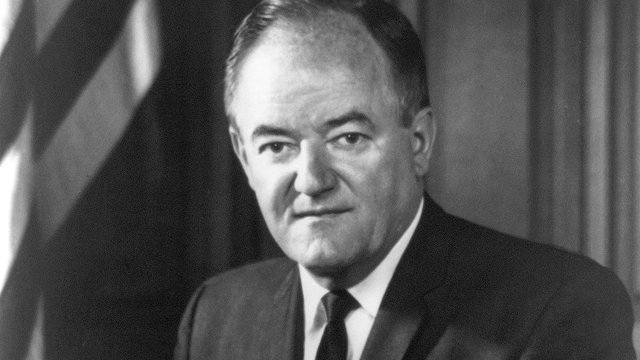
Humphrey was the chair of the Senate Subcommittee on Reorganization and International Organizations. In June of ’60, Humphrey’s subcommittee held hearings on Estes Kefauver’s proposed bill to create a federal Department of Consumers.
One of the witnesses was Ross Newmann, associate general counsel of the Civil Aeronautics Board. The airline industry was heavily regulated in that era; the CAB was responsible for certifying airlines to provide passenger service in America. Along with that, the CAB dictated the fares airlines could charge, the cities they served, and the frequency of service they provided. The CAB also had the power to investigate and correct unfair competition or misleading business practices.
Newmann came before Humphrey’s subcommittee to express the CAB’s opposition to the proposed Department of Consumers. Like many other agencies, the CAB saw consumer protection as part of its mission, and they didn’t want some new department interfering with their operations.
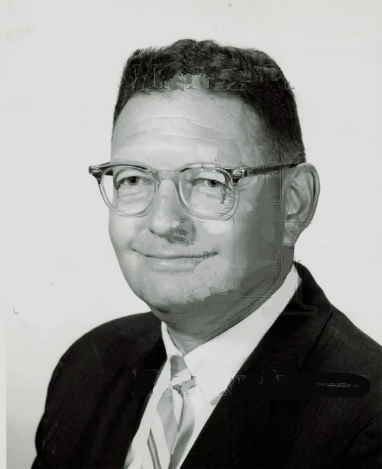
Newmann read a statement to this effect. He likely expected to field a question or two about the statement and then be sent on his way. Unfortunately for him, Humphrey had an axe to grind about airlines, and he was about to grind it right on Newmann’s head.
Humphrey interrupted Newmann in mid-statement to ask the following:
Why do you people stop these airlines, then, if you are so interested in consumers, from having coach flights that have two seats on each side? I fly airplanes a lot, and I like coach flights that give me enough room to sit, living more time in an airplane than I do in my home. I recall, I think it was United Airlines for a period of time had two seats across, then an aisle and two seats, and they even served a little lunch or something.
All at once they had that altered in order to get into conformity with some other airlines that were not giving as good a deal.
Why, if you are so much for the consumer?
Although Newmann likely hadn’t expected this particular question, he attempted an answer. He told Humphrey that the CAB had not outlawed two-and-two seating in the coach section of airplanes. Instead, said Newmann, “I think the Board was interested in seeing that it was, in fact, truly a coach service and not, in fact, a first-class service.”
This answer sat poorly with Humphrey. “What difference does it make to you,” Humphrey snapped, “if they are willing to charge the coach price? After all, we are the people that ride the airplanes.”
Newmann tried to respond, but Humphrey cut him off. “Mr. Newmann,” the Senator said irritably, “I ride the airplanes a great deal, and if United Airlines wants to give me first-class service for coach rates, I hope you are not going to tell me they can’t.”
Newman pointed to Section 403(b) of the Federal Aviation Act which, he said, “prohibits unjust discrimination.”
“Unjust?” Humphrey cried. “The other airlines were discriminating.”
But Newman explained that, in the eyes of the CAB, “a coach service must truly be a coach service.” In other words, there had to be enough difference between coach and first-class that “the person who paid the first-class fare would not be discriminated against.”
Humphrey wasn’t having it. “When you get the first-class fare,” he pointed out, “in most of these planes they give you some champagne or they give you some hors d’oeuvres and they give you a hot lunch, a hot dinner, a few more stewardesses, and more leg room.”
Newmann then recalled another reason why United moved away from two-and-two seating in coach. “I recall – and as I say, that was many years ago,” Newmann explained,” there was… a safety requirement that in high-density aircraft there be a certain number of exits for a certain number of seats… I think that United did not have a sufficient number of exits at that time, and I think that entered into the problem.”
Newmann attempted to defend the CAB’s record on the issue, noting that they had recently opened an investigation into whether the airlines were providing enough coach service to New York.
Humphrey still wasn’t satisfied, pointing out that United’s coach service used to be better than the others. “I am sure the other airlines were not told to catch up with that airline,” he huffed. “The airline with better coach service was told to downgrade to the others. I don’t consider that to be in the consumer’s interest.”
Humphrey’s gripe with the airlines wasn’t limited to cramped seats in coach, either. “I also don’t consider it in the consumer’s interest letting these airlines get by without radar,” he said. “If you travel through that thunderstorm alley that I travel through out to Minnesota you would know what I mean. Why not put on radar, if you are interested in the consumer?”
Weather radar first became available on civilian airplanes in the mid-‘50s, but it was not yet mandatory. (It would become so in 1964.)
Newmann, hoping to avoid another Humphrey harangue, pointed out that safety regulations were no longer part of the CAB’s responsibility. As part of the Federal Aviation Act of 1958, that authority was transferred to the FAA.
Humphrey wasn’t satisfied with that answer. He asked why the CAB did not mandate radar when they had the authority “if you were interested in the consumer, instead of the owner of the airplane?”
“I was told the reason they did not put on radar is because it costs money,” Humphrey added dismissively. “It costs money to carry insurance, and I don’t want to collect on it.”
Newmann responded that the CAB was “severely criticized” by airlines whenever they enacted expensive regulations, such as their recent decision to mandate flight recorders.
“Well, the carriers – after all, we are talking about consumers,” Humphrey snorted.
Newman agreed, but argued “I think the Board certainly did have the consumer at heart and his interest in these matters.”
This set Humphrey off yet again. “I don’t think so, sir,” he snapped, “when it is a known fact that radar gives the passenger a safer ride, a more comfortable ride and protects life and property.” He argued that airlines would avoid installing radar as long as they could get away with it, pointing out that railroads similarly avoided installing critical safety equipment until the ICC enacted a regulation to force their hand.
Humphrey said the airlines treated radar as a luxury rather than a vital safety feature, noting that they displayed “on the side of the airplane when you go up the ramp, ‘This plane is equipped with radar.’ Why don’t they put on the sign the airplane is equipped with ball bearings, too, or has brakes on it, or flaps?”
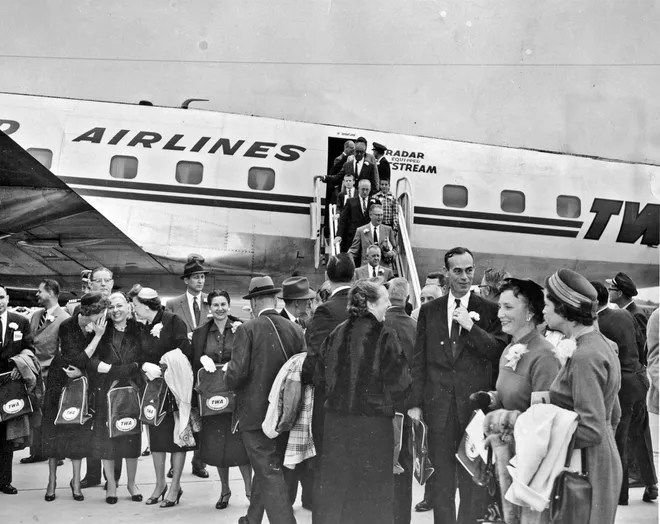
By this point, Newmann was doubtless hoping for anything – an earthquake, a hurricane, a missile strike, anything – to bring this grilling to an end. When Humphrey again demanded an answer for why the government had not mandated radar on planes, Newmann wearily replied, “Mr. Chairman, I couldn’t comment on that, since that is no longer a function of the Board.”
“Why didn’t you, when you did have a chance to comment on it?” Humphrey retorted.
“I couldn’t answer that, sir,” Newman sighed.
“You must have a reason,” Humphrey insisted. He pointed out that the CAB required commercial airplanes to fly with a copilot. “Why?” he said. “They don’t usually need them. May times they fly with automatic pilot… Why do you require a copilot? It is expensive.”
Newmann didn’t even try to argue. “I am afraid I can’t give you the answer as to not requiring the radar at the time we have the civil air regulation function,” he replied.
Humphrey then gave a little stump speech about how “[i]t’s high time these airlines quit fighting” against safety regulations just because they cost money. “An air crash is a little more expensive than radar,” he pointed out. “Most of these flights through thunderstorm areas could be eliminated with radar equipment. I think the agencies are derelict in their responsibilities for not insisting upon it regardless of whether the airlines can afford it or not. If they can’t afford it, they ought to quit, because they are hauling human beings.”
Humphrey asked Newmann to deliver this message to his colleagues at the CAB, and Newmann promised to do so.
“I am going to be after these agencies,” Humphrey promised. “They haven’t had anybody after them until they get me after them because I am going to insist that these airlines get on the stick.”
To Newmann’s great relief, Humphrey adjourned the hearing shortly after this, as he had to go to the Senate floor for a vote. God knows how many more airline gripes Humphrey might have aired if he’d had more time.
Reading through this amazing transcript, I have three thoughts:
- Newmann showed admirable grace under fire.
- Apparently, people complaining about the shrinking size of coach seats isn’t a modern-day phenomenon. Humphrey, at least, was complaining about it 60 years ago.
- It must be a nice perk, as an elected official, to be able to hijack a hearing on an unrelated topic so that you can air your grievances about air travel, and have those grievances enshrined in the Congressional Record. It almost makes me want to run for office.

 Estes Kefauver for President
Leave a comment