
I recently came into possession of a pamphlet from Estes Kefauver’s final Senate campaign in 1960. It aims to answer a question that was doubtless on some voters’ minds that year:
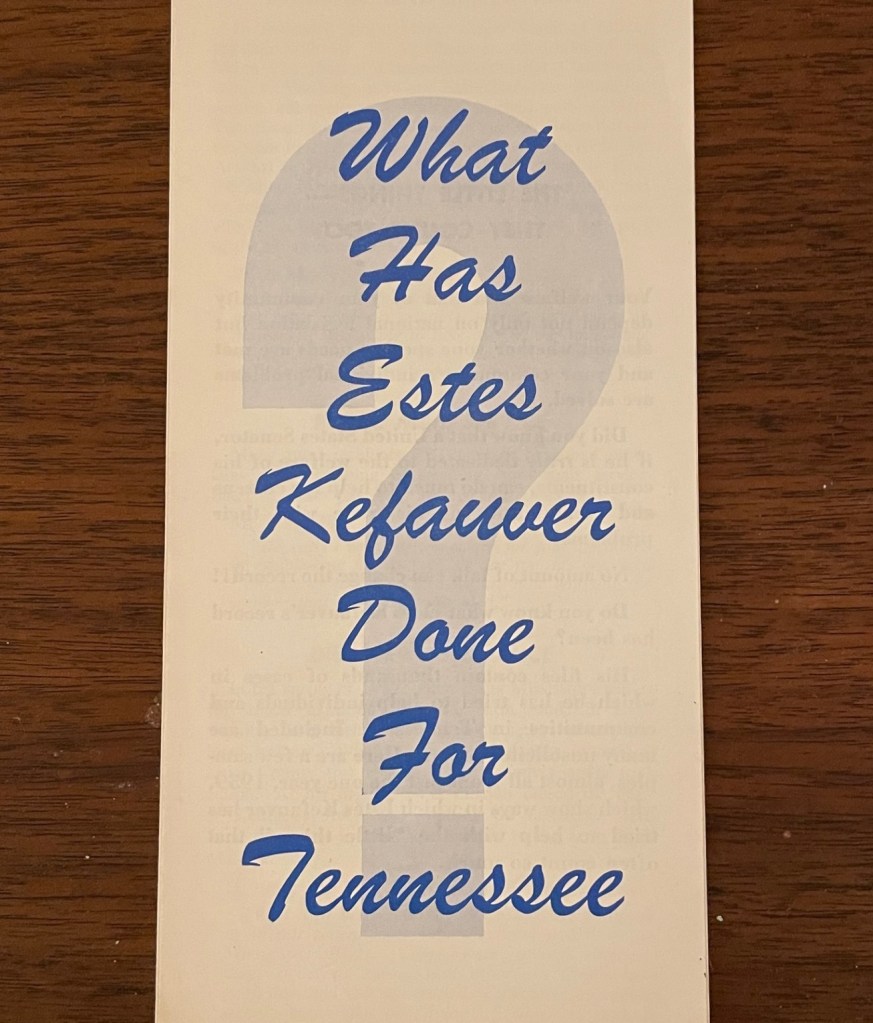
You might assume from the title that the pamphlet touted a bunch of pork-barrel spending that Kefauver had secured for his state. Primarily, though, that’s not what it was about. It was instead making a homelier – and to me, more interesting – story about Kefauver’s constituent service.
Here’s the headline on the inside flap:

The text below it lays out the importance of these “little things”:
Your welfare and that of your community depend not only on national legislation but also on whether your specific needs are met and your community’s individual problems are solved.
Did you know that a United States Senator, if he is truly dedicated to the welfare of his constituents, can do much to help the citizens and communities of his State with their problems?
No amount of talk can change the record!!
Do you know what Estes Kefauver’s record has been?
His files contain thousands of cases in which he has tried to help individuals and communities in Tennessee. Included are many unsolicited letters. Here are a few samples, almost all from just the one year, 1959, which show ways in which Estes Kefauver has tried to help with the “little things” that count so much.
In this era, before Senate elections were completely nationalized, incumbents frequently sought to highlight the ways in which they served their state. For Kefauver, this was a particularly important point to establish, for two reasons.
First, Kefauver’s critics had long accused him of being obsessed with chasing national headlines for caring more about his Presidential aspirations than about his Senate duties. This pamphlet demonstrated that he was in fact dedicated to his Tennessee constituents and working hard on their behalf.
In this election specifically, challenger Tip Taylor hammered Kefauver for his openness to civil rights, suggesting that he was out of step with the Volunteer State. “I’m tired of giving New York a third Senator,” Taylor frequently complained. For those voters who might be uneasy with Kefauver’s views on civil rights, this pamphlet reminded them of other things he did in office that they might appreciate.
So what sorts of things did the Kefauver campaign highlight in this pamphlet?
For instance, Kefauver helped hundreds of older Tennesseans get their Social Security benefits. He helped an army veteran get a visa for his German fiancée. He assisted several rural constituents in getting mail service, and helped the town of Church Hill get approval for a new post office building. He helped the town of Milan lure an industrial company to locate a factory in their abandoned arsenal facility. He helped the town of Pulaski secure federal funding for needed improvements to their airport.

None of these activities were huge or earth-shaking, but they made a real difference in the lives of his constituents. And each activity included an excerpt – typically from a constituent’s letter – thanking Kefauver for his help. For instance, the veteran whom Kefauver helped with the fiancee’s visa wrote, “I sincerely believe that had it not been for your assistance, our marriage could not have taken place at such an early date. Again, we both wish to thank you.”
Even some of the big issues that animated Kefauver’s career were broken down to view through a local lens.
For instance, Kefauver was a staunch opponent of big companies using false advertising to prey on consumers. This pamphlet cited the specific case of a company that falsely advertised a product to turn straight hair “naturally curly.” Kefauver prodded the FTC to issue a consent order stopping that advertising claim, and he received a grateful letter from Rubye House, the President of the Tennessee Hairdressers and Cosmetologists Association.
As another example, Kefauver had long supported the TVA and public power in general. This pamphlet zeroed in on Kefauver’s work to secure federal approval and funding for a bridge over the TVA’s Pickwick Dam, the construction of which led to the opening of a paper and pulp mill in economically struggling Hardin County. That effort earned appreciative letters from both the paper company and an official at the Hardin County Port Authority.

What I love about this pamphlet is that it highlights Kefauver’s approach to politics. While he certainly cared about big national issues – and had a burning ambition to rise through the ranks in order to deal with them – he understood that, fundamentally, a politician should help make the lives of his constituents better.
Just as he understood the importance of shaking hands and making personal connections on the campaign trail, he understood the importance of helping his constituents with “the little things.” His dedication to constituent service – not just through words and letters, but through actions – helped him remain immensely popular in Tennessee even as the political climate in the state shifted against his brand of liberalism.
Obviously, this pamphlet by itself wouldn’t have been sufficient. The Kefauver campaign also issued pamphlets describing his stances and his record on national issues. (I have obtained one of those pamphlets from the 1960 campaign, and I’ll share it in a future post.) But it’s marvelous to see a campaign piece like this, which focuses on issues that would never garner national headlines but would make a real difference to individuals and communities.
I struggle to imagine a U.S. Senator today advocating for his or her re-election by pointing to the way he or she helped constituents get visas or mail service. But it just goes to show the way that Kefauver understood the relationship between an elected official and the voters. He would have shaken every hand in Tennessee if he could, and he would have helped each individual Tennessean however he could.

 Estes Kefauver for President
Leave a comment