
As I’ve mentioned previously, Estes Kefauver’s Senate hearings into organized crime in 1950 and 1951 created a national sensation. The televised hearings introduced many Americans to the concept of the Mafia, and to the operation of regional and nationwide crime syndicates in cities and towns all across the country. The hearings created an uproar across the country to do something to combat the reach of organized crime in America.
One group, however, seemed largely unaffected by the hearings and the nationwide uproar that they generated: the FBI.
The FBI’s lack of prominence in these hearings always struck me as odd. Why wouldn’t America’s top federal law enforcement agency be closely involved with the battle against organized crime?
Granted, the FBI wasn’t totally absent from the hearings. Director J. Edgar Hoover testified before the subcommittee fairly late in the proceedings. He argued, despite the massive amount of evidence that the subcommittee had uncovered to the contrary, that organized gambling was primarily a state and local problem.
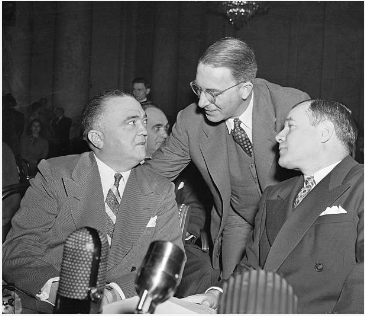
“If the laws against gambling presently on the state and local statute books were earnestly and vigorously enforced,” Hoover claimed, “organized gambling could be eliminated within 48 hours in any community in this land.” Upon questioning, Hoover admitted that the FBI itself was doing little to combat organized crime.
If the FBI wasn’t devoted its resources to organized crime, what were they doing? Primarily, they were engaged in Hoover’s favorite pastime: chasing Communists and spying on alleged leftist subversives. For instance, in the 1950s, the FBI’s New York field office had 400 special agents assigned to hunting Communists and only four looking into organized crime. In fact, one might reasonably argue that the reason for the Kefauver Committee’s existence was the FBI’s failure to take organized crime seriously.
So obviously, after being forced to confront its failures on the issue, the FBI started taking organized crime more seriously after the hearings, right? Wrong.
One of the Kefauver Committee’s most controversial recommendations was to create a federal crime commission to continue the work that the probe had started, and to provide information and recommendations for combatting organized crime in order to assist state and local law enforcement agencies (many of whom had complained that sharing information with the FBI was a “one-way street”).
Hoover fiercely opposed the creation of such a commission, raising fears that it would lead to some sort of Gestapo-style national police force. (Let’s pause here to note the irony of J. Edgar Hoover, of all people, complaining about Gestapo-style tactics.) I suspect the real reason for Hoover’s opposition is that he didn’t want some other federal organization looking over his shoulder.
He also shot down the idea that the FBI’s jurisdiction should be expanded to devote more resources to organized crime. “I am very much opposed to any expansion of the Federal Bureau of Investigation,” Hoover testified. “I think it is too big today.”
And after the hearings were concluded, the FBI went right back to their previous policy of largely ignoring organized crime in favor of hunting subversives. Hoover continued to downplay the existence of the Mafia in America, despite the Kefauver Committee’s confirmation that it existed and was quite active.
This set the FBI up for a major embarrassment when, in November 1957, mob members from around the nation gathered for a summit in Apalachin, New York. Had the FBI devoted any meaningful resources to tracking the activities of organized crime, they likely could have scored a huge bust. Instead, it was a New York state trooper who happened to notice a lot of out-of-state license plates outside the home of a local criminal and had the place surrounded, leading to the arrest of 58 prominent Mafia figures. (Ultimately, none of the charges against them would stick.)

The dramatic nature of the arrest – and the FBI’s complete lack of involvement or knowledge – finally forced Hoover to take organized crime seriously. Four days after the Apalachin bust, Hoover launched an initiative within the FBI to combat the Mob. This included the development of a centralized database on mobsters based on reports from the FBI’s field offices, and the use of (illegal) wire tapping to track the activity of mob leaders.
(Let me also point out the hilariously defensive wording of the FBI’s account of these events on its website, where it insists that the FBI was too taking organized crime seriously before Apalachin, and pleads that most of the Mafia’s activities were outside the Bureau’s jurisdiction. Nice try, guys.)
The Bureau could have saved itself the embarrassment if it had heeded the findings of the Kefauver Committee six years earlier. Sadly, Hoover was more focused on a different Senate investigation from the 1950s – Joseph McCarthy’s Communist witch hunt. The Kefauver Committee showed the road on which the FBI could have traveled in order to function more effectively as the country’s top law enforcement agency; sadly, Hoover chose not to follow that road until it was too late.

 Estes Kefauver for President
Leave a comment