
In my earlier piece on Estes Kefauver’s civil rights record, I noted that his views evolved over time. The Supreme Court’s decision in Brown v. Board of Education marked a watershed in his thinking. Accepting the decision as the law of the land, he focused his efforts thereafter on urging cooperation between the races to figure out the best path toward integration.
Perhaps the clearest demonstration of Kefauver’s shift – and his growing courage on civil rights – can be seen in his responses to the battle over integration at a high school in his home state of Tennessee.
Kefauver’s consistent denunciation of segregationist violence, and his repeated praise for officials at the state and local level who were following the law and doing the right thing, helped bring calm to a troubled situation. And when the situation took a tragic turn, Kefauver stood shoulder to shoulder with those seeking to repair the damage.
Little Rock Before Little Rock
Clinton, Tennessee is a small town in the eastern part of the state, about 15 miles away from Knoxville. Today, its population is a little over 10,000; in the 1950s, it was about half that. Like most Southern towns, it was segregated, but there was no real history of racial animosity there. The black families, who lived in a separate part of town, generally kept to themselves. In short, it seemed an unlikely place to become a flashpoint in the struggle over school integration.
The Supreme Court’s follow-up ruling to Brown v. Board in 1955 (known colloquially as Brown II) the decreed that the schools should be segregated “with all deliberate speed.” But by declining to impose a specific timeline, the Justices essentially left it up to district courts to figure that out.
As a result, when Judge Robert Taylor ordered Clinton High School to desegregate in the fall of 1956, it was the first Southern public high school to be integrated, a full year before Little Rock Central. (Why we remember Little Rock so vividly and have largely memory-holed Clinton is a mystery.)

A dozen black students enrolled at Clinton High on August 26, 1956, the first day of the school year. There was some public curiosity, but the day essentially passed without incident. It wouldn’t stay that way, however; segregationist agitators would soon arrive in town and whip the white population of Clinton into a frenzy.
The idea of “outside agitators” is often a punch line these days, but in this case it was true. Two pro-segregation activists – John Kasper, a bookseller from Washington DC who claimed to represent a group called the “Tennessee Society to Maintain Segregation,” and Asa Carter, representing the Northern Alabama White Citizens’ Council – went door-to-door in Clinton’s white neighborhoods, sounding the alarm about the horror of black and white children attending school together. By the end of the first week of school, hundreds of protestors were gathering outside the school, waving signs with racial slurs and spitting on the students.
Judge Taylor quickly issued an order barring Kasper and Carter from causing disturbances in Clinton, but they’d already succeeded in sowing mayhem. After Carter made an anti-integration speech in the town square on September 1st, he and Kasper left town, leaving a frantic mob in their wake.
That mob blocked traffic on Main Street through Clinton, stopping cars with black people inside, smashing their windows and slashing their tires. The local police department, helplessly outmanned, could only stand by and watch.
The town of Clinton and Anderson County appealed to Tennessee Governor Frank Clement for help. Governor Clement responded by ordering 100 state highway patrolmen to Clinton to open the road, with the National Guard to come the next day.
“I am not doing this to promote integration or segregation,” Clement said. “I am doing this to promote law and order and to preserve the peace.” He added that he could not “sit back as governor and allow a lawless element to take over a town and county in Tennessee.”
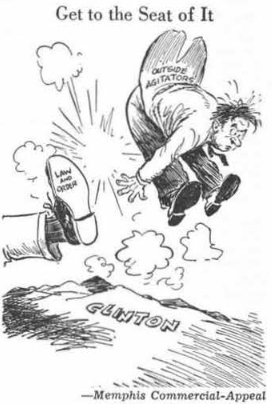
The highway patrolmen arrived as pro-segregation groups were staging a rally in the town square. A crowd of over 2,000 people showed up for the rally; ultimately, the cops used tear gas bombs to disperse them.
Calling for Calm Amid the Storm
While the trouble unfolded in Clinton, Kefauver was on the campaign trail as Adlai Stevenson’s running mate in the 1956 Presidential election. He wasted no time putting out a statement condemning the violence.
“We of Tennessee must proceed in a legal and lawful manner,” his statement read. “Whenever any individual or group of individuals takes the law into their own hands, then innocent people suffer and local government, the foundation of democracy, is endangered. I hope, as I know the great majority of citizens do, that the violence will cease and we will proceed with this problem in a spirit of good will on both sides.”
Sadly, Kefauver’s hope would not come to pass. The next day, 633 National Guard troops arrived in Clinton under the command of State Adjutant General Joe Henry, along with several tanks and armored personnel carriers. That evening, a crowd of 1,000 gathered in the courthouse square. A black sailor passing through town on his way home to Knoxville was briefly surrounded and harassed by the crowd, before being rescued by the Guardsmen.
At 9 PM that night, the Guardsmen fixed their bayonets and advanced into the square to clear the crowd.
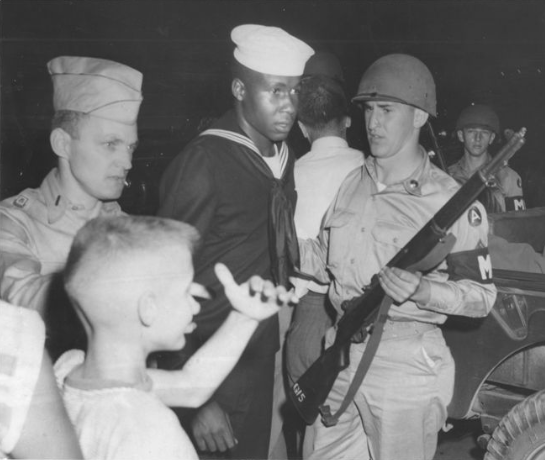
Still on the trail, Kefauver again spoke out against the violence and in support of the law. “Along with Governor Stevenson, I deeply regret violence and am glad that the local authorities and state authorities in Tennessee have shown such a firm determination to continue this a government of laws rather than of men,” Kefauver said. “Their actions have been commendable in a serious and difficult situation.”
Kefauver also lauded Governor Clement’s decision to call in the National Guard. “The governor had no choice but to send troops there,” he said. “Local and state people have shown they know how to handle a very ugly situation.”
The next day was Labor Day. Anderson County indicated that they would keep Clinton High closed until the situation was under control. In a bid to restore calm, General Henry issued an order prohibiting outdoor assemblies and public speeches in Clinton and assembly in the courthouse square after 6 PM.
There were no disturbances that night. Clinton High reopened on the next day. Nine of the twelve black students returned to school that day, but only 257 of the expected 800 white students attended. Principal D.J. Brittain Jr. said that a campaign was being waged to keep the white kids away.
From that point, though, tensions slowly dissipated. All 12 black students were in school the next day, and white student attendance rose steadily over the next couple of weeks, reaching a total of 650 by mid-month. Most of the Guard troops left town by Friday, with the remainder heading home in the following weeks.
And with that, seemingly, the crisis was over; things largely went back to normal . There were several more racial incidents during the course of the school year, but nothing like the rallies or riots that marred the beginning of September. One of the black students, Bobby Cain, graduated in 1957, becoming the first black graduate of an integrated Southern school.
Compared to the situation in Little Rock the following year, the integration of Clinton High was a success story. Or so it seemed. It turned out the segregationists weren’t ready to give up just yet.
“Dynamite Terrorism”
On a Sunday morning in early October 1958, the citizens of Clinton were awakened by an explosion. Someone had placed between 75 and 100 sticks of dynamite around Clinton High and touched them off, damaging most of the school beyond repair.
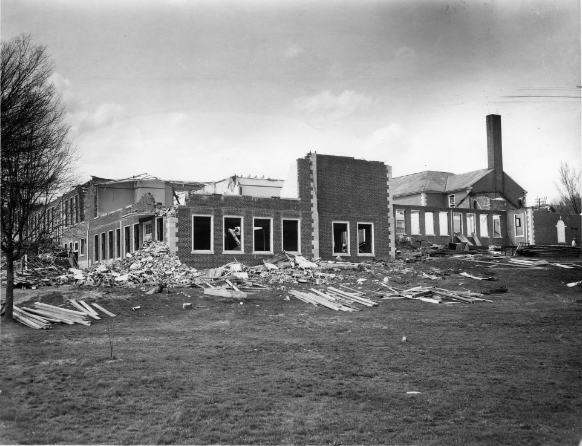
It was a shocking act, and it left the Anderson County school board scrambling for money to repair the damage and a place for their students to go to school. Governor Clement, who had since renounced his own decision to call in the National Guard back in 1956, wasn’t going to help this time around. So the school board wrote a letter to President Eisenhower asking for federal funds to repair from the “criminal acts of dynamite terrorism” that had destroyed Clinton High.
“We do not intend now to be intimidated or to have our children deprived of an education by the closing of our public schools by acts of terrorism,” the letter stated. “Through no choice of our own and to the great distress of our County, Clinton was chosen as the battleground for the opening of the integration struggle. We have borne the burden until now and have sought to fulfill our obligations to the best of our ability and to provide for the education of the children of Anderson County in our public school. We most earnestly request your assistance in meeting this present emergency.”
(The school board also saw fit to mention – twice – in the letter that they personally were opposed to school integration.)
A delegation from the school board came to Washington on October 8th to deliver the letter in person. Kefauver’s office arranged an audience with a White House aide. President Eisenhower himself, however, didn’t attend.
And the following week, he denied their request, saying that he was limited in what he could offer, and that school funding needs should be dealt with at a local level. (The lone thing the administration offered was the use of a vacant school building in Oak Ridge, home of the AEC’s nuclear laboratory and a few miles away from Clinton, so that the Clinton High students could continue to attend school.)
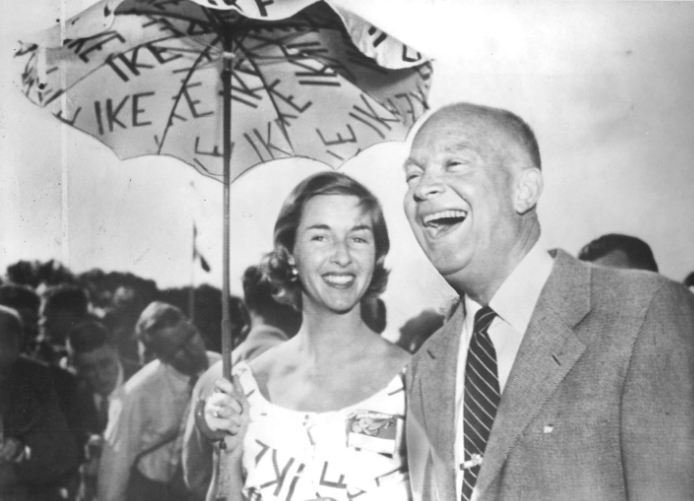
The President’s paltry response sat poorly with Kefauver, who slammed both Eisenhower’s lack of compassion and his unwillingness to help. “I think that the President should have shown his interest by visiting with” the school board, Kefauver said. “Not only his interest in getting money for the school, but in condemning what took place in Clinton.”
Kefauver also had no patience for Eisenhower’s excuse that he couldn’t offer much, noting that the White House had access to funding for emergency situations. “When a tornado or some unprecedented damage occurs that the people can’t take care of, money is usually made available from the President’s emergency fund,” he said. “I think it should be in this case. It’s within his discretion to do it.”
Despite Kefauver’s appeal, Eisenhower held firm in his refusal. That meant it would be up to private fundraising to make up the difference.
Raising Money to Rebuild from “Bombs of Bigots”
Political columnist Drew Pearson helped set up a group called “Americans Against Bombs of Bigots” to raise money to rebuild Clinton High. As soon as Pearson told Kefauver about it, he joined up. (Pearson later noted that Kefauver and John Sherman Cooper of Kentucky were the only Southern Senators “with the courage to help the Clinton school committee.” Pearson invited Governor Clement to join as well, but he refused.)
In November, Kefauver’s longtime friend and political advisor Bradley Eben wrote to the Senator, advising him that he hoped to raise money to rebuild Clinton High, as well as some synagogues that had been bombed recently. Kefauver strongly supported the idea, writing, “I think any efforts in this direction are good and noble.” He put Eben in touch with Pearson’s group, and they joined forces.
After spending time in Europe at a NATO meeting, Kefauver lamented the damage the bombing had done to America’s image overseas. “People just can’t understand these bombings,” he said to Pearson. “They tell me, ‘Of course you spend a lot of money for underdeveloped countries, but at the same time you kill school children and worshippers. You have lots of money but you have no heart.’ These bombings have hurt us abroad more than any single development in recent history.”
Fortunately, Americans Against Bombs of Bigots was successful in its efforts, raising over $27,000 to rebuild Clinton High. On December 14th, Reverend Billy Graham (who was also a member of Pearson’s group) delivered a sermon at the Clinton High gymnasium, which had survived the blast. A crowd of over 5,000 people, black and white alike, came to hear.
Graham’s sermon cited the parable of the Good Samaritan and reminded the audience of Jesus command to his followers, “Thou shalt love they neighbor as thyself.” He added, “Whatever our views about the race problem, all civilized people are opposed to violence. Hot heads and cold hearts never solved anything.”
Kefauver was also in attendance for Graham’s sermon. He told the audience that because of this meeting, “confidence will be restored” that Americans are “tolerant and in favor of law enforcement.” His remarks received a burst of applause.
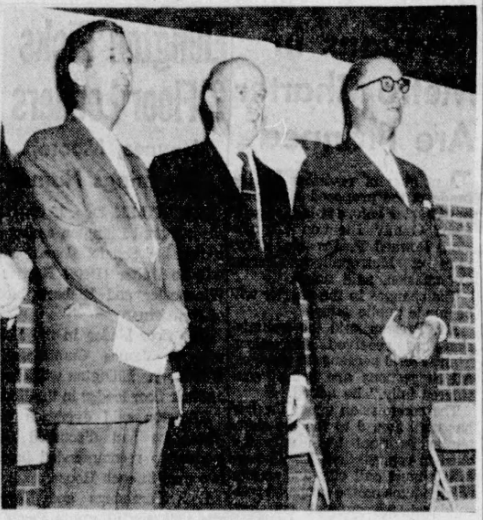
Kefauver then introduced Pearson, who presented Mayor R.G. Crossno with the funds raised by Americans Against Bombs of Bigots. Mayor Crossno said that with the group’s contribution, “We are now able to say that Clinton High School will be rebuilt in the foreseeable future.”
Postscript
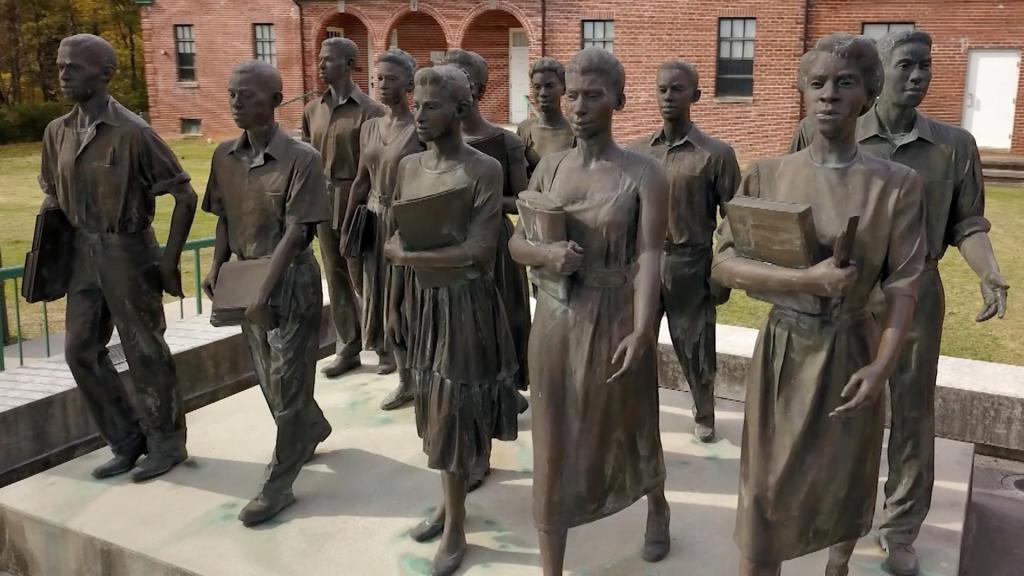
It took until 1960, but Clinton High School was rebuilt. (The students were bused to Oak Ridge in the interim.) And in time, the black students who integrated the school – known as “The Clinton 12” – received overdue recognition. In the 2000s, they were added to the school’s Wall of Fame. There is now a bronze statue in Clinton outside the elementary school the Clinton 12 attended.
Although the FBI investigated the Clinton High bombing for months, no one was ever arrested in connection with it.
One thing you may be wondering: Where was Albert Gore while all this was going on? Kefauver’s home-state Senate colleague had also refused to sign the Southern Manifesto, and he too tended to be favorable toward civil rights for black Americans. So why wasn’t he joining Kefauver in speaking out against the events in Clinton? (I searched the Tennessee papers both in September 1956 and October through December 1958, and if Gore said anything about Clinton High during those periods, I couldn’t find it.)
With all due respect to Senator Gore, who was a genuinely decent man and – by the standards of a Southern politician of his era – fairly courageous on civil rights, his courage tended to fail him in re-election years. It’s why he voted against the Civil Rights Act of 1964, but for the Voting Rights Act of 1965.
Similarly, in 1958, he was up for election to a second term in the Senate, and he seems to have felt it best to keep his head down and avoid speaking out on this issue. This calculation was probably influenced by the fact he was running alongside gubernatorial candidate Buford Ellington, who was an avowed segregationist. (Gore was not running for anything in 1956, however, so his silence then was more perplexing.)
Gore’s silence, however, only brings Kefauver’s willingness to speak out into even sharper relief. As difficult as it may be to imagine today, in a world where Governor Clement disavowed his own decision to stop the violence and the school board felt the need to affirm its support for segregation while asking for money to rebuild their bombed-out school, it took real courage for a Southern politician in that era to speak out against segregationist violence and in favor of the rule of law.
Kefauver showed that courage, and it would not fail him. In these angry and divided times, we would do well to remember his example.

 Estes Kefauver for President
Leave a comment