I have a fascination with, shall we say, arcane bits of history. (Given that I have devoted an entire site to the history of a long-dead Senator and failed Presidential candidate, you’d probably figured that one out already.) But unlike those who like to mine the past for irony or bits of amusing/bizarre/outrageous trivia, I have a fascination with finding out the whole story. If I’m reading an old newspaper article or looking at old photographs and a question pops into my head, I can’t just let it go. It nags at me until I track it down and find out the answer.
When I read Tyler Vigen’s piece last year about his quest to find the story behind a seemingly random pedestrian bridge in the Twin Cities suburbs, I loved it. This guy is a kindred spirit: he would not rest until he found out why the bridge had been built. It’s a fascinating tale and he tells it well.
The rabbit holes I fall down aren’t usually as deep as the one Tyler Vigen went down chasing the Bloomfield Bridge story, but they can be twisty and convoluted journeys in their own right.
Want to take a trip down the rabbit hole with me? All right, let’s go. (This story is nominally about Kefauver, which is why I’m including it here, but it’s more about me and my unquiet mind.)
The Mysterious Photo
Last week on my Instagram account, I posted a picture of Kefauver standing in a hotel lobby in 1952 that I found in the Life magazine photo archive. Here’s the photo:
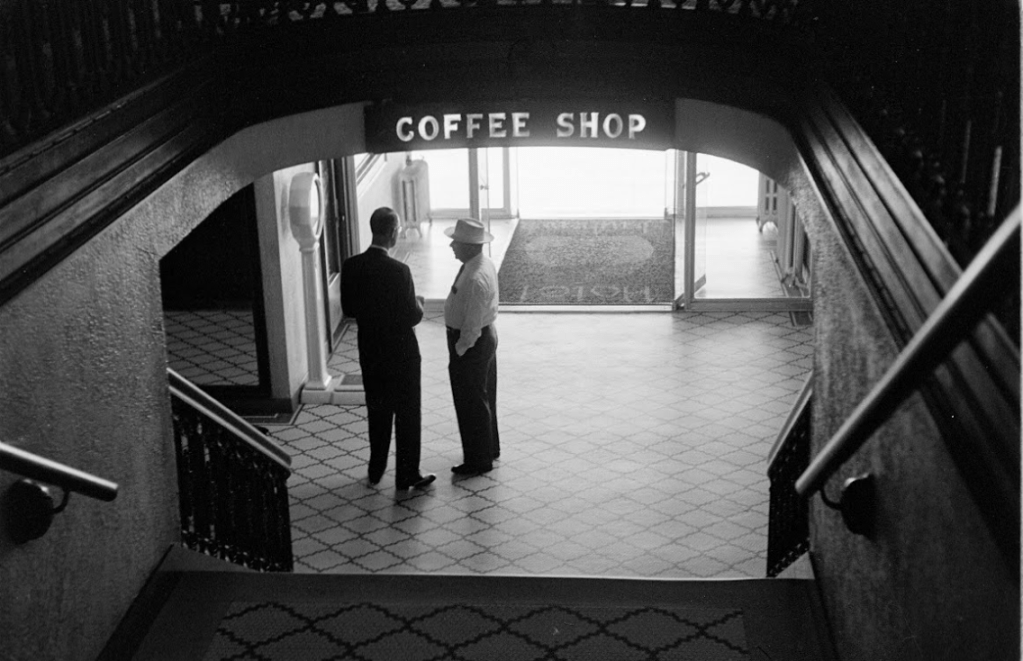
Honestly, the reason I posted the photo is because I found it aesthetically appealing. It had a film-noir kind of vibe that I liked. I didn’t (at the time) know the story behind the photo, where it was taken, or when in 1952 it occurred, and I didn’t (at the time) care. I just thought the picture looked cool.
But then, as I was posting the photo, I happened to notice that the rug by the door appeared to have the name of the hotel on it. I could read the word “Hotel,” but not the rest of it; the light from outdoors made that part too hard to read. But that was okay, because it was a cool-looking picture, and who cares what hotel it was, right? I added a comment stating: “The hotel’s name is on the carpet in front of the door. If you can read it, I salute your eyesight.” I posted it, it got a few likes, and I moved on to other things.
The Mystery Begins
Or at least that’s what a normal person would have done. But since I’m definitely not a normal person, I had a little voice in my head going: Man, I can almost read that. Wouldn’t it be great if I could?
After a while, I remembered that I have a suite of photo-editing software. Maybe if I zoomed in, fiddled with the contrast, changed the perspective a bit, maybe I could read it.
I loaded the image in my editing program, zoomed in on the rug, turned the image so the words were right side up, adjusted the contrast, changed the perspective, and I came up with… this:
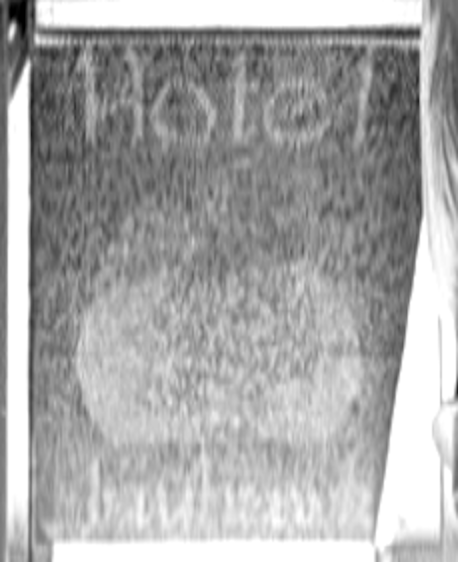
My first reaction upon seeing this was: Yep, that definitely says “Hotel,” all right. Below the word “Hotel” is a logo of some kind, and then… a word that, maddeningly, I still couldn’t quite make out.
The Hunt for the Hotel
But as I stared at it and squinted a bit, I thought I could see that the back half of the word said “hawk.” Aha! Now we’re getting somewhere! Maybe.
What’s a word that ends in “hawk”? My first thought was “Mohawk.” Perhaps the logo on the carpet was a Native American in a headdress. Seems plausible enough for the time.
So I googled the Hotel Mohawk, but my searches proved fruitless. There were several Mohawk Hotels, most of them in New York, plus a Mohawk Motor Inn chain of motels. But none of these were the “Hotel Mohawk,” and most of them were too small or too run-down (even in 1952) to be a plausible Kefauver campaign stop.
So maybe “Mohawk” was wrong. It didn’t quite seem to match the lettering, anyway. So I went back and stared at the image some more. Maybe it didn’t say Mohawk. Maybe it said… Jayhawk? This appeared to be a closer match for the lettering on the carpet.
So back to Google to search for “Hotel Jayhawk.” This search was much more successful! It returned one – and only one – result, in Topeka, Kansas. I found the hotel’s logo, which looked like this:
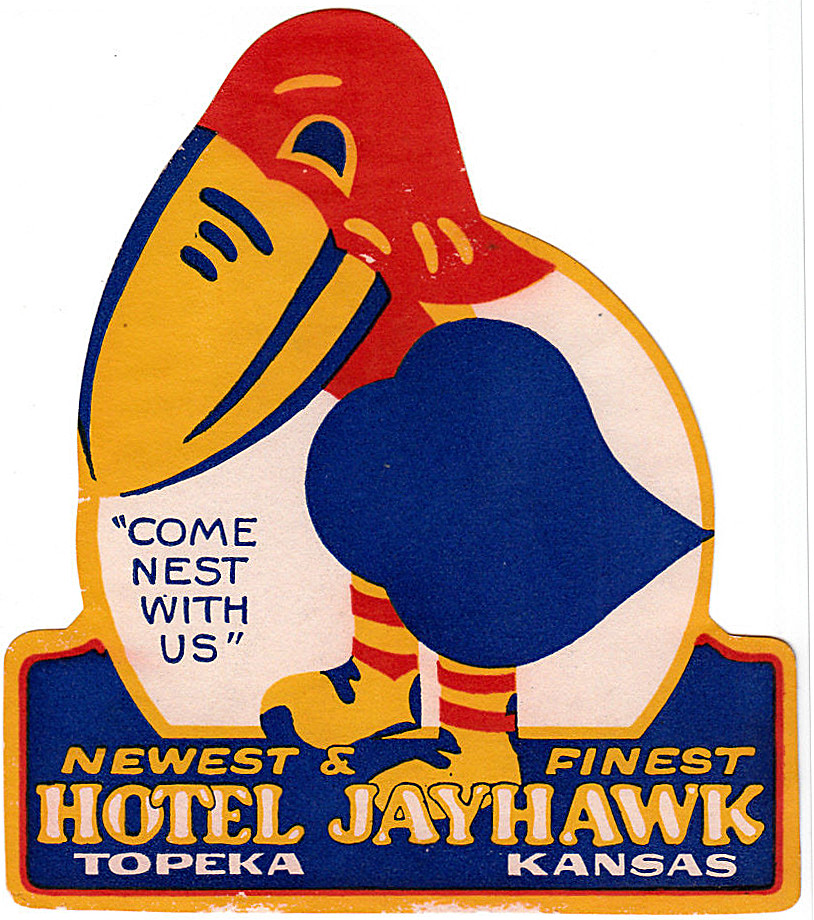
That looks like a plausible match for the logo on the carpet. Seems like a strong possibility!
Now that I’d come this far, naturally I had to learn about the Hotel Jayhawk. I found an old ad that promoted its location just one block from the Kansas state capitol. (Sounds like a good spot for a political visit!)
I learned that the structure was remarkable in its day; it contained not just a hotel, but the Jayhawk Theatre (which seated 1,500 and boasted air conditioning!), a coffee shop, and the “Jayhawk Walk,” which was a shopping arcade (sort of the precursor to a mall).

I learned that the whole complex cost over $1 million to build back in 1925. I learned that the first movie showed at the opening of the Jayhawk Theatre was “Mantrap,” starring Clara Bow. I learned that civic boosters hoped that the hotel and theater – which were state of the art for their time – would turn Topeka into a first-class city. I learned that Kansas Governor Alf Landon accepted the Republican nomination for President at the Hotel Jayhawk.
I learned that even though the theater closed in 1976 and the hotel shuttered a few years after, the structure still stands. The theater is run by a local nonprofit, and the hotel became the Jayhawk Tower and is used as an office building. It’s still a source of civic pride in Topeka; the neon jaybird sign atop the old hotel building is a city landmark. In 1993, the theater was designated as the official State Theater of Kansas.
It’s a fascinating story, and I made a mental note to visit the Jayhawk if I ever find myself in Topeka. But it didn’t prove that this was the hotel from the picture. All of the lovely pictures I saw when I looked up the Hotel Jayhawk showed the outside of the building. I needed a picture of the inside… and ideally one that showed a view similar to the one from the photograph.
Catching a Lucky Break
Googling “Hotel Jayhawk lobby” turned up a bunch of pictures… too many pictures, in fact. The hotel’s ads boasted that its lobby was half a block long, and there were pictures to prove it. I saw the sitting lobby, the Jayhawk Walk, the passage to the theater… all ornate, all gorgeous, but not providing the proof that I sought.
One of the pictures looked newer than the others, so I clicked on it. This took me to the site for the Jayhawk Corner Café, which appears to be a conversion of the coffee shop in the old hotel. (At least it was; its Facebook page seems to suggest that it was a victim of the pandemic.) At any rate, the site had a picture gallery, so I started clicking through and… wait, what’s this?

I couldn’t believe my eyes. Someone, for some reason, had taken a picture from the exact same angle as the one from 1952. The closer I looked, the more details I saw that matched. The pattern of the floor tile was the same. The design of the railings was the same. The curvature of the top of the stairwell was the same; even the molding seemed to match. The “COFFEE SHOP” sign is gone, the yellow wall at the bottom of the staircase is new, as is the exterior door, but virtually everything else matched. Even the rug by the exterior door seems to be in the same location. As close to proof positive as you could possibly find for two shots taken 70 years apart.
I’d done it! Against all odds, I’d managed to use a a couple of meager context clues and (a frankly ridiculous amount of) online sleuthing to find the location of this random photograph from the 1952 campaign. Victory!
I updated the Instagram post with the name and location of the hotel, closed my laptop and headed off to bed, triumphant in my discovery.
Just One More Thing…
Except. As I drifted off to sleep, I had a nagging thought tugging at the back of my mind: What the heck was Kefauver doing in Topeka? Yes, obviously he ran for President in ’52, and he traveled all over the country shaking hands and courting voters in the various primaries he entered. But Kansas didn’t have Presidential primaries in 1952.
Neighboring Nebraska did, so maybe he popped into Kansas while he was campaigning there. But why? Kansas was – and still is – a rock-ribbed Republican bastion. Even if Kefauver had received the nomination, and even given his appeal in farm states, he can’t possibly have been delusional enough to imagine he’d have a shot to win Dwight Eisenhower’s home state.
(Indeed, Ike took almost 69% of the vote in Kansas against Adlai Stevenson in the actual 1952 election. Amazingly, that was only the fifth-highest vote percentage he received in a state that year, trailing Vermont, the Dakotas, and… Nebraska.)
Surely, even a campaigner as tireless as Kefauver wouldn’t have wasted time campaign in flippin’ Kansas, would he? It just… didn’t… make… sense.
Sigh.
Hitting a Series of Brick Walls
So the next day, back down the rabbit hole I went, this time to figure out why Kefauver was in Topeka. One theory occurred to me quickly: Kefauver was a nationally popular figure, and Democrats frequently asked him to campaign on their behalf. Perhaps he was there to speak on behalf of a Democratic senatorial or gubernatorial candidate?
Promising thought, but quickly dashed. There was no Senate election in Kansas in 1952. There was a gubernatorial election, but it was a contest in name only: incumbent Republican Edward Arn was running for re-election, and he cruised to a 15-point win. (Honestly, given Eisenhower’s margin of victory, Governor Arn should have won by more.) It seemed unlikely that Kefauver would have been there on behalf of the no-hope Democratic candidate.
Maybe he was campaigning for a Congressional candidate? This also seemed unlikely, but not impossible. All of the incumbent Congressmen from Kansas in 1952 were Republicans (big surprise), and they were all re-elected in November… except one. In the 1st District, Albert Cole lost his re-election bid to Democrat Howard Miller.
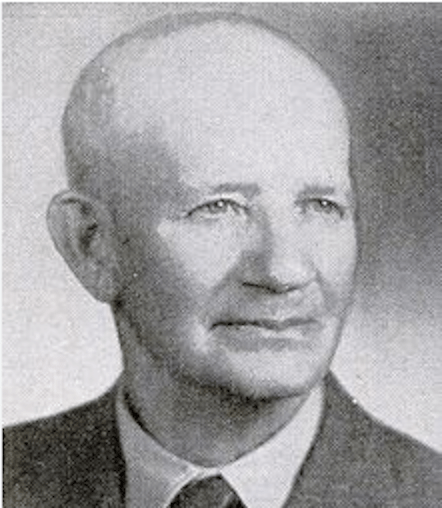
Maybe – just maybe! – Kefauver had come to Topeka to campaign on Miller’s behalf. And perhaps – perhaps! – Kefauver’s popularity had helped carry Miller to a stunning upset victory in an otherwise GOP-dominated year. A somewhat far-fetched scenario, perhaps, but… not completely impossible?
But wait. Was Topeka even in the 1st District? This turns out to be a harder question to answer than you might think. It definitely isn’t part of the 1st now – the district mostly covers the western part of the state; Topeka is in the 2nd District – but that doesn’t mean it wasn’t then.
Kansas had to redraw its districts significantly when they dropped from 6 Representatives to 5 in 1963 (they’re now down to 4). Wikipedia has the district boundaries going back to 1973; good luck trying to figure things out before that. (You can find a remarkable amount of information online, but decades-old Congressional district maps are generally not among them.)
I will spare you the tortured roads I went down in order to figure out that yes, Topeka was in the 1st District in 1952.
Also, good luck finding out much about a one-term Congressman with a name like Howard Miller. One of the advantages of researching someone named Estes Kefauver is that you don’t turn up a lot of false positives. Any reference to “Estes Kefauver” – or even just “Kefauver” –is almost certainly about him or a member of his family, especially if you’re searching something from the time period where he was a public figure.
As you can imagine, “Howard Miller” returns a lot more false positives. And one-term Representatives generally don’t have a lengthy record of achievements from their time in office; Miller is no exception.
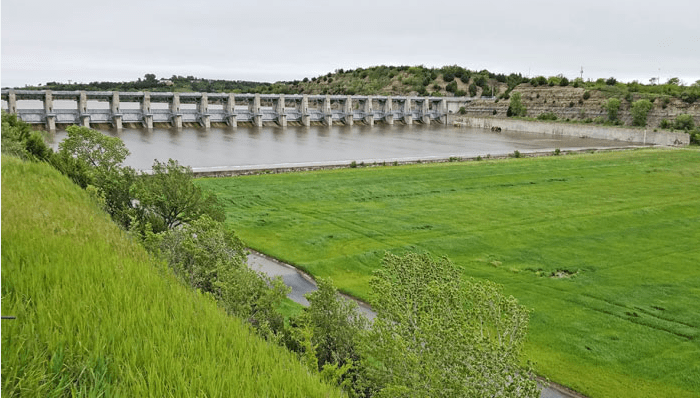
That said, by looking at the scant information available on Miller – including an oral history interview of the man who succeeded him, William Avery – I was able to learn that Miller’s surprise victory was fueled by a local controversy over an Army Corps of Engineers proposal to build a flood-control dam on Tuttle Creek near the town of Manhattan. A group of locals pushed for a series of smaller dams upstream.
The battle grew quite heated, and Miller allied himself with the group opposed to the “Big Dam Foolishness,” as they called it, and rode that furor to a win over Cole. (Avery also sided with the anti-dam group, and used the district’s natural Republican lean to oust Miller two years later. He would go on to serve two terms as governor of Kansas in the ‘60s.) The dam opponents lost their fight, and the dam was completed in 1959.
So much for the idea that Miller rode Kefauver’s coattails to victory. Back to square one.
At this point, I felt like I’d gone from the Hotel Jayhawk to the Hotel California: I could check out any time I liked, but I could never leave… at least until I solved this (objectively, completely meaningless) mystery. The inside of my head is a dangerous place to hang out.
Trying A New Tack
Okay, if Kefauver appeared in Topeka, surely the local paper must have written about it. A Presidential candidate appearing in town would have been a big story in 1952.
But I quickly ran into another roadblock. Although a lot of back issues of old newspapers have been either scanned or digitized for online access, Topeka’s newspaper aren’t among them, at least not for the period I’m interested in.
The online archives of Topeka’s current newspaper, the Capital-Journal, only go back to 1996. I have access to a couple of sites that contain digital records of old papers, but those also came up empty. I could find records from Topeka papers in the 19th century up to the 1920s, but nothing for the 1950s.
The Kansas State Historical Society helpfully points out that they have the old Topeka dailies (the Daily Capital and the State Journal, which merged in 1981) on microfilm, but even I’m not crazy enough to fly to Kansas and spend hours or days poring over a microfilm reader to solve such a picayune mystery. (Even if I were, my wife would undoubtedly put the kibosh on that. “You want to spend our summer vacation where, doing what?”)
So I switched to Plan B: looking at other Kansas newspapers that had digital archives. A visit from Kefauver would likely have been a big enough story that a paper from a neighboring city might have written about it, or at least mentioned it. This seemed like a viable alternative. At this point, however, I really had two challenges to solving this riddle.
The fact that the Topeka papers from 1952 aren’t available online was one thing. But I still didn’t know when in 1952 Kefauver might have visited there. So I had to do searches on Kansas newspapers for the entire year.
This meant there was good news and bad news. The good news was that there were plenty of hits for “Estes Kefauver” in the Kansas papers in ’52. The bad news was that almost all of them were wire stories about the primary results, or syndicated political columnists assessing his chances to win the nomination.
All of this would have been very interesting back when I was writing about Kefauver’s first Presidential campaign! Honestly, it was still interesting to me now. But I couldn’t let myself get distracted by these stories… I was on a mission!
So I clicked through story after story about the close primary race against Sen. Richard Russell in Florida and the battle against a Stevenson write-in effort in Illinois, past column after column by Drew Pearson and Doris Fleeson and the Alsop brothers, looking for something… anything… about Kefauver’s visit to Topeka.
At Last, I Get a Clue
Then, finally, after dozens and dozens of false leads, I finally encountered this item from the Council Grove Republican dated June 28, 1952:
Kansas City – Three political aspirants will be in the Kansas-Missouri area over the weekend.
Senator Richard Russel [sic] will speak in Wichita tomorrow and then move to Kansas City for another address.
Senator [Robert] Kerr will be in Excelsior Springs over the weekend.
July 3, Senator Estes Kefauver will be in Wichita in the morning and fly to Topeka for an afternoon conference.
Eureka! I had a confirmation that Kefauver was in Topeka, and I had the date. I even knew that he was there for an “afternoon conference.”
But what kind of conference? Probably a press conference, but maybe he was addressing a conference of doctors, or traveling salesmen, or state legislators? I proceeded to waste some time trying to figure out whether there was any sort of conference held in Topeka on that date, but that proved fruitless (particularly since I didn’t have access to the Topeka papers).
But with a date, I could at least narrow my search. Now, searching for articles on July 3rd, I came across the following wire-service item that ran in the Daily Oklahoman:
TOPEKA, Kan., Jul 2 – UP – Democratic Presidential candidate Estes Kefauver will speak in Topeka Thursday night and his vivacious wife Nancy will be with him.
The Tennessee senator will arrive here by plane from Wichita at 5 p,m. and conduct a press conference with Mrs. Kefauver at the governor’s suit of the Jayhawk hotel at 6 p.m.
I now had confirmation that the “conference” was a press conference, and that he did indeed hold it at the Hotel Jayhawk.
But in order to find writeups of the actual event, of course, I’d need to look at papers from July 4th. Again, the lack of papers from Topeka was a hindrance, particularly given that the papers in Wichita – the nearest larger city – obviously focused on that leg of the trip. That said, I was able to cobble together enough information to essentially reconstruct Kefauver’s day.
The Story Behind Kefauver’s Trip
In the morning, Kefauver and his wife Nancy left Washington to fly to Kansas. They’d originally planned to be in Wichita by 11 AM to participate in a luncheon at the Lassen Hotel, but engine trouble delayed their departure and they had an unscheduled stopover in Newark, New Jersey.
Such was the nature of air travel in those days; political reporters had a habit of applauding every time the plane they were on took off and landed safely.
By the time the Kefauvers got to Wichita, it was almost 3 PM. They were greeted at Municipal Airport by a crowd of local Democratic luminaries, who whisked them off to the hotel.

Despite the fact that the candidate had missed the luncheon, most of the crowd – who’d paid $1.50 a plate for the privilege – remained in attendance; those who had left came back when Kefauver arrived in the hotel ballroom. And despite being hours behind schedule, he carried on with his planned speech, reception, and press conference.
Addressing the crowd in the Lassen Hotel ballroom, Kefauver laid out a three-point platform for his administration: continuing the Democratic program of economic opportunity, pursuing a lasting peace, and eliminating crime cartels. He lambasted Republicans for their isolationism and their opposition to Democratic economic policies, calling them “a party which which has fought every progress we have made under Roosevelt and Truman.”
While acknowledging that he “started out with no organization and no money” and was “running a campaign of prayer and pennies,” Kefauver lauded the fact that he had received almost 4,000,000 popular votes in the primaries, and said this was proof that the people “want to have more say-so about the political candidates they are going to nominate.”
He concluded his speech with some word of inspiration for his fellow Democrats: “Let us go forward in the next election with confidence that we are going to win, because we’re going to win.”
As was usually the case, the crowd was charmed at least as much by Nancy Kefauver as they were by her husband. “Being the wife of a candidate for the Democratic nomination for the presidency is hectic,” she told reports, “but it’s so exciting!” The papers referred to Nancy as Kefauver’s “No. 1 backer and most enthusiastic fan.”
Kefauver wasn’t the only candidate speaking in Wichita. Henry Parkinson, a farmer from Scott City running for the Democratic nomination for governor, was also there. He said he was running in part because he was tired of lawyers running everything. “Why can’t farmers be successful in running the affairs of this great state of ours?” he asked.
(Unfortunately, he wouldn’t have a chance to answer that question. He finished fourth in the Democratic primary, losing to Charles Rooney, who was – you guessed it – a lawyer. Rooney was routed by Governor Arn in the general, as I mention about 1,500 words ago.)
After the whirlwind tour of Wichita, Kefauver got back in his plane in the late afternoon and flew down to Topeka. He arrived at the Hotel Jayhawk in time for a dinner meeting with about 100 state Democratic leaders.
At the meeting, he predicted a Democratic sweep in November, predicting that the ill feelings between pro-Taft and pro-Eisenhower factions of the Republican party would persist after the convention, which was set to begin the following week.
“A breach is forming in the Republican ranks that will not heal after the GOP convention in Chicago,” he told the crowd. He said that the Taft-Eisenhower feud was a proxy fight for the real battle “between the isolationist and internationalist wings of the GOP,” blaming the past generation of Republican isolationists for doing “more than any other factor towards starting World War II.” (Kefauver turned out to be wrong about the whole Republicans-in-disarray thing, although he had reason to believe it.)
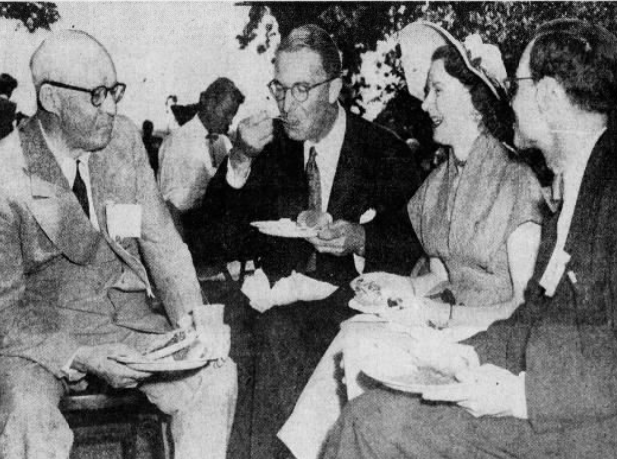
That night, the Kefauvers stayed at the Jayhawk in the governor’s suite. The next morning, they were off to Cedar Falls, Iowa, where he spoke at the city’s centennial celebration and rode in the parade in front of a crowd of 15,000.
A Fruitless Chase for Delegates
So, what was the point of this visit? The timing makes it obvious. The primaries had wrapped up in June, and although Kefauver had won by far the most votes and the most delegates, he didn’t have nearly enough to win.
And it was abundantly clear that neither President Truman nor the party bosses had any interest in helping him get over the line. If Kefauver wanted to round up the delegates he needed to win, he’d have to do that himself, the same way he’d done in the primaries: by taking his case to the people.
While in Wichita, Kefauver had a reception with Kansas delegates and alternates. The next day in Cedar Falls, he met a 23 of the 24 Iowa delegates, along with six alternates.
At both stops, he made the same fundamental case: he was the people’s choice. “I just want the delegates to follow the will of the people,” he told the folks in Cedar Falls. “I believe the people ought to have more to say in the select of a president.”
Was the trip a success? In a word: no.
Obviously, he didn’t win the nomination. But he also failed to win the hearts of the Kansas delegation. He got half a delegate vote from the Sunflower State in the first round of balloting, but before the voting closed, the entire delegation shifted to Stevenson and remained there for the remainder of the contest.
He did a bit better in Iowa, attracting 8 of the 24 delegates. Those eight stuck with him until the end, when the entire convention voted to make Stevenson’s nomination unanimous.
Conclusion
So, after all of this, what did I learn? Well, for one thing, I learned far more about the history of Topeka and midcentury Kansas politics than I ever expected to know. Also, the fact that I felt the need to pursue the question this far – and then to write it all down for you – demonstrates that there’s something very wrong with me. (Sincerely, for those of you who made it this far, I salute you.)
But another thing this reinforced for me is just what a remarkable wealth of information is online these days.
If I’d wanted to go down this particular rabbit hole 20 years ago, or even 10, I pretty quickly would have hit a dead end. I almost certainly would have had to fly to Kansas in order to access microfilm records to figure all this out. And without the ability to do keyword searches on those records, who knows how long it would have taken me to find out when Kefauver was in Topeka, or what he said there? The ability to reconstruct whole chunks of our past on our computers is nothing short of an information revolution, and one we all too often take for granted.
A mystery that would have taken weeks or months to unravel – if I could have solved it at all – can now be resolved in a couple of days, without leaving my living room. Granted, it was a mystery that in no way needed to be solved. But the point is, I solved it! I figured out the where, when, and why behind the photograph. The only thing I don’t know is the identity of the man standing next to Kefauver in the photo.
But that’s okay, I don’t need to know that.
Right?
 Estes Kefauver for President
Leave a comment