
I’ve always been fascinated by alternate history. There’s a whole community of people who write speculative stories about what might have happened if the South had won the Civil War, or if the Axis had won World War II, or if various other hinge points in history had turned out differently.
Despite the title of this site, I don’t generally engage in alternate history here. (For those interested, there are several sites that explore the idea of a Kefauver presidency.) I prefer to focus on telling the story of Kefauver’s life and times as they actually happened.
Still, sometimes I do ponder what might have happened if Kefauver had succeeded in claiming the nomination in 1952 or 1956. What would his general-election campaign have looked like? Could he have overcome Eisenhower’s broad national popularity and general exhaustion with 20 years of Democratic rule?
We can never know the answers for certain. But I came across a significant piece of the puzzle: the 1952 acceptance speech that Kefauver never got to give.
In 1970, historian Richard Fried ran the text of the would-be acceptance speech in the Tennessee Historical Quarterly. The speech was drafted by Kefauver advisor Richard Borwick and circulated among the campaign’s chief lieutenants. While we can’t be sure that this is exactly the speech Kefauver would have delivered had he claimed the nomination, it’s the closest we can come.
The speech suggests that Kefauver would have run a far more aggressive campaign than Adlai Stevenson did, and he wouldn’t have hesitated to bring the fight to Eisenhower and the Republicans.
For comparison, take a look at the acceptance speech that Stevenson actually gave in 1952.

After several paragraphs about how he never sought to be the nominee and how he wishes the convention had chosen someone else, Stevenson devotes the rest of his speech to the kind of lofty, high-minded, erudite rhetoric that has led him to be remembered as one of history’s noblest losing candidates.
He praises the Democrats for “not spoil[ing] our best traditions in any naked struggles for power.” He describes the election as a “great quadrennial opportunity to debate issues sensibly and soberly.” He views the campaign as “a great opportunity to educate and elevate [the] people.” He never mentions Eisenhower by name, and barely even mentions him by reference. Apart from a couple gentle jibes about the GOP’s “split personality,” he doesn’t go after the opposing party.
It’s a lovely speech. I’m sure it would make Aaron Sorkin smile. But a candidate who says things like “Better we lose the election than mislead the people” is a candidate who already knows he is going to lose.
Kefauver’s speech, meanwhile, sounds like a candidate who is trying to win an election, a candidate who understands that it doesn’t matter how admirable voters find you as they’re pulling the lever for the other guy. It reflects a grasp of the practical realities of politics. While Stevenson goes on and on about how much he didn’t want to be the nominee, Kefauver – in the second paragraph of the speech – stresses the importance of electing Democrats at all levels of government. Because that’s how you get to govern.
Kefauver’s speech also reflects an understanding that, when going up against a candidate as popular as Eisenhower, you have to give people a reason not to vote for him, and that means going after the GOP – and even the candidate himself – harder than Stevenson would dream of doing.

The indictment of the GOP in Kefauver’s speech is scathing, associating Republicans with breadlines, slums, sweatshops, isolationism, imperialism, and corporate rule, while associating Democrats with progress, broad-based prosperity, peace, and international cooperation. The speech traces a path from Teddy Roosevelt’s Square Deal through Franklin Roosevelt’s New Deal to Harry Truman’s Fair Deal. (Clever bit of rhetoric there, tying the Republican TR to FDR and Truman.) The GOP, by contrast, is the party of “No Deal,” whose idea of change is “retreat to the past gone with the wind.” The speech also mocks the Republican habit of calling Democratic policies “socialism,” which goes to show just how long the GOP has been trotting out that particular attack.
The speech doesn’t pull any punches when it comes to Eisenhower, either. Kefauver’s speech talks a lot about the importance of civilian rule – implying that Eisenhower would operate some kind of military junta. The speech alleges that during his acceptance, Eisenhower said “that because he had led American boys in a crusade against Hitler he was now fit to lead a second crusade against millions of his fellow countrymen.”
I found it hard to believe that Ike would be foolish enough to say this, so I looked up his acceptance speech. Here’s what he actually said: “[Y]ou have summoned me on behalf of millions of your fellow Americans to lead a great crusade—for Freedom in America and Freedom in the world.” So no, he didn’t explicitly claim to be leading an attack on his fellow countrymen. But by equating the campaign to a crusade, Eisenhower implicitly cast the millions of Americans backing the Democratic candidate as the opposing force.
The speech also attacks the idea of military rule from another angle, invoking Ulysses Grant as an example of why it’s a bad idea to entrust the Presidency to a general. “I can well understand how the bosses would use the good name of a soldier as they used the good name of Ulysses S. Grant,” the speech states, “to cover up their own corrupt machinations.” This was a perfect line of attack for Kefauver, who loved attacking “bossism” in all its forms.
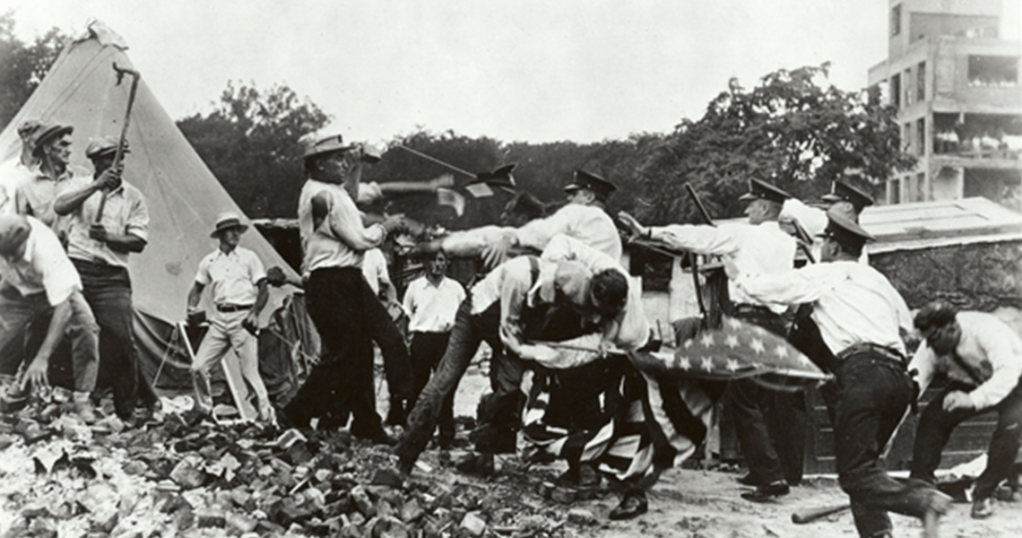
The speech also cites the 1932 Bonus Army incident, when President Hoover ordered General Douglas MacArthur to attack and evict by force an encampment of World War I veterans who came to Washington to demand early payment of their promised service bonuses. This rhetorical tactic tied together two themes of the speech: blaming Republicans for the Great Depression and raising the specter of the military attacking fellow Americans. It helped that both Hoover and MacArthur were featured speakers at the Republican convention – and that Eisenhower was present at the Bonus Army attack as a junior aide to MacArthur. (In Eisenhower’s defense, he thought the attack was a bad idea and tried to convince MacArthur not to do it.)
The speech includes some more personal salvos as well, accusing Eisenhower of being a political dilettante with a jibe about his “newly discovered politics.” In another passage, noting that generals are used to carrying out orders, the speech suggests that an Eisenhower presidency would be a stalking horse for arch-conservatives like Robert Taft and Joe Martin, as well as controversial characters like MacArthur and Joe McCarthy.
One of the most fascinating passages in the speech contains an extended metaphor involving television. Since television was both the hot new technology and the source of Kefauver’s national fame, it only makes sense that he would mention it. But the speech also imagines a world of “television in reverse,” where the delegates in the convention hall could peer into the homes and lives of ordinary Americans. (In a way, you could say this idea envisioned social media.)
The metaphor is then continued with the idea of adding a “play-back attachment” to the reverse television, which would allow people to peer backward into history. (A sort of proto-YouTube, perhaps?) Kefauver’s speech argues that with such a device, “[w]e would see the American people on the march.” It then envisions the playback demonstrating 20 years of progress under Democratic administrations. This is the most optimistic part of the speech, and it lays out an effective case for the accomplishments of the Roosevelt and Truman administrations.
The speech concludes with eight points that would be the focus of Kefauver’s administration.
1. To raise to new heights of strength the union of the freedom-loving peoples of the world forged by the Democratic Administration to preserve the peace.
2. To double American production and thereby double American living standards in the next decade.
3. To wipe out the corruption of our public servants by malefactors of great wealth.
4. To eliminate discrimination and racial hatreds from American life.
5. To vanquish communism by rooting out its lawless instigators in our land and by showing the peoples of the earth that our way of life can conquer the evils of poverty, hatred, and militarism which are the breeding grounds of communist imperialism.
6. To remove McCarthyism and planned hysteria from our public life.
7. To extend the benefits of social security and the protections against natural disaster and human exploitation established by the social legislation of twenty years to every worker, farmer, homeowner, bank-depositer, and veteran, and to every household in our land.
8. To maintain civilian government, -the supremacy of private citizens over generals, which is the heart and soul of our democracy.
Most of these are goals that would be typical of any midcentury Democratic candidate. However, there are a few points worth noting.
- Point 3 is pure Kefauver-style populism, the point that feels most distinctly his. It not only harks back to his organized crime hearings, but also touches on his career-long battle against monopolies and corporate power.
- Point 7 is interesting, especially when paired with Point 4, because it suggests – without stating it in so many words – that Kefauver wanted to eliminate the racially discriminatory elements of some New Deal programs. This seems consistent with Kefauver’s overall view of civil rights, that all people should be treated equally under the law.
- Points 5 and 6 are also interesting, suggesting that the best way to triumph over communism is not through Red Scare tactics, but by demonstrating that the American way of life is more effective at solving the problems of humankind. The bit about “rooting out its lawless instigators in our land” was basically mandatory for a candidate running in 1952, but Kefauver’s heart wouldn’t have been in it.
- Point 8 is one more jab at Eisenhower, because the speech didn’t have enough of them already.
All in all, it’s not a speech that would have been remembered as a model of eloquence and decorum. But it’s a speech that would have set up an aggressive campaign to win the Presidency, which – again – is the point of the exercise. Kefauver would still have faced an uphill battle, but at least he recognized that he needed to battle. Stevenson’s ivory-tower phrases, lovely as they were, amounted to bringing a dessert spoon to a gunfight.
But don’t take my word for it. I have posted the full text of the speech, so you may judge for yourself how effective it would have been.
 Estes Kefauver for President
Leave a comment