Here’s a picture of Estes Kefauver campaigning in Southside Virginia in September 1956:
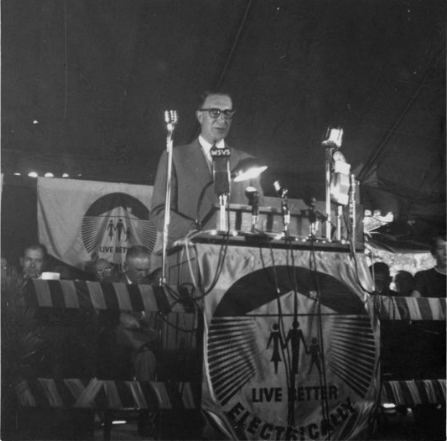
When I saw this picture, my eye was drawn to the logo draped on the front of the podium (and also displayed on the banner behind Kefauver’s right arm). Here’s a clearer picture of the logo:
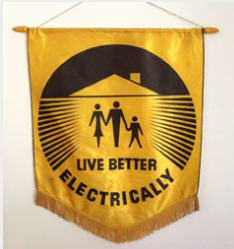
What the heck does “Live Better Electrically” mean? And what, if anything, did it have to do with the 1956 Presidential campaign?
To answer the second question first: It didn’t have anything to do with the campaign, although there was a connection with a future President. (More on that in a minute.)
In the late ‘40s and early ‘50s, the wave of returning GIs and the baby boom in postwar America led to a huge spike in demand for housing. As new suburbs and subdivisions sprung up to meet the demand for new houses, this created a huge demand for electrical power. The utility companies responded by building new power plants as fast as they could. But as these new plants came online, the price of electricity dropped.
Looking for ways to expand their markets, electric-appliance companies like GE and Westinghouse devised the “Live Better Electrically” campaign as a way to encourage homeowners to consume more power and buy more of their products. They promoted the idea of electrified homes, with electric heat, electric stoves, and a variety of nifty new electric appliances.
The campaign launched in March 1956, supported by hundreds of utilities across the country along with 180 electric manufacturers. The following year, they expanded the campaign to include the “Medallion Homes” program, in which all-electric homes (that is, homes using only electricity for heat, light, and power) received brass badges to attach to their doorbells, walls, or front sidewalks.
The sponsors launched a full-court marketing press that included newspaper and magazine ads, as well as TV and radio spots. Here’s one of their TV ads from 1961:
Here’s an excerpt from one of their magazine ads:
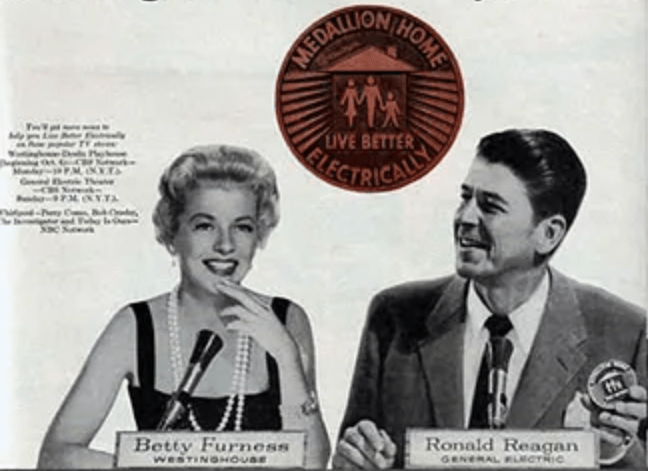
Yes, that’s future President Ronald Reagan there on the right. Reagan was the chief spokesman for GE at the time, and was one of the primary faces of the LBE campaign. In one episode of “General Electric Theater,” he took viewers on a tour of his all-electric home in Pacific Palisades.
The campaign was a huge success. By some estimates, 1 million Medallion Homes were built by the early 1970s. Unfortunately, some of those homeowners would live to regret their decision as electricity prices climbed in future decades. This 2001 LA Times article mentions all-electric Southern California homeowners trying to retrofit their homes for natural gas or resorting to other extreme measures – like not turning on the heat in the winter – to cut their power bills.
It’s somewhat ironic that Kefauver would speak in front of a banner promoting the electric industry, given that he would launch hearings into those companies a couple years later. The investigation was sparked by a series of suspiciously similar bids that the companies submitted to the Tennessee Valley Authority, The hearings led to a Justice Department investigation that yielded over $2 million in fines for companies like GE and Westinghouse, and seven electric-company executives going to prison.
 Estes Kefauver for President
Leave a comment