
Throughout most of his career, Estes Kefauver was never beloved by the Democratic Party establishment. During his runs for the Presidency in 1952 and 1956, Kefauver suffered numerous blows from a party that seemed determined to thwart his ambitions at every turn. As it turns out, that rough treatment extended to some of his Presidential backers as well.
Coya Knutson was a first-term House member from Minnesota at the time Kefauver mounted his 1956 Presidential bid. She was Minnesota’s first female Representative; after two terms in the state legislature, she ran for the 9th District House seat in 1954 and won.
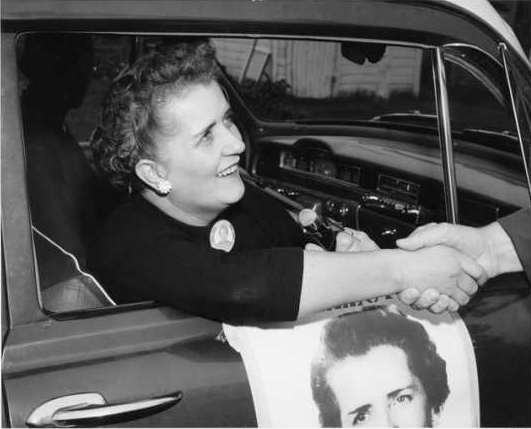
Like Kefauver, Knutson was a hard-working campaigner; she traveled the farms of her district, helping her constituents milk their cows while she asked for their votes. She also was known for singing and playing the accordion at county fairs and campaign events. (See the featured image of today’s post for proof.) She landed a prize seat on the House Agriculture Committee, originated legislation creating the federal student loan program, and urged federal funding for cystic fibrosis research.
The Minnesota primary was one of the first on the calendar in 1956. Knutson’s Democratic Farmer-Labor (DFL) Party was all in for Adlai Stevenson, from Governor Orville Freeman and Senator Hubert Humphrey (who hoped to be Stevenson’s VP) on down.
But Knutson wasn’t on board. She liked Kefauver’s stances on farm policy. And she likely saw in him a kindred spirit, a tireless campaigner who stood up for the “little people” and understood the importance of personal connections with voters. She defied the party and chaired Kefauver’s Minnesota campaign, working hard on his behalf.

When Kefauver won the Minnesota primary in a shocking upset, the DFL establishment was furious with Knutson. She’d established herself as an outsider when she beat the party’s preferred candidate to win her seat in the first place. And like Kefauver, she did not spend much time making nice with the party leaders, preferring to focus on serving her constituents.
When she ran for a third term in 1958, the DFL party primaried her, but she won. Then came the bombshell.
Knutson was estranged from her husband Andy, an abusive alcoholic. When she went to Washington, he didn’t come with her. Instead, she spent her time in DC juggling her work with raising her adopted son, Terry, essentially as a single mother. She did her best to ignore the whispers that she was having an affair with her chief of staff.
Then on the day before Mother’s Day, a letter ran in papers across the nation, signed by Knutson’s estranged husband, under the headline “Coya, Come Home.” The letter said in part:
Coya, I want you to tell the people of the 9th District this Sunday that you are through in politics. That you want to go home and make a home for your husband and son. As your husband I compel you to do this. I’m tired of being torn apart from my family. I’m sick and tired of having you run around with other men all the time and not your husband. I love you, honey.
That was enough to ensure her narrow defeat to Republican Odin Langen, whose campaign slogan was “A Big Man for A Man-Sized Job.” She was the only incumbent Democrat to lose re-election to the House that year.
Where did the letter come from? One thing was for sure: Andy didn’t write it (though he was reportedly paid to sign it). Knutson and her son believed that her enemies within the DFL were behind the letter, though they never obtained proof. Certainly, the party didn’t lift a finger to defend her when the letter came out.
After her loss, Knutson finally divorced Andy (too late). He drank himself to death in 1969. (Although Knutson didn’t attend his funeral, she refused to speak ill of him publicly.) Knutson tried unsuccessfully to win back her old seat a couple times, then moved back to Washington as a liaison officer for the Office of Civil Defense. She died in 1996 at age 84. An attempt to build a memorial to her at the Minnesota state capitol building in St. Paul failed, and she largely faded away into history. (Thankfully, in more recent years her story has been told more often, and a biography of her came out in 2014.)
When Kefauver was agonizing over whether to drop out of the 1956 race, he worried about his supporters, saying: “My people went through hell for me.” Coya Knutson’s tragic story shows that he was right to be worried, and that at least one of his supporters really did go through hell.

 Estes Kefauver for President
Leave a comment