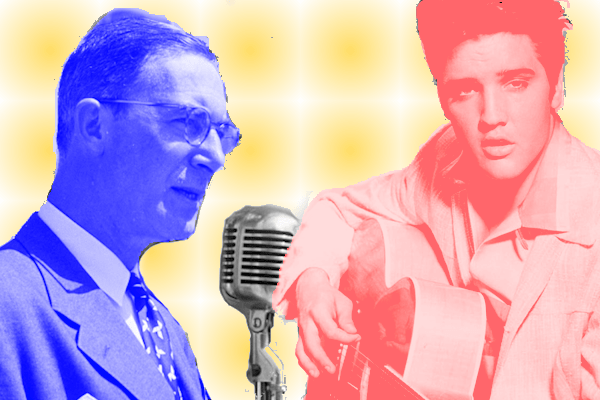
In the wake of the televised crime hearings and his 1952 Presidential run, it’s fair to say that Estes Kefauver was the country’s most famous Tennessean in the early ’50s. Within a few years, however, he would lose that title to a young man from Memphis with a curled lip and gyrating hips.

There’s no evidence (at least none that I’ve been able to find) that Kefauver and Elvis ever met. However, Kefauver was a savvy enough politician to indicate familiarity with the rock-and-roll legend from his home state.
Elvis burst onto the national scene in early 1956, when his song “Heartbreak Hotel” hit #1 on the Billboard charts. That was the same year that Kefauver made his second try for the Presidency, and wound up as Adlai Stevenson’s running mate. Presley’s name came up at least a couple times on the campaign trail. Time magazine relayed this anecdote that September:
Landing in Los Angeles, Stevenson and Kefauver faced a mob scene sufficient to warm any politician’s heart. As they prepared to meet the crowd, someone remarked that it was a greater throng than the one that recently met Rock-‘n’-Roll Star Elvis Presley. “Who,” asked Stevenson, “is Elvis Presley?” As usual, Estes Kefauver was right on hand to help fill Stevenson’s fund of commoner knowledge. Elvis the Pelvis, he said, was “a fine boy” from Tennessee.
It is 100% on-brand that Stevenson had no idea whatsoever who Elvis was. The man had many fine qualities, but a pop-culture savant he was not.
Later that month, United Press reported that Kefauver discussed The King on the campaign trail again:
Estes Kefauver, on the start of a barnstorming tour of Pennsylvania today, took note of a sign carried by some Erie Academy students. The sign read, “Elvis for President.”
“Elvis Presley is a Tennessee boy from Memphis,” the Tennessee Senator told the students. “He’s not running for president, and he’s for Adlai and me.
“The Republicans use an Elvis Presley record every leap year, though. On one side is ‘I Need You, I Want You, I Love You’ (sic). They play that during the campaign. After election day they play the other side – ‘See You Later, Alligator.’”
Kefauver handled this moment well, and his joke about the Republicans was pretty good. There were a couple problems with it, however. He garbled the name of the first song a bit; it was actually “I Want You, I Need You, I Love You.” More problematically “See You Later, Alligator” was actually by Bill Haley and His Comets, not Elvis. Oh well, it’s not like anyone thought Kefauver was really listening to rock and roll in his spare time.
As for his claim that Elvis was “for Adlai and me”… not so much. When a reporter asked the young star about the Stevenson-Kefauver race during that summer, Elvis responded that he was busy touring and “I don’t hardly ever get a chance to read the newspapers anymore.”
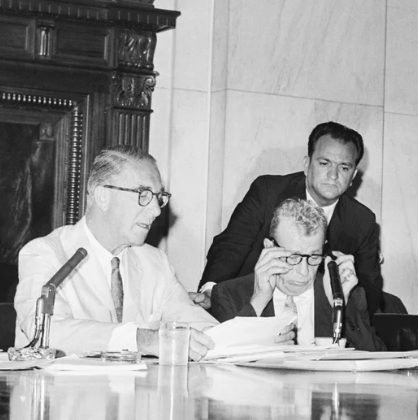
A couple years later in February 1958, Elvis’ name came up on the Senate floor during Kefauver’s Anti-Monopoly Subcommittee hearings on the auto industry. Kefauver was questioning General Motors president Harlow Curtice about the rising prices of new cars. At one point, he directed Curtice to provide the subcommittee with the salaries of all the executives at GM.
This caused another subcommittee member, Republican Everett Dirksen of Illinois, to pipe up. Dirksen, a noted defender of big business, felt the demand was unreasonable. To stick it to Kefauver, he interjected: “If that is done, I also want Mr. Curtice to supply the same information for such well known figures as Elvis Presley, the celebrated torso shaker from Tennessee.” (Even just typing the phrase “celebrated torso shaker,” I can feel the derision dripping from Dirksen’s voice.)
Kefauver replied, “I don’t know anybody else in Tennessee who makes as much as Elvis Presley.”
Unlike his claim about Presley’s support for the Democratic ticket in ’56, this one was correct. It’s estimated that Elvis cleared a million dollars the year before from his concerts and movie appearance alone, never mind the royalties from his records and merchandise sales.
Shortly after that hearing, however, Elvis’ income took a hit when he was drafted, and he traded his life on the stage for life as a G.I. He served his two-year hitch and returned home in March 1960. Upon his return, Kefauver read into the Congressional record a tribute to Elvis for his service, saying: “To his real credit, this young American became just another G.I. Joe… I for one would like to say to him, ‘Yours was a job well done, Soldier.’”
There’s another connection between Kefauver and Elvis, a bit of an odd one. When Elvis became a nationwide sensation back in ’56, he was still dating his high school sweetheart, a woman named Barbara Hearn. Unsurprisingly, their relationship didn’t last after he hit the big time, although they continued to see each other on and off for a few years.
Hearn wound up going to Washington to work as a staffer for Kefauver. While in Washington she met Jim Smith, the man who would become her husband, They have remained together for over 50 years.

 Estes Kefauver for President
Leave a comment